
Duluth’s school referendum should be watched throughout Minnesota — not because its financial troubles are unique, but because they are not.
School districts across the state face rising special education costs, expensive transportation contracts, inflation, enrollment changes and government funding that often fails to keep pace with their obligations. Many districts will eventually turn to local property owners for additional operating revenue.
When they do, the decisive issue will be trust.
Duluth Public Schools is asking voters to approve two inflation-adjusted operating levies lasting 10 years, for over $103 million in additional revenue during the period. The estimated combined cost is approximately $15 a month for the owner of a $300,000 home. The second question would take effect only if the first passes, and both levies would increase annually with inflation.
The district is trying to be transparent about its financial condition. It has published referendum information, discussed its budget publicly, made board presentations and meeting videos available and responded in writing to detailed questions.
That effort should be acknowledged. The answers are difficult because the underlying financial problems are difficult. But a request for 10 years of additional public money requires more than access to financial documents. It requires a recovery plan that ordinary voters can understand, measure and trust.
The district’s own records establish the seriousness of the situation.
In fiscal 2025, Duluth Public Schools’ General Fund expenditures and other financing uses exceeded revenues and other financing sources by approximately $11.5 million. The final budget had anticipated a gap of about $2.8 million. The actual result was roughly $8.75 million worse than projected.
Expenditures and other financing uses finished nearly $15 million over the final budget, although approximately $6.2 million in additional revenue offset part of that overrun. The district’s audit attributed the higher spending primarily to special education and transportation costs.
Those are substantial and legitimate pressures. Special education is a responsibility, not an optional expense. Transportation costs can rise sharply, particularly when labor, fuel and contractual expenses increase. The fiscal 2025 audit says the district entered a new 10-year transportation contract that resulted in increased fuel and employee costs.
The question is not whether those costs were real. It is when the district recognized the size of the developing shortfall and how quickly it responded.
When I asked Superintendent John Magas when administrators and School Board members first knew spending was moving substantially beyond the final budget, he wrote that “District leadership and the School Board were informed of the financial trajectory as soon as the financial data was verified following the completion of the annual audit in December.”
Magas added an important qualification: “The answer above assumes you mean the 2025-2026 fiscal year which is FY2026.”
My question concerned fiscal 2025, so the exchange did not completely resolve the timing issue. That does not mean district leaders were concealing information. It means the public still needs a clear chronology showing when internal reports first identified the fiscal 2025 variance, when administrators and board members were notified and what corrective measures followed.
Magas said that after the financial trajectory was verified, “district administration and the School Board immediately initiated budget reduction and realignment strategies aligned with our guiding principles to address the shortfall.”
That is important context. Voters would benefit from seeing those strategies collected in one public document, including the reductions made, the savings achieved and the remaining gap.
Magas also emphasized that the district did not operate without regular financial review.
“The district maintains regular communication with the School Board regarding financial conditions, including updates provided during monthly HR and Business committee meetings,” he wrote. “As budget projections evolved, leadership communicated these developments promptly.”
That response demonstrates an existing reporting process. It also raises the natural next question: What did the monthly reports show as the year progressed, and what actions were taken when the projections worsened?
This should not become an exercise in assigning motives. Financial projections change. State and federal funding can shift. Special education and transportation expenses can exceed expectations. But when actual results depart dramatically from the final budget, public confidence depends on a transparent timeline explaining how the variance developed.
The district’s fiscal 2025 audit identified another challenge: two material weaknesses in internal financial controls.
Significant accounts — including federal and state receivables, investment income and accrued expenses — had not been reconciled at year-end. Auditors proposed material adjustments to correct misstatements and concluded that district controls had not prevented or detected them. They recommended that significant accounts be reconciled monthly.
The audit also found that the district lacked sufficient internal expertise to prepare its complete financial statements and related notes without assistance from its outside auditors. Both material weaknesses were repeated from fiscal 2024.
These findings must be represented accurately. The auditors issued an unmodified opinion, meaning the district’s financial statements were presented fairly in all material respects. They reported no material legal noncompliance. A material weakness is not an allegation of theft, fraud or intentional wrongdoing.
Magas correctly explained that a material weakness is “an internal control deficiency where there is a reasonable possibility that a material misstatement may not be prevented or detected on a timely basis.”
He also placed the findings within a broader statewide context.
“Audit findings regarding internal controls are common across many Minnesota public school districts due to resource constraints that limit business office staffing levels relative to auditor recommendations,” Magas wrote.
That explanation deserves consideration. Minnesota expects school districts to operate increasingly complicated financial systems while directing as much money as possible toward classrooms. Smaller administrative staffs may lack the specialized accounting capacity auditors would ideally recommend.
But a problem being common does not make it unimportant. It may instead indicate a statewide weakness deserving attention from lawmakers, school boards and the Minnesota Department of Education.
For Duluth voters, the immediate need is a concise corrective-action report. It should explain which accounts are now being reconciled monthly, what additional expertise has been secured, what work remains and whether the district expects either material weakness to appear again.
The district has provided portions of its recovery strategy publicly. Asked whether it would release a five-year plan showing projected revenues, expenditures, staffing and fund balances, Magas said that “A comprehensive financial plan outlining multi-year budget considerations was presented to the School Board during the June Committee of the Whole meeting.”
He noted that the presentation materials are available through BoardBook and that a video is posted on the district’s YouTube channel. He also said, “Staffing allocations are evaluated continuously and adjusted based on student enrollment trends and student supports.”
Those are meaningful disclosures. The district can strengthen them by consolidating the information into one prominently displayed, regularly updated document comparing what happens if both questions pass, if only the first passes or if neither passes.
Voters should not have to assemble a 10-year decision from multiple presentations, meeting videos, audit pages and referendum materials. Transparency is not merely making information technically available. It is organizing that information so the public can understand the decision it is being asked to make.
The same principle applies to financial targets.
Magas said, “Financial targets, fund balances, and spending plans are reviewed and reported publicly each spring during Committee of the Whole meetings in April, May, and June as part of the annual budget adoption process.”
That establishes when the district discusses its finances. The next step is to define the destination.
District policy says Duluth Public Schools strives to maintain an unassigned General Fund balance equal to at least 8% of annual budgeted expenditures. Voters should be told whether that remains the recovery standard, when the district expects to reach it and what annual benchmarks will demonstrate progress.
The district should also explain what additional review would occur if it missed those benchmarks, received another material audit finding or suffered another credit-rating downgrade.
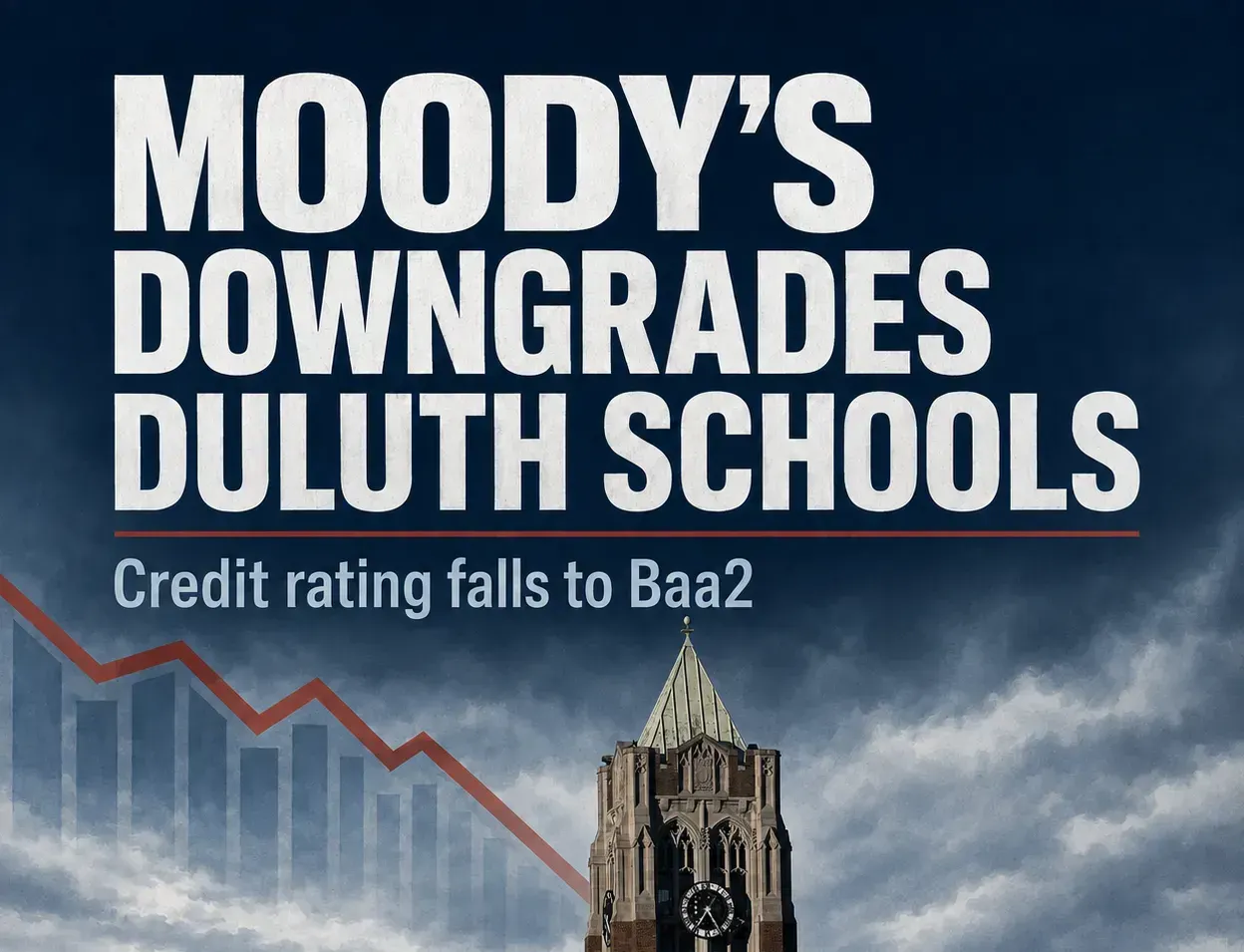
Magas fairly noted that “Credit ratings reflect broader fiscal dynamics, including state and federal funding structures.” They do. Credit ratings are not report cards assigned exclusively to a superintendent or School Board. They reflect funding systems, local economics, debt, reserves, liquidity and operating performance.
Magas also wrote that “The district remains committed to prudent financial management and responsible stewardship of public funds.”
There is no reason to question the sincerity of that commitment. The task now is to translate it into measurable promises the public can follow over the life of the levies.
Duluth’s referendum must not become a referendum on whether residents care about children, teachers or public education. They do. Nor should difficult questions about financial management be portrayed as hostility toward schools.
Students and teachers have the greatest stake in restoring stability. They would bear the consequences if depleted reserves, continuing deficits or additional credit downgrades forced deeper reductions later.
The lesson from Duluth is relevant throughout Minnesota. When a school district asks taxpayers for long-term help, referendum advocates should provide the clearest possible account of how the financial problem developed, what the new money will accomplish, how progress will be measured and what will happen if the recovery falls short.
Duluth Public Schools has begun that work. It has released information, held public discussions and answered questions. The next step is to place the entire recovery case before voters in one clear, measurable and accessible plan.
The district is asking for money, but the decision ultimately rests on trust. Trust is not created by pretending the answers are easy. It is created by confronting difficult facts openly, defining the path forward and allowing the public to measure whether promises are being kept.
That is the standard Duluth should meet — and the standard Minnesota should expect whenever any school district asks voters for a decade of additional support.
Howie Hanson is editor and publisher of HowieHanson.com, a former Duluth City Council member and a Minnesota journalist with more than 50 years of experience.