


Howie is Minnesota’s Columnist, writing about power, money, sports and civic life across the state. His daily column is sponsored by Lyric Kitchen . Bar of Duluth.
Every spring in Minnesota, long before the last snowbank disappears and well before the fishing opener arrives, a quieter seasonal ritual begins high above the streets of downtown St. Paul.
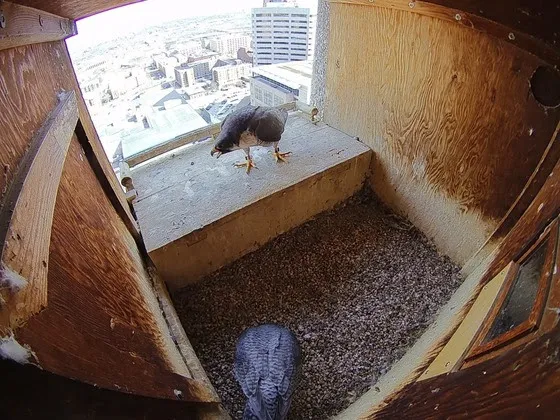
A pair of peregrine falcons returns to a gravel nest box on a skyscraper ledge, settles in for the nesting season, and — thanks to a small camera mounted nearby — thousands of people across the state get a front-row seat.
The Minnesota Department of Natural Resources’ FalconCam is now live for the 2026 nesting season, and the annual livestream returns with a notable upgrade. This year’s broadcast uses a new camera that delivers a much sharper view of the birds, and for the first time the DNR FalconCam includes sound.
For viewers, that means the experience is no longer limited to watching one of the fastest birds on Earth glide into the nest box. Now, you may hear the falcons as well.
The FalconCam, now in its 16th year, offers a close-up, high-resolution view of the seasonal behaviors associated with nesting — courtship displays, nest preparation and the quiet moments that unfold before eggs arrive. Viewers may also hear occasional calls by the falcons, adding another layer to what has quietly become one of the most fascinating wildlife livestreams in Minnesota.
One of the adult birds returning to the nest box this year is a familiar resident.
The female falcon, now 14 years old, fledged from St. Cloud and has nested in the downtown St. Paul box since 2016. The Minnesota DNR says it will update the FalconCam webpage if more information becomes available about the male bird currently using the site.
Inside the box, the pair has already begun the work that signals spring in the falcon world. The birds have dug a shallow bowl in the gravel, forming what biologists call a “scrape,” where eggs may soon be laid.
If the nesting timeline follows recent years, viewers could see eggs appear later this month. Last year the pair laid their first egg on March 31. Peregrine falcons typically lay three to four eggs each season, and if the eggs hatch again this spring, FalconCam viewers will be able to watch the chicks grow through the early weeks of life.
For the DNR, the camera serves a larger purpose beyond curiosity.
“We hope the FalconCam inspires appreciation for this fascinating species of special concern — the fastest birds in the world — and helps Minnesotans feel a connection to the incredible wildlife around them,” said DNR Wildlife Engagement Supervisor Jessica Ruthenberg. “We’re grateful for the ongoing support of Sentinel Properties and the Town Square building tenants, who help make the FalconCam possible.”
The camera offers more than entertainment. It also provides educational and research opportunities, allowing wildlife staff and the public to observe peregrine behavior during the nesting season.
In the wild, peregrine falcons typically nest on high, open ledges such as rocky cliffs. In modern cities, tall structures — including skyscrapers — serve as stand-ins for those natural cliff faces, and the St. Paul nest box has become a reliable urban nesting site.
The chance to watch peregrines today is the result of one of the most successful wildlife recoveries in North America.
In the 1970s, peregrine falcons nearly disappeared from the continent, largely because of pesticide use that weakened eggshells and devastated nesting success. In Minnesota, populations rebounded through decades of restoration work involving Minnesota falconers, the Midwest Peregrine Society and the DNR’s Nongame Wildlife Program.
Public support helped fuel that recovery, and the DNR says Minnesotans can still support the work today. Donations to the Nongame Wildlife Fund can be made through state tax returns or through the DNR’s wildlife donation page. Those contributions help fund projects that protect rare and vulnerable wildlife across the state, including the peregrine restoration effort and the FalconCam itself.
For anyone curious about what spring looks like from the edge of a skyscraper, the camera is already rolling.
The FalconCam livestream is available on the DNR website and on the DNR YouTube channel.
Viewers who want updates throughout the nesting season can sign up for alerts on the FalconCam webpage or follow the Minnesota Nongame Wildlife Program Facebook page, where staff share educational content and updates as the season unfolds.
And if history is any guide, sometime soon — perhaps near the end of March — the first egg will appear in that small gravel scrape, marking the quiet beginning of another Minnesota spring.