Howie's daily online column is powered by Lyric Kitchen · Bar of Downtown Duluth. Purchase Minnesota Monsters season and single game tickets, here.
BY ANY SERIOUS POLITICAL MEASURE — money, name recognition, coalition history, and county-level math — Amy Klobuchar enters the 2026 Minnesota governor’s race in front. Not narrowly. Structurally.
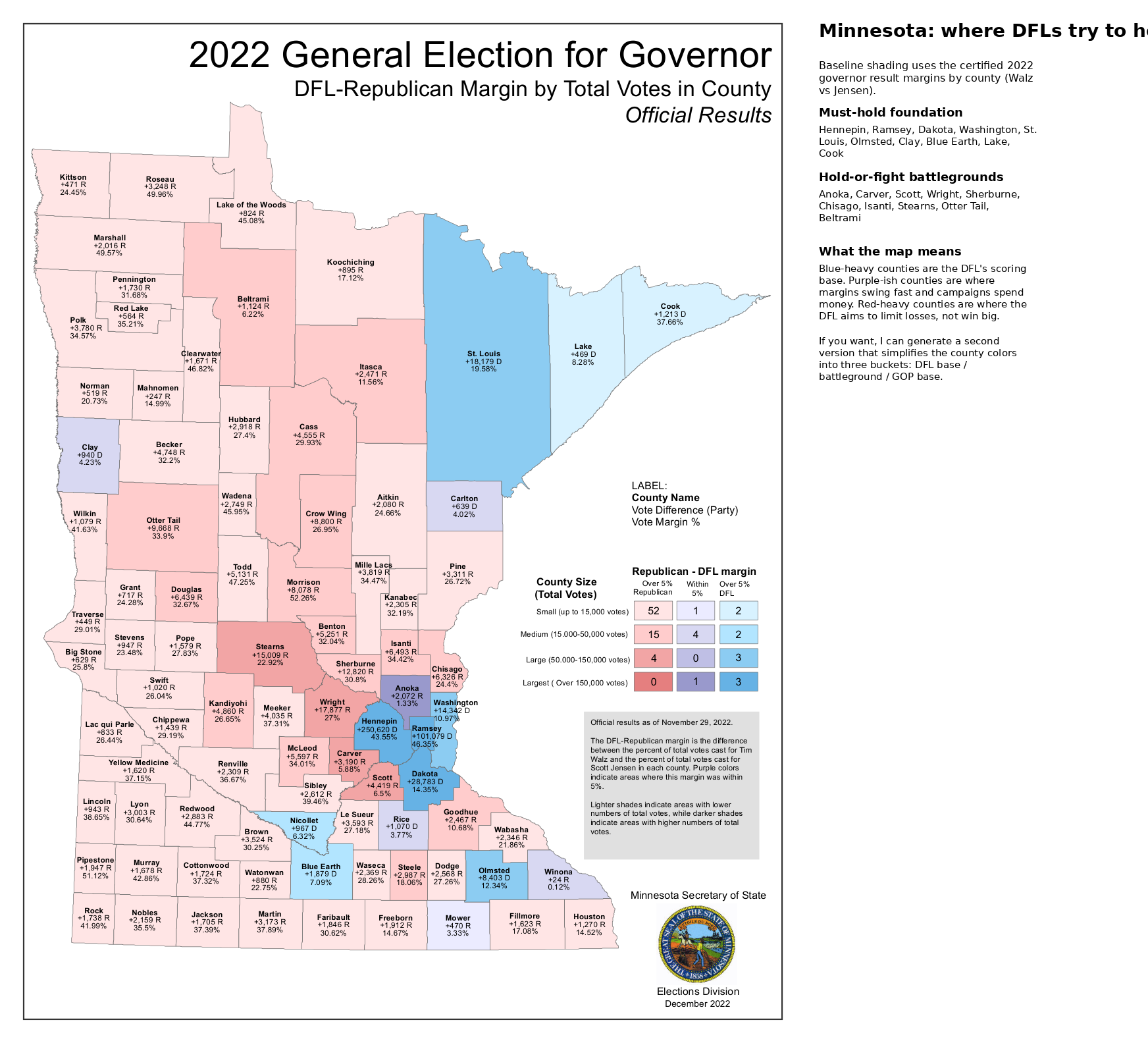
This is not a race defined yet by advertising, slogans or personalities. It is being shaped, quietly and relentlessly, by arithmetic. The same arithmetic that has decided nearly every modern statewide election in Minnesota.
Strip away the noise, and what remains is a familiar question Minnesota voters answer the same way every cycle: Who can assemble a winning coalition on this map — as it exists, not as either party wishes it existed?
Right now, Klobuchar starts with that coalition already built.
That does not mean the race is over. It does mean the burden of proof sits squarely with Republicans — and the list of GOP candidates who can plausibly meet it is short.

A race defined by counties, not crowds
Minnesota statewide races are not won by enthusiasm alone. They are won by margins, accumulated across counties that behave predictably over time.
The modern Minnesota map has three immutable truths.
First, Hennepin and Ramsey counties are structural pillars, not symbolic prizes. Together, they form the largest single bloc of votes in the state. A candidate who dominates them does not automatically win statewide — but a candidate who gets crushed there almost certainly loses.
Second, the suburban ring counties — Anoka, Dakota, Washington, Carver, Scott and Wright — are where modern elections are decided. These counties swing. They reward moderation and punish ideological excess. They are large enough to change outcomes and elastic enough to move.
Third, Greater Minnesota remains deeply red in geography but capped in population. Republicans can — and do — win dozens of counties outside the metro. What they cannot do anymore is win them by margins large enough to offset overwhelming losses in the urban core unless they also make gains in the suburbs.
This framework explains nearly every recent statewide result. It also explains why Klobuchar’s entry into the race immediately reorders the field.

Klobuchar’s starting advantage
Klobuchar does not enter this contest as a blank slate. She enters it as one of the most durable vote-getters in Minnesota political history.
Across four U.S. Senate campaigns, she has repeatedly demonstrated the same pattern: dominant margins in the core metro, competitiveness in the suburbs, and relative resilience in Greater Minnesota compared with other DFL candidates.
Her coalition is not theoretical. It has been tested — and retested — under different national climates, against different Republican opponents.
In practical terms, Klobuchar’s map begins with commanding advantages in Hennepin and Ramsey counties. Those margins alone are often large enough to neutralize Republican gains across much of the rest of the state. From there, she has consistently performed well in Anoka County — a critical bellwether — and has remained competitive across Dakota and Washington counties, which together represent the hinge of statewide politics.
That combination explains why early head-to-head polling shows Klobuchar leading every tested Republican by double digits. But the more important takeaway is not the polling margin itself. It is the shape of the vote underneath it.
Republicans are not simply behind. They are behind in the places that matter most.

The Republican field: many names, few paths
Minnesota Republicans are not lacking candidates. They are lacking proven coalitions.
As the field currently stands, the GOP includes a wide range of contenders: legislators, activists, business figures and repeat candidates. But when the analysis shifts from name recognition to electoral geometry, only a handful of profiles emerge as even plausibly aligned with the map Republicans must win.
That does not mean these candidates are certain finalists. It does mean that if Republicans are to be competitive, the nominee is likely to come from a narrow lane.

Scott Jensen: the known quantity
Scott Jensen is the most obvious name in the field, and for one simple reason: he has already been the Republican nominee for governor.
Jensen’s 2022 campaign provides a complete data set. He ran strongly across much of Greater Minnesota, posting decisive wins in rural counties and exurban areas. He lost, however, because those gains were overwhelmed by losses in the metro and suburbs — particularly in Hennepin County, where the margin against him exceeded the statewide margin of defeat.
That history cuts both ways.
On one hand, Jensen has demonstrated that he can consolidate the Republican base and compete statewide. He remains, in early polling, the closest Republican to Klobuchar in head-to-head matchups.
On the other hand, his 2022 map highlights the GOP’s central dilemma: rural dominance without suburban expansion is not enough.
If Jensen is to be a finalist — or a serious general election threat — he would need to materially change his performance in suburban counties that previously rejected him. That is a heavy lift, but not an impossible one. It is also the clearest test of whether Minnesota Republicans can broaden their coalition without abandoning their base.

Lisa Demuth: the suburban profile
Lisa Demuth represents a different theory of the race.
Her appeal is rooted less in rural mobilization and more in suburban credibility. That matters, because the counties Republicans most need to flip or hold close — Anoka, Dakota, Washington, Wright — are not rural counties. They are populated, politically mixed, and sensitive to tone.
Demuth’s path would depend on improving GOP performance in exactly those places where recent Republican nominees have fallen short. She does not need to win Hennepin or Ramsey. No Republican does. She would need to reduce the margins there while flipping at least one major suburban county and remaining competitive in others.
That is a demanding strategy, but it aligns with the math of the state. If Republicans are serious about winning statewide again, this is the lane they must eventually master.

Kristin Robbins and Kendall Qualls: adjacent lanes
Kristin Robbins and Kendall Qualls occupy similar conceptual ground.
Both bring profiles oriented toward suburban or exurban voters rather than deep rural bases alone. Both would likely frame their campaigns around competence, restraint and coalition-building rather than confrontation. Both remain untested at the statewide executive level.
Their challenge is not ideological positioning. It is scale. Building statewide infrastructure, fundraising capacity and message discipline at the level required to compete with a candidate like Klobuchar is an enormous task — particularly in a party still sorting out its identity after recent defeats.
Still, if the Republican primary electorate signals a desire to expand rather than retrench, these profiles cannot be dismissed.
The rest of the field
Other Republican contenders may influence the primary dynamic, shape debate topics or pull the field in specific directions. But based on current data, their pathways narrow quickly in a general election scenario.
Candidates who rely almost exclusively on rural turnout or ideological enthusiasm face the same hard ceiling: Minnesota’s population is concentrated elsewhere. Winning more counties does not matter if those counties do not contain enough voters.
This is not a judgment on passion or conviction. It is a statement of math.
What Republicans must do — and why it is difficult
To understand what Republicans must accomplish, it helps to be blunt.
They must do three things at once, all of which are hard.
First, they must hold their rural margins without bleeding support elsewhere. Any erosion in Greater Minnesota weakens the base they rely on to counter metro losses.
Second, they must materially improve performance in the suburbs, particularly in Anoka County. Anoka is not optional. If a Republican cannot flip Anoka — or at least keep it within a point or two — the rest of the map becomes nearly impossible.
Third, they must reduce, not eliminate, DFL margins in Hennepin and Ramsey. No Republican expects to win those counties. But shaving even a few percentage points off the margin can amount to tens of thousands of votes statewide.
This is why Klobuchar’s coalition is so difficult to beat. It is not flashy. It is efficient.
What to watch as the race develops
Despite Klobuchar’s early advantage, the race will not remain static. Several indicators will signal whether Republicans are closing the gap or simply rearranging it.
Primary consolidation. If the GOP field narrows quickly around a candidate with suburban appeal, that will signal strategic clarity. A prolonged, fractious primary will do the opposite.
Fundraising patterns. Money does not guarantee victory, but it enables organization. Watch whether Republican donors coalesce behind one or two candidates early — particularly those capable of funding suburban outreach.
Early suburban polling. Statewide numbers matter less than county-level movement. Any Republican who begins to show competitiveness in Anoka, Dakota or Washington counties deserves attention, regardless of the statewide topline.
Klobuchar’s margin discipline. Klobuchar does not need to expand her coalition to win. She needs to maintain it. Any unexpected softening in her suburban numbers would be noteworthy.
The likely finalists — and the race as it stands
Based on current data, the most plausible Republican finalists are Jensen and Demuth, with Robbins and Qualls as secondary possibilities depending on how the primary electorate defines its priorities.
That is not an endorsement. It is an assessment rooted in history and geography.
Klobuchar, meanwhile, enters the race as the clear favorite — not because she is invulnerable, but because she occupies the center of Minnesota’s most reliable statewide coalition. Her challenge is not to reinvent herself, but to defend ground she has already proven she can hold.
Minnesota does not often produce surprises at the statewide level. When it does, it is usually because the map changes. So far, it has not.
Until it does, this race belongs to the arithmetic — and the arithmetic favors Klobuchar.