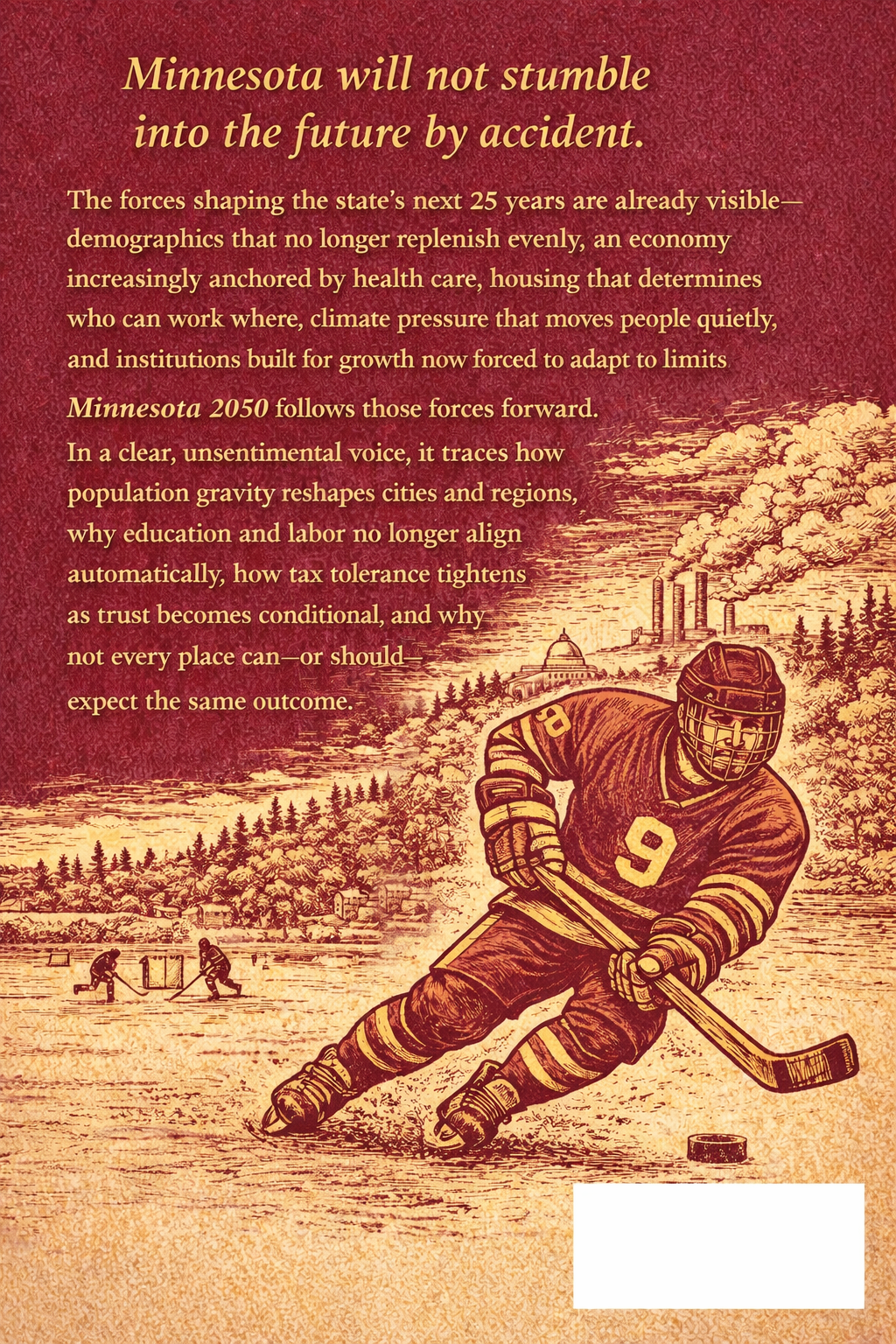
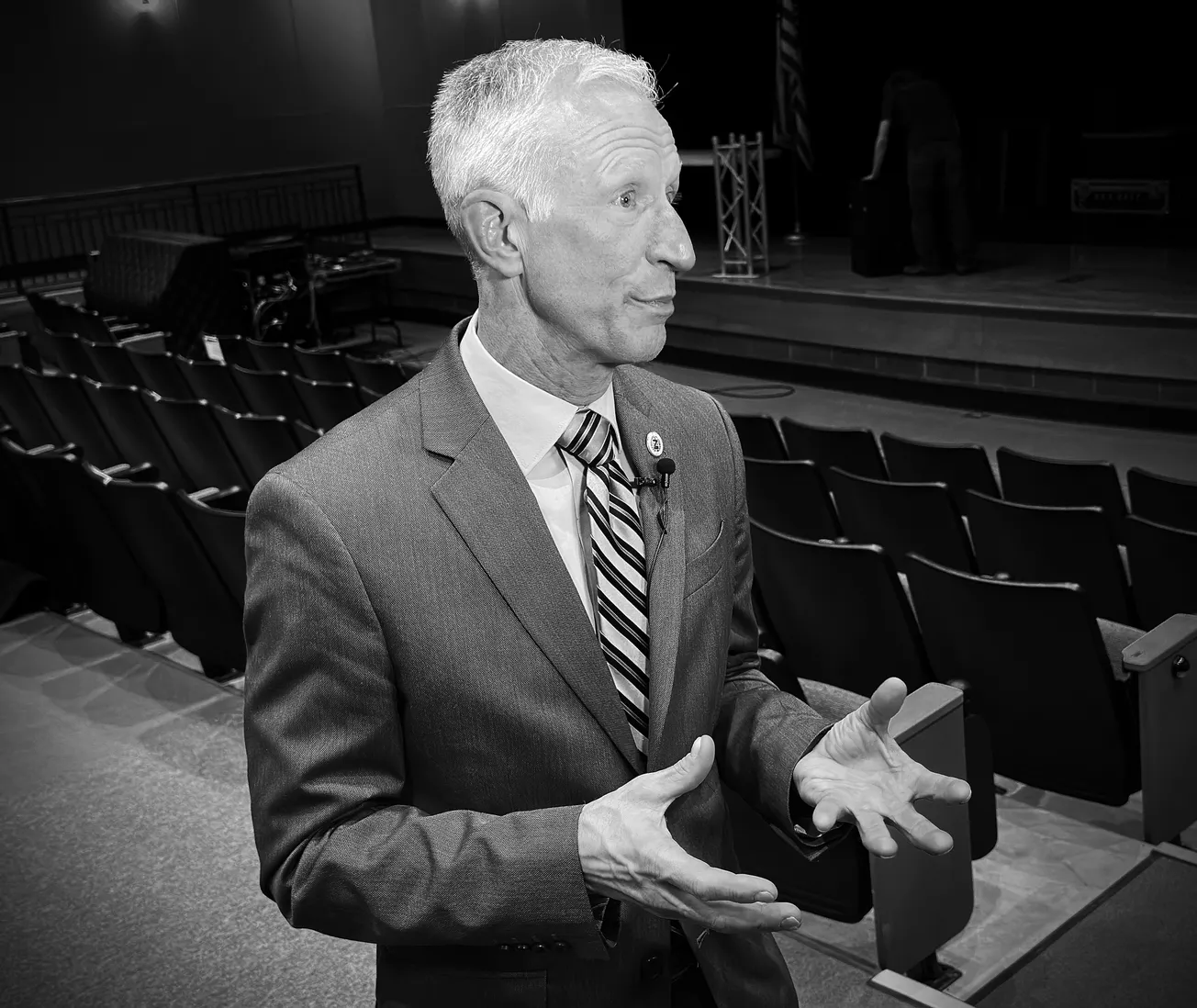
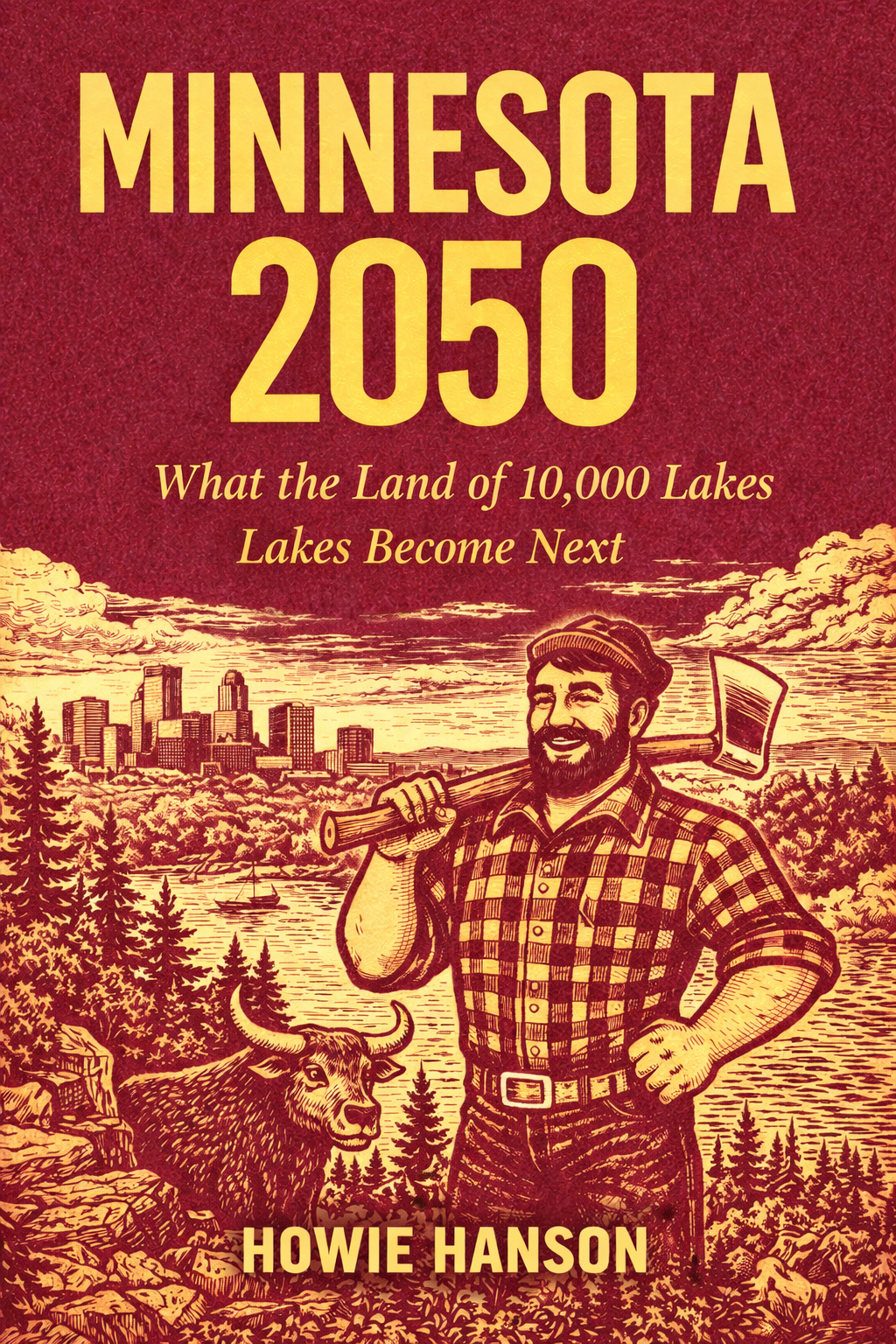
Minnesota journalist and author Howie Hanson will soon release his third book, Minnesota 2050, an examination of the state’s economic, civic and cultural trajectory over the next quarter century. The book will be published through Amazon.
Minnesota 2050 explores how long-term forces already shaping the state — demographics, labor shortages, housing pressure, climate migration, taxation, health care and institutional capacity — are likely to reshape Minnesota by mid-century. Written in a clear, unsentimental voice, the book focuses on adaptation rather than ideology, tracing where current trends lead if left uninterrupted.
The book follows Hanson’s earlier works, 50 Yard Football and Stop Managing Media Decline, both of which examined industries confronting structural change. Like those books, Minnesota 2050 emphasizes system-level analysis over short-term reaction.
Rather than offering predictions tied to election cycles or policy debates, Minnesota 2050 looks at compounding pressures already visible across Minnesota’s cities and regions. Topics include population shifts between metro and greater Minnesota, the future affordability of professional sports, changing tax tolerance, the central role of health care in the state economy, and why not all communities will experience the same outcomes.
Hanson has spent decades covering Minnesota sports, business, media and civic institutions. He is the founder of HowieHanson.com and has written extensively about power, money and decision-making across the state.
A release date for Minnesota 2050 will be announced in mid-February.
FOREWORD
Minnesota Does Not Drift
Minnesota will not wake up one morning in 2050 surprised by what it has become.
States do not drift into the future. They arrive there by accumulation of choices made quietly, budgets passed without headlines, systems left intact too long, others dismantled too fast. The idea that Minnesota’s future remains unwritten is comforting, popular, and mostly false. Much of it is already locked in by demographics, infrastructure, labor math, climate pressure, and the slow-moving machinery of institutions that do not pivot on slogans.
This book starts from that premise.
Minnesota 2050 is not a guess. It is a projection drawn from observable forces already at work: where people are moving, where money is consolidating, which communities are still able to staff hospitals and schools, and which are not. It is shaped by what the state chooses to fund, what it chooses to protect, and what it quietly allows to erode while arguing about something else.
The future is not evenly distributed here. It never has been.
By mid-century, Minnesota will not be one state so much as several overlapping economies sharing borders and tax codes. The metropolitan core will continue to generate wealth, innovation, and political gravity. A set of regional hubs—cities large enough to sustain health care systems, higher education, and logistics—will act as stabilizers for surrounding counties. And beyond them, a wide band of places will exist in a permanent state of economic maintenance, dependent on health care payrolls, public-sector employment, and extraction or service industries that no longer pretend to grow.
That is not decline. It is sorting.
For most of Minnesota’s modern history, growth was assumed. Population increased. School enrollments rose. Housing expanded outward. Public institutions were built to last generations. That era is over. The next 25 years will be defined not by expansion but by alignment—matching systems to a population that is older, more diverse, more urbanized, and less evenly spread across geography than the one those systems were designed to serve.
Health care will sit at the center of everything. It already does. By 2050, hospitals, clinics, and teaching centers will not merely support regional economies; they will be the regional economies. Communities that can recruit physicians, nurses, and specialists will survive. Communities that cannot will contract, regardless of their grit, pride, or history. The distance between those outcomes will widen quietly and then all at once.
Education will narrow and sharpen. Fewer students will attend fewer campuses, and institutions that once marketed themselves broadly will survive only by specializing. K-12 systems will stop being the primary driver of opportunity; early childhood access and post-secondary alignment will matter more. The debate will shift from test scores to pipelines—who moves from learning into work without falling out of the system.
Labor will remain Minnesota’s most unsolved problem. The workforce will age faster than it replenishes. Automation will fill gaps unevenly. Immigration will no longer be a political abstraction but a practical necessity, particularly in health care, agriculture, and manufacturing-adjacent industries. The state will depend on new Minnesotans while still arguing about whether it wants them.
Climate will not arrive as apocalypse. It will arrive as pressure.
Minnesota will warm, but it will also attract. Water will remain abundant by continental standards. Summers will lengthen. Winters will change more than they disappear. By 2050, people will relocate here not because it is perfect, but because it remains workable. Climate migration will not announce itself. It will show up as school enrollments stabilizing in some places, housing prices rising in others, and infrastructure straining quietly where planning did not anticipate growth.
Lake Superior will become more important, not less. Not symbolically—economically. Shipping, tourism, freshwater security, and environmental stewardship will collide there. The lake will draw investment and scrutiny in equal measure. How Minnesota manages that pressure will be one of its defining tests.
Politics will become more transactional and less romantic. Consensus will be harder to achieve and easier to break. The old civic language—nice, pragmatic, reasonable—will still be spoken, but with less shared meaning. Minnesota will stop pretending it is exceptional and, in doing so, may become more effective. The state will be forced to choose outcomes over posture.
Local media will thin further, but influence will concentrate rather than vanish. Fewer voices will shape the public narrative, and those voices will carry more weight. Authority will matter again—not because of personality, but because clarity becomes scarce in fragmented information systems. Who explains Minnesota to itself will shape what it is willing to accept.
Tourism will evolve from marketing into infrastructure. The places that succeed will treat visitors not as seasonal bonuses but as year-round economic participants. The ones that cling to nostalgia will discover that memory is not a business model.
None of this requires pessimism. It requires honesty.
Minnesota has advantages most states do not: stable institutions, deep human capital, natural resources that retain value, and a political culture that—while fraying—still understands governance as a long game. But those advantages are not automatic. They must be maintained, targeted, and sometimes defended against inertia.
This book does not argue for what Minnesota should be. It describes what Minnesota is becoming, based on what it is already doing. The chapters that follow move system by system—economy, education, health care, culture, tourism—not to predict outcomes, but to trace trajectories. Where the math is clear, the conclusions are direct. Where uncertainty remains, it is named.
There are no villains here, and no heroes either. There are decisions, trade-offs, and consequences. Some communities will adapt early and benefit quietly. Others will delay and then face abrupt correction. The gap between those paths will widen, not because of ideology, but because time compounds advantage.
Minnesota in 2050 will still recognize itself. The accent will remain. The seasons will still organize life. High school sports will still matter more than outsiders expect. But beneath those familiar surfaces, the state will operate differently—leaner in some places, denser in others, more dependent on systems that work and less forgiving of those that do not.
The future is already underway here.
The only open question is whether Minnesota chooses to understand it while there is still time to shape it—or whether it waits, as states sometimes do, until the arrival feels sudden and irreversible.
This book is an attempt to read the map early.