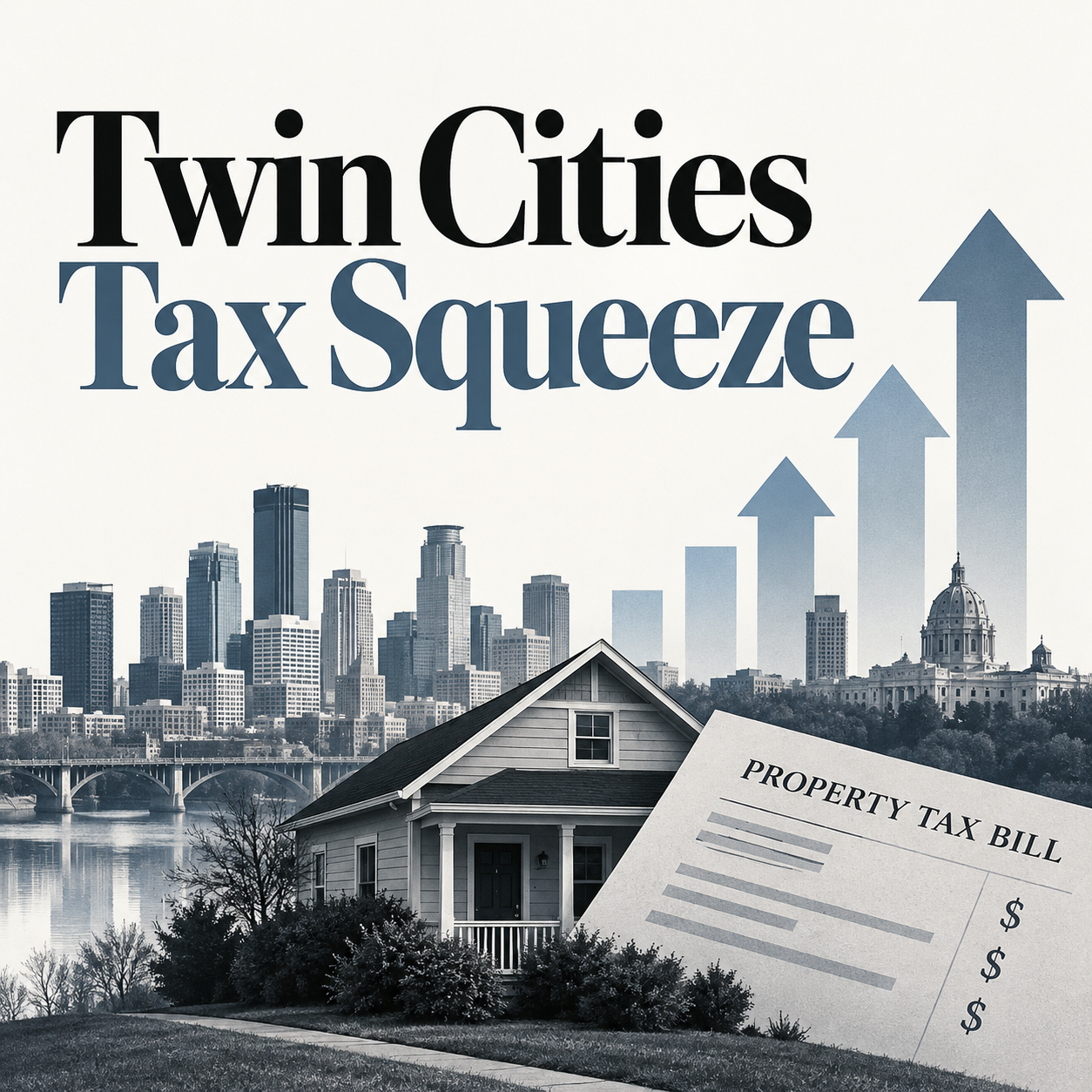
MINNEAPOLIS — The financial reckoning confronting Minneapolis and St. Paul has reached the front doors of the people who live there. Property taxes are climbing, commercial real estate values are deteriorating, municipal operating costs continue rising, and homeowners are increasingly being asked to absorb the difference.
The numbers are substantial. Minneapolis Mayor Jacob Frey has proposed an 11.3% property tax levy increase for 2027. St. Paul Mayor Kaohly Her has proposed 6.8%. Hennepin County has approved a maximum levy increase of 8.15%, while Ramsey County has established an 8.25% ceiling. These are separate taxing authorities, each facing its own financial pressures, but their decisions eventually converge on the same household tax bills.
This is no longer simply an argument over whether local governments should spend more or less. It is a test of whether Minnesota's two largest cities can maintain essential services, confront changing economic conditions and demonstrate enough financial discipline to justify what they are asking residents to pay.
The most troubling development is that Minneapolis and St. Paul are demanding more tax revenue at the same time that important portions of their commercial tax bases are losing value. It is an expensive combination, particularly for homeowners on fixed incomes, younger families trying to establish themselves and property owners whose incomes are not increasing nearly as quickly as their government obligations.
Minneapolis: An expensive government confronts an expensive reality
Minneapolis has proposed a $2.3 billion budget for 2027, including $753 million in general fund expenditures. The city faces a budget gap exceeding $60 million, even as the mayor proposes more than $20 million in spending reductions.
The administration estimates that approximately $33 million is needed simply to maintain existing services, with more than $30 million in additional departmental cost pressures. Without spending adjustments, the city projects that the property tax levy increase would exceed 19%.
That is a remarkable admission about the financial position of Minnesota's largest city. An 11.3% levy increase is being presented not as an expansionary budget but as the more restrained alternative to something considerably more expensive.
For the owner of a median-value Minneapolis home, the mayor's proposal translates to approximately $409 more annually, or $34 monthly, in city property taxes alone.
The county government has its own demands. Hennepin County's proposed $2.993 billion budget is supported by a maximum property tax levy of $1.219 billion, an increase of approximately $91.8 million from 2026.
Hennepin County Commissioner Irene Fernando has calculated that the proposed county increase would add about $129 annually to the tax bill of a median-value Minneapolis homeowner.
Combined, the two proposals would add approximately $538 a year, or nearly $45 monthly, before any changes in school district or other property tax levies are considered.
That figure deserves attention. A household does not experience property taxation as a collection of independent government budgets. It receives one bill, pays one bill and must somehow accommodate every government's demands within the same family finances.
Another $538 may not materially change the living standards of the wealthiest residents. But for a retiree managing Social Security income, a young household carrying a substantial mortgage or a family already struggling with insurance and utility costs, it represents money that cannot be spent elsewhere.
And this is only one budget cycle.
Downtown's collapse is becoming a homeowner problem
The deeper financial challenge is taking shape in the commercial real estate market.
Downtown Minneapolis commercial property valuations declined 13.7% in 2025, marking the fifth consecutive year of decreases. Since 2022, those properties have lost nearly 35% of their assessed value.
That erosion has consequences well beyond the owners of office towers.
Commercial real estate historically has provided an important share of local property tax revenue. As office valuations decline, the taxable value available to support government services weakens. If officials maintain or increase the total levy, the burden can shift toward residential properties and other taxpayers whose valuations have held up better.
Remote work has permanently altered the economics of many downtown office buildings. Employers need less space, investors are cautious, refinancing can be difficult, and declining property valuations complicate municipal financial planning.
Cities cannot legislate their way back to the office occupancy patterns of 2019. They can attempt to encourage residential conversions, attract employers, streamline development and make downtown districts more inviting. But even successful redevelopment takes years, and the resulting tax revenue may differ considerably from what a fully occupied commercial office tower once generated.
That leaves a fundamental question Minneapolis officials must answer: How long can homeowners reasonably be expected to compensate for downtown property values that may never fully recover? The answer cannot simply be another substantial levy increase every December.
St. Paul faces a different version of the same problem
Across the Mississippi River, St. Paul's proposed 2027 budget totals approximately $887.8 million in operating expenditures, including $438 million in general fund spending.
The city entered the budget process confronting a projected $26 million shortfall. Her's administration developed a plan combining spending reductions, reallocations and additional revenue.
Its proposal includes $11.3 million in savings and reallocations to offset approximately $11.8 million in spending commitments and previously unbudgeted needs. The resulting proposed levy increase is 6.8%, compared with more than 12% had the city attempted to close its financial gap through property taxes alone.
The estimated increase for a median-value St. Paul homeowner is approximately $58 annually from the city proposal.
That estimate is substantially smaller than Minneapolis' $409 figure, despite the percentage increases being closer together. It illustrates why levy percentages alone are inadequate for comparing municipal tax burdens. Property values, assessment changes, tax classifications and the distribution of the levy all affect what individual households actually pay.
St. Paul's problem becomes particularly revealing when the longer-term numbers are examined.
A 2026 analysis by the Federal Reserve Bank of Minneapolis found that the median annual property tax on a single-family home in St. Paul increased from $3,442 in 2020 to $4,264 in 2025.
That is an increase of $822 annually, approximately 24%, over five years.
During that same period, the median assessed market value of apartment units declined 12.9%, from $121,547 to $105,875. The median sales price of an apartment unit, adjusted to 2025 dollars, dropped from $160,525 in 2020 to $103,249 in 2025, a decline of approximately 36%. Those are not minor fluctuations. They represent a considerable repricing of an important portion of the city's housing market.
The Federal Reserve analysis also found that inflation-adjusted property taxes paid by multifamily apartment owners declined 27% between their 2022 peak and 2025, falling from $141 million to $103 million. The median annual tax paid per apartment unit dropped from an inflation-adjusted $2,825 in 2020 to $1,958 in 2025.
Meanwhile, single-family homeowners paid substantially more.
This is the financial squeeze in its clearest form: When one significant category of property loses taxable value, other property owners can be left carrying a larger share of the cost of local government.
The federal analysis also found that residential housing accounted for approximately 71% of St. Paul's property tax base. That leaves city finances heavily dependent on the strength of residential property values, with weakened downtown commercial properties providing less opportunity to spread the burden.
The pressure extends into county government
The county tax increases deserve as much scrutiny as the city budgets.
Hennepin County's maximum 2027 levy of $1.219 billion represents an 8.15% increase. Ramsey County's proposed maximum levy is approximately $464 million, an 8.25% increase, or about $35.4 million more than its 2026 levy.
Those increases matter because counties provide essential and often expensive services, including public health, human services, transportation, public safety and responsibilities driven partly by state and federal requirements.
Some of those expenses cannot simply be eliminated through a vote by county commissioners. Employee compensation, contracted services and the demands of vulnerable populations create obligations that continue regardless of political promises to hold the line on taxes.
Nevertheless, an obligation to provide services is not an exemption from demonstrating efficiency.
County officials should be expected to document how much of their proposed increases is attributable to employee compensation, mandated services, debt obligations, declining revenue or expanded programs. They should also show which expenditures they reduced, which services improved and which operating practices they changed before approving higher levies.
Taxpayers deserve something more precise than assurances that expenses are rising.
Spending cuts are real, but so are the questions
There is evidence that municipal leaders recognize the seriousness of the problem.
Minneapolis has proposed eliminating approximately 100 full-time positions, with vacancies, retirements and other departures potentially reducing the number of layoffs. St. Paul's administration has proposed departmental reductions and reallocations while trying to sustain core public services.
These are meaningful budget decisions. It would be inaccurate to claim that city governments are making no effort to control spending.
But the existence of reductions does not, by itself, establish that the remaining expenditures are efficient.
A city can reduce its payroll and still operate with outdated administrative systems, overlapping programs, costly procurement practices or insufficient measures of performance. It can also cut too deeply into essential services and ultimately create more expensive problems.
Both possibilities deserve examination.
Residents should know how much their governments spend per capita, how staffing compares with similarly sized municipalities, what pension and labor obligations will cost over the next five years, and whether spending increases are producing measurable improvements in public safety, infrastructure maintenance, permitting and basic neighborhood services.
Those are reasonable standards of financial accountability, not ideological demands.
A government budget is more than a statement of what officials hope to accomplish. It is a financial contract with people who are required to pay for it.
A tax increase is not the same as a tax bill
One important distinction is often lost in the public debate.
An 11.3% municipal levy increase does not automatically mean every Minneapolis property owner's total tax bill will increase 11.3%. Likewise, St. Paul's 6.8% proposal does not translate directly into a 6.8% increase for every resident.
A levy is the total amount a taxing authority intends to collect. The amount assigned to an individual property depends on its taxable valuation, classification, applicable tax rates and the changing value of other properties.
The total bill also includes taxes imposed by other jurisdictions.
That complexity makes government transparency particularly important. Residents should be able to determine exactly how much of their increase comes from the city, county, schools and other authorities, and how much reflects changes in their individual assessment.
The November truth-in-taxation notices will provide a more complete picture of the proposed 2027 burden on individual properties.
Until final levies are adopted in December, the increases remain proposals or maximum authorizations rather than final tax bills.
Still, the direction of the financial pressure is unmistakable.
The problem with financing tomorrow using yesterday's assumptions
For decades, metropolitan governments benefited from a financial model in which thriving downtown office districts, commercial development and residential growth supported expanding public services.
That model now faces a different economic reality.
Office space has lost substantial value. Inflation has increased the cost of labor, equipment and construction. Federal pandemic assistance that temporarily supported government operations has expired. Aging infrastructure continues demanding maintenance, and county service responsibilities remain extensive.
These pressures are genuine. They cannot all be blamed on excessive spending, and eliminating inefficient programs would not automatically restore lost commercial valuations.
But changing economic conditions require changing financial plans.
If downtown commercial real estate is permanently worth less than previously assumed, cities must build budgets around that reality rather than wait for an improbable return to earlier conditions.
If operating costs are growing faster than the tax base, elected officials must examine the long-term structure of municipal services rather than repeatedly closing annual gaps.
And if significant increases are unavoidable, governments owe taxpayers detailed explanations of the alternatives considered and the consequences of choosing one approach over another.
A five-year financial forecast should be standard public information. So should understandable comparisons of staffing, operating costs, debt commitments and major departmental performance.
The public should not have to become municipal finance experts to determine whether its government is living within a sustainable financial framework.
The taxpayers deserve a better bargain
Minneapolis and St. Paul remain major economic, cultural and educational centers. Their public services support businesses, neighborhoods, visitors and the broader regional economy. Maintaining effective city government is essential to keeping those communities attractive places to live and invest.
But public confidence depends on more than recognizing the value of government.
It depends on whether residents believe the services they receive justify the steadily increasing cost.
Minneapolis is proposing an 11.3% city levy increase. St. Paul is proposing 6.8%. Their two counties have approved maximum increases exceeding 8%. Downtown Minneapolis commercial valuations have fallen nearly 35% since 2022. St. Paul single-family homeowners experienced a roughly 24% increase in median annual property taxes between 2020 and 2025.
Those figures describe a metropolitan financial challenge that extends well beyond a single budget season.
The next question is whether local governments can demonstrate that they are addressing its underlying causes.
More money may be necessary to sustain essential public services. Some reductions may prove more costly than the savings they produce. Redeveloping downtown commercial districts may require investments that take years to generate sufficient tax revenue.
All of that can be true.
But taxpayers are entitled to see the long-term numbers, the measurable results and the financial consequences of decisions made on their behalf.
Minneapolis and St. Paul cannot control every economic force affecting their budgets. They can control how candidly they confront those forces, how carefully they measure expenditures and how thoroughly they explain their decisions.
The Twin Cities tax squeeze is not merely about how much more homeowners will pay in 2027. It is about whether the region's governments can build a financial future in which residents are not repeatedly asked to absorb rising costs without a clear understanding of what comes next.
That is the accountability test now confronting Minnesota's two largest cities.