By Madison McVan, Minnesota Reformer
Most Minnesota families with young children could qualify for child care assistance under a subsidy program proposed by DFL state lawmakers.
If passed by the Legislature, the Great Start Affordability Scholarship program would assist families making up to 150% of the state median household income — around $174,000 for a family of four — on a sliding scale.

ThinkSmall, a child care advocacy group, estimates the program would reduce child care costs for 86% of Minnesotans with children under the age of 5.
Minnesota’s high-priced child care is among the nation’s most expensive, according to the Center for American Progress, a liberal think tank. At the same time, child care workers are saddled with low pay, causing significant turnover and disruption for the state’s struggling child care centers.
The legislation (SF3790/HF3681) cleared its first hurdle Monday when the Senate Education Policy committee passed the bill with a unanimous voice vote. It will go to the Senate Education Finance committee next.

The program’s cost will likely be the obstacle, as the most recent budget forecast showed a rapidly shrinking surplus, causing some DFL leaders to balk at the idea of more spending.
And the program doesn’t yet have an official price tag.
The bill’s authors — led by Sen. Grant Hauschild, DFL-Hermantown, and Rep. Carlie Kotyza-Witthuhn, DFL-Eden Prairie — say the program can be scaled up or down depending on the available funding. The authors are waiting for the updated budget forecast, which will be released Thursday, before adding a funding request to the legislation.
The program would build on existing state child care support programs, including the Great Start Compensation Support Payment Program, which supports increased wages for early education staff, and the Child Care Assistance Program, which subsidizes child care for low-income families.

Under the proposed Great Start Affordability Scholarship program, the state would pay child care providers directly, up-front, the subsidy amount that corresponds to a family’s income. That subsidy would be subtracted from the family’s bill.
The authors aim to cap a family’s child care expenses at 7% of household income.
The bill is based on recommendations from the Great Start for All Minnesota Children Task Force, a mostly governor-appointed panel created by the Legislature in 2021.
The task force took the 7% cap from federal benchmarks included in the 2014 reauthorization of the Child Care and Development Block Grant program; Congress landed on that number after reviewing data that show families consistently spent about 7% of their household income on child care from 1997 to 2011, according to the task force’s final report.

Minnesotans spend closer to 20% of their income on child care, according to the Center for American Progress.
The goal of the program is to provide more support to middle class families and those who make slightly too much to qualify for existing child care subsidies, Hauschild said.
Affordable child care would enable parents to join the workforce or move up in their jobs without fear of losing their child care subsidy.
Marian Farah, a Bloomington mother of two who works full-time in school administration, said her family is receiving child care assistance — she’s the sole provider for the family because her husband is in medical school.

The income cutoffs for child care assistance in Minnesota have put her career goals on hold.
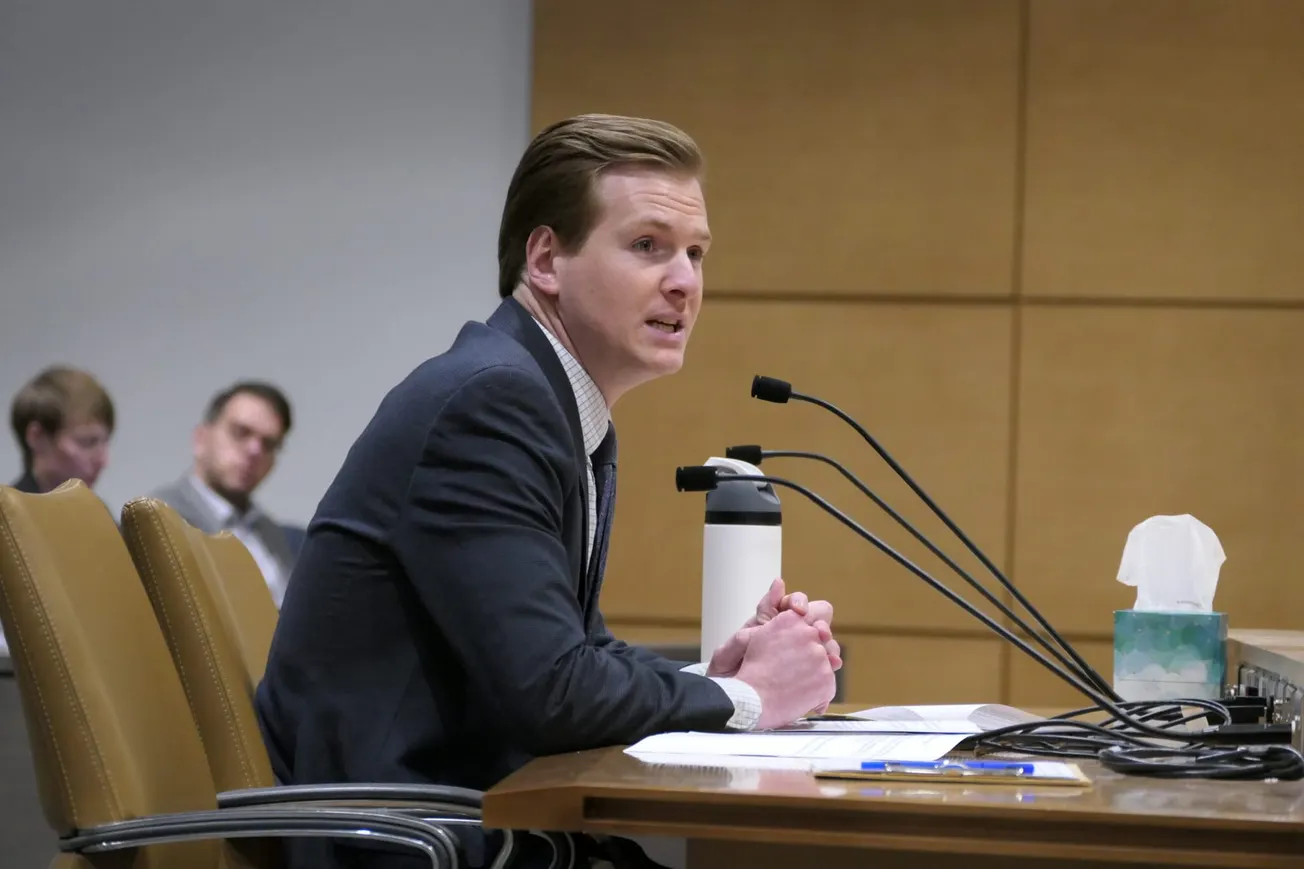
“If I make too much money, we won’t be able to qualify for assistance. And if we don’t qualify for assistance, then we can’t afford child care … And if we don’t have child care, that means I can’t work,” Farah told the Senate Education Policy Committee Monday.
The subsidies could also act as an inducement for parents who wish to have bigger families but can’t currently afford child care.
Alaina Skoglund, a Moorhead early education teacher, said she and her police officer husband have postponed having a second child because of the cost of child care.

“Together we make too much money to qualify for child care assistance, but not nearly enough to comfortably pay for child care,” Skoglund said.
Minnesota Reformer is part of States Newsroom, a nonprofit news network supported by grants and a coalition of donors as a 501c(3) public charity. Minnesota Reformer maintains editorial independence. Contact Editor J. Patrick Coolican for questions: info@minnesotareformer.com. Follow Minnesota Reformer on Facebook and Twitter.