
Howie's daily online column is powered by Lyric Kitchen · Bar of Downtown Duluth. Purchase Minnesota Monsters Arena Football One season and single game tickets, here.
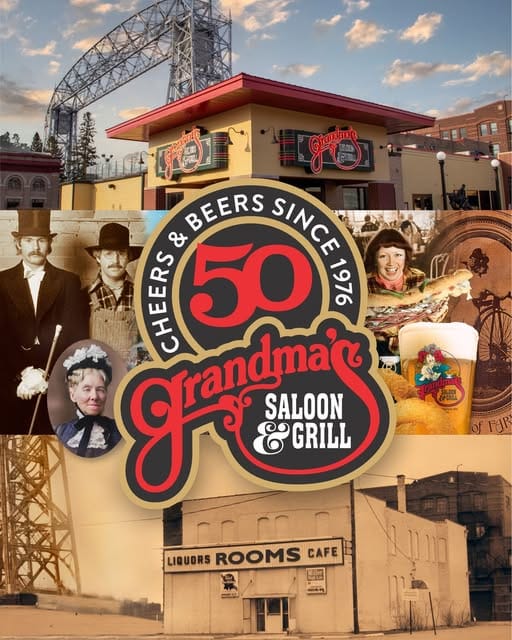
Grandma’s is celebrating its 50th anniversary on Sunday, and that simple sentence still lands with a little thump in Duluth — the kind that carries memory, muscle and the smell of burgers and lake air.
Fifty years. In restaurant years, that’s an eternity. In Canal Park years, it’s practically a geological age.
On Sunday, Feb. 8, 1976, Grandma’s Saloon & Grill opened its doors at 522 S. Lake Ave., in a then-sleepy, working waterfront neighborhood that few would have predicted would someday become the city’s front porch. The restaurant was founded by Mickey Paulucci and Andy Borg Jr., operating out of the former Sand Bar Cafe, a modest space with more grit than gloss.
The original concept was simple, almost modest to a fault: a self-serve deli paired with a saloon. The idea lasted exactly one day.
By Monday, Feb. 9, customer demand had already forced a pivot. People wanted to sit down. They wanted plates, not paper. They wanted burgers hot and fast, and they wanted to stay awhile. Grandma’s responded immediately, shifting to full service and, in the process, unknowingly setting the tone for the next half-century.
That adaptability — quick, practical, customer-driven — would become the restaurant’s defining trait.
Today, Grandma’s sits in the same building, steps from the Aerial Lift Bridge, a fixture so permanent that it’s hard to imagine Canal Park without it. The address hasn’t changed. The crowds haven’t stopped. The menu has evolved, but the mission hasn’t: feed people well, move them through efficiently, and make them feel like they belong.

A place that grew with the city
In 1976, Canal Park was not Canal Park as people know it now. It was a working waterfront, dominated by shipping, warehouses and wind. Tourism existed, but quietly. Few locals lingered. Fewer still imagined it as a dining destination.
Grandma’s didn’t just arrive in that environment — it helped shape what came next.
As the neighborhood slowly transformed through the late 1970s and 1980s, Grandma’s became a constant. When hotels arrived, Grandma’s was already there. When the boardwalk grew busier, Grandma’s was already full. When Duluth leaned into its lakefront identity, Grandma’s was already feeding the people who came to see it.
The restaurant’s location — tucked beside the lift bridge and the lake — became a kind of civic advantage. Tourists found it first. Locals kept returning. Over time, it became a default answer to a familiar question: Where should we eat?
The answer didn’t require explanation.

The Paulucci blueprint
Mickey Paulucci was never interested in precious dining. He believed in volume, consistency and speed — without sacrificing quality. Grandma’s reflected that philosophy from the start.
The menu leaned American and made no apologies for it. Burgers, sandwiches, hearty plates. Food that could handle crowds. Food that traveled well from kitchen to table. Food that didn’t ask questions.
It was democratic dining in the best sense: families, dockworkers, college kids, tourists, business travelers — all sharing the same space, ordering from the same menu, sitting elbow-to-elbow when the lines backed up.
That approach allowed Grandma’s to scale without losing itself. As the restaurant expanded and later inspired additional Grandma’s locations, the Canal Park original remained the standard bearer.

More than a restaurant
Over five decades, Grandma’s has hosted more moments than any ledger could capture.
First dates and last meals before college. Post-game celebrations. Funeral lunches. Marathon weekends. High school graduations. Tourists on their first trip to Lake Superior. Locals bringing out-of-town guests to prove that, yes, Duluth really is like this.
For many Minnesotans, Grandma’s is less a restaurant than a reference point — a place you measure other places against.
It’s where you go when you don’t want to gamble. When you don’t want to explain. When you just want to eat.

The Rosa’s boarding house myth — and the real thing
The building that houses Grandma’s has long carried a bit of local lore, tied to the fictional Rosa’s boarding house — a reminder that Canal Park has always blurred the line between fact and folklore. That blending fits Grandma’s just fine.
The restaurant has never pretended to be anything it isn’t. It doesn’t trade in nostalgia as a gimmick. It earns it by staying open.
That matters.
In an industry where turnover is constant and concepts are disposable, Grandma’s longevity is its loudest statement. It has outlasted trends, recessions, labor shortages, pandemics and more than a few skeptical predictions.

Weathering the hard years
Fifty years doesn’t happen without scars.
Grandma’s has endured economic downturns that emptied dining rooms across the country. It has survived shifts in tourism patterns, changes in labor laws, rising food costs and the relentless pressure that comes with operating in one of Duluth’s most visible locations.
And like every restaurant, it faced its sternest test during the COVID-19 pandemic — a period that upended the hospitality industry and forced even the most stable operations to rethink everything from staffing to service models.
That Grandma’s is here at all, celebrating a 50th anniversary, is no small thing. That it remains busy is something close to remarkable.
A Duluth landmark, whether it asked to be or not
Some landmarks are declared. Others are earned. Grandma’s became a landmark by repetition — by being there every day, year after year, feeding generations of Duluthians and visitors alike.
It’s a place people give directions by. A place parents point out to kids. A place that shows up in vacation photos, wedding weekends and memory.
It stands not just beside the lift bridge, but alongside Duluth’s own reinvention — from gritty port town to outdoor-loving, visitor-friendly city with a strong sense of itself.
Fifty years, still full
On Sunday, Grandma’s turns 50. There will be no shortage of stories told over tables that day — stories that stretch back to the late 1970s, to winters harsher than this one, to summers when Canal Park was still figuring out what it wanted to be.
The remarkable thing is not that Grandma’s has changed over 50 years. It has, in all the ways that matter to survival. The remarkable thing is how much it hasn’t. Same building. Same address. Same role in the life of the city.
In Duluth, where the lake teaches patience and permanence, Grandma’s Saloon & Grill has done the same — one plate at a time, for half a century.
And on Sunday, it will do what it has always done best: open the doors, fill the room, and get to work.