
Howie's daily column is sponsored by Lyric Kitchen Bar.
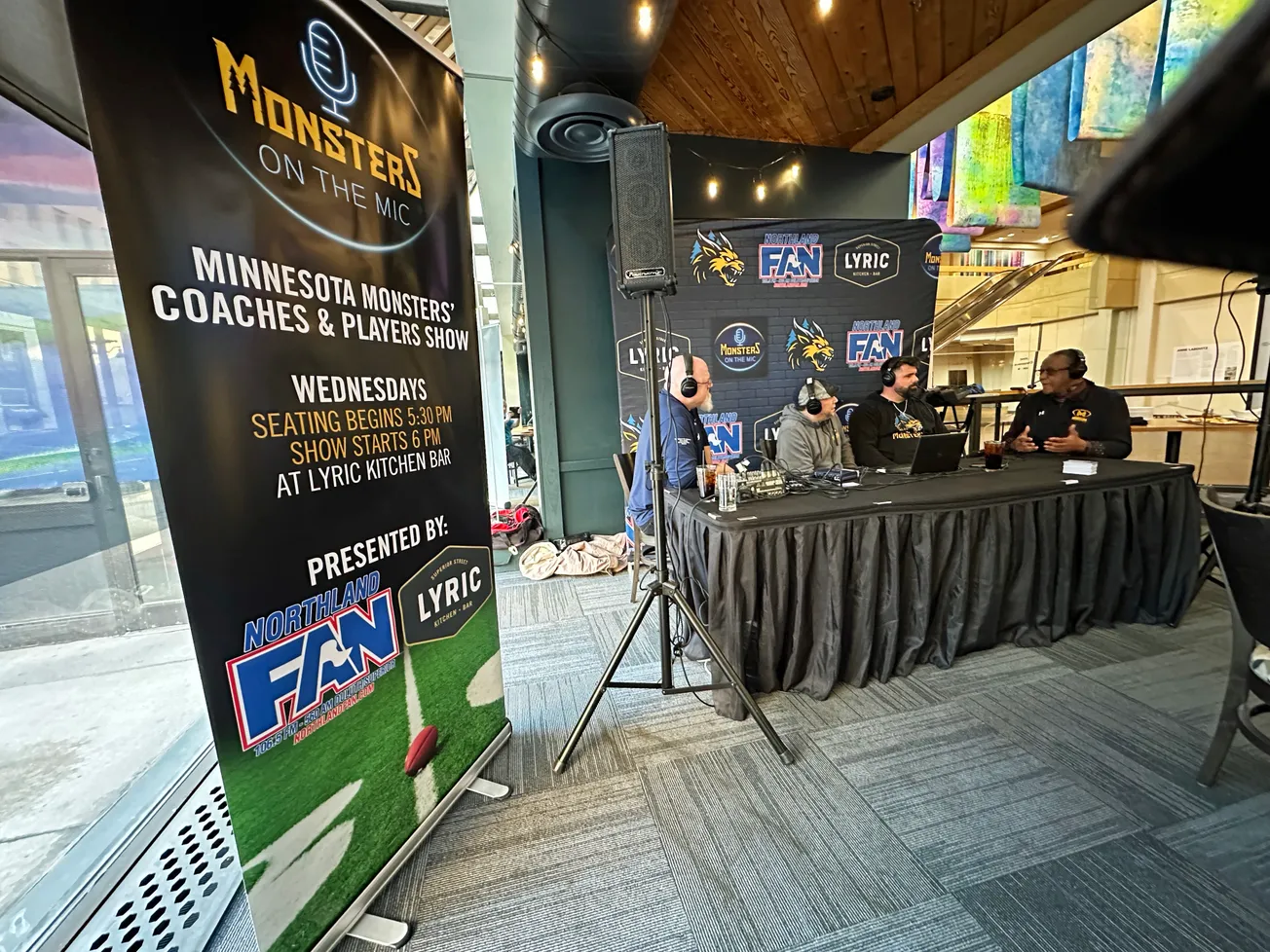
The Minnesota Monsters did not arrive for the inaugural Northland Fan Monsters on the Mic live weekly radio show at Lyric Kitchen Bar on Wednesday night with a polished sales pitch. They arrived with something rarer — unfiltered honesty, delivered in a sharp, well-paced conversation guided by co-hosts Brian Prudhomme and David Cook, whose steady, probing questions kept the discussion grounded and revealing.
Monsters owner Jacob Lambert and general manager Meadow Lemon laid out, in clear terms, what this franchise is, what it is not, and what it is trying to become ahead of Saturday’s Arena Football One opener at defending champion Albany.
Prudhomme and Cook did not let the conversation drift into cliches. They pressed for specifics — about ownership, about expectations, about the gap between past success in this market and what comes next. That tone set the stage for answers that carried weight because they were not rehearsed.
Lambert, a first-time owner, did not attempt to hide behind confidence or corporate language. He spoke plainly about the emotional pull of ownership and the reality that followed.
“What it means to me is it’s that sense of passion and it’s something that I’ve always wanted,” Lambert said. “You always want a sports team. We always hear, we always say, ‘Oh, I want to be an owner. I want to be a coach.’ I get to finally say that. Yeah, it’s hard, but just like anything that you want, this should be hard. This is what I want and I love it.”
That passion, he acknowledged, came with a steep learning curve he did not anticipate.
“When I came into the picture, I thought — you always think, ‘Oh, I know everything or I know this because I know business.’ I only knew probably 25%,” Lambert said.
It is a striking admission from an owner days before a season opener, but it framed the rest of his comments with credibility. Lambert described a role that extends far beyond game day — managing travel, overseeing logistics, balancing finances, and, most critically, taking responsibility for players’ livelihoods.
“You got players. So you have lives in your hands,” he said, before outlining the strain of juggling those responsibilities with the instinct to remain close to the team. “The hardest part is honestly just realizing that I have to do the business side versus just being a fan and loving these guys.”
That tension — between emotional investment and operational discipline — is where this franchise will be tested most.
It is also where Lemon’s role becomes central.
Introduced by Prudhomme as the voice who would bring specificity to Lambert’s broader vision, Lemon delivered a detailed blueprint that emphasized experience, consistency and community integration. His approach was direct and measurable for fans.
“My biggest thing is I can get you to one game,” Lemon said. “One game, I’ll get you hooked. That’s all it’s going to take.”
He described a game-day model built on constant engagement — not just football, but a full presentation designed to hold attention from start to finish. Dance teams, mascots, on-field promotions and continuous activity between plays are not extras; they are essential components of the product.
“Every time out should be something,” Lemon said. “If they sit back, they’re saying it’s tame. If I get them at the edge of the seat, I want them to say, ‘What’s next?’”
That philosophy extends beyond the arena. Lemon outlined partnerships with community organizations, including the Boys and Girls Clubs, and promotional initiatives such as a faith-and-family night tied to a local sponsorship. The goal, he said, is to create connection while maintaining identity.
“We’re going to be a part of it, but we’re going to be ourselves,” Lemon said. “We’re going to add our flair to everything that we do.”
The purpose behind that approach is rooted in a broader view of what the team represents.
“We’re going to bring joy to people and we’re going to do it through football," Lemon said. "Football’s our tool. Football’s our vehicle.”
Cook steered the discussion toward continuity and change — what carries over from a winning past in Duluth and what must evolve. Lemon declined to compare eras directly, instead focusing on accountability and effort.
“We’re responsible for what we bring to the table,” he said. “Are we going to be excellent? No. Are we going to make mistakes? Yes, we are. But you’re going to get 100% commitment that we’re going to try to do our best for our public, our fans, our players, our league.”
That league, under commissioner Jeff Fisher, is pushing for higher standards — in presentation, in compliance, and in overall professionalism. Lemon pointed to those expectations as a defining factor in AF1’s direction.
“There’s a standard,” he said. “Everybody else is forced to rise to that standard.”
He also acknowledged the immediate benchmark. “Right now, Albany is the standard,” Lemon said.
That standard will be waiting Saturday night.
Lambert, asked by Prudhomme about the challenges of the opening week, returned to the personal side of the job — the difficulty of separating himself from the players he relates to and supports.
“Sometimes I feel like I’m still a player,” he said. “But I have to remember … I’m their boss. I have to compartmentalize.”
Lemon’s answer revealed a different kind of pressure — urgency.
“The hardest thing for me is being patient enough to say, ‘OK, we’ve got a couple more weeks before a game,’” he said. “I want a game right now. I want to put on this show right now.”
He added that his focus has been on easing Lambert’s burden and getting the operation to a point where the owner can step back and enjoy what he built.
“He’s spent a lot of money to get this and I want him to enjoy it,” Lemon said.
That exchange — one owner learning to lead, one general manager pushing to deliver — captured the current state of the Minnesota Monsters more clearly than any preseason projection.
They are not presenting themselves as a finished contender. They are presenting themselves as accountable.
The conversation, shaped by Prudhomme’s pacing and Cook’s measured follow-ups, did not produce bold guarantees or inflated expectations. It produced something more durable: a clear understanding of the work ahead, the standard in front of them, and the responsibility they have accepted.
Saturday in Albany will provide the first external judgment. Wednesday in Duluth provided something just as important. A team willing to say exactly where it stands — and why.