
Howie Hanson is an independent journalist based in Duluth. He publishes daily at HowieHanson.com, covering sports, media, and civic life with a long memory, a short tolerance for nonsense, and no interest in press-release journalism. Howie's column is powered by Lyric Kitchen · Bar.
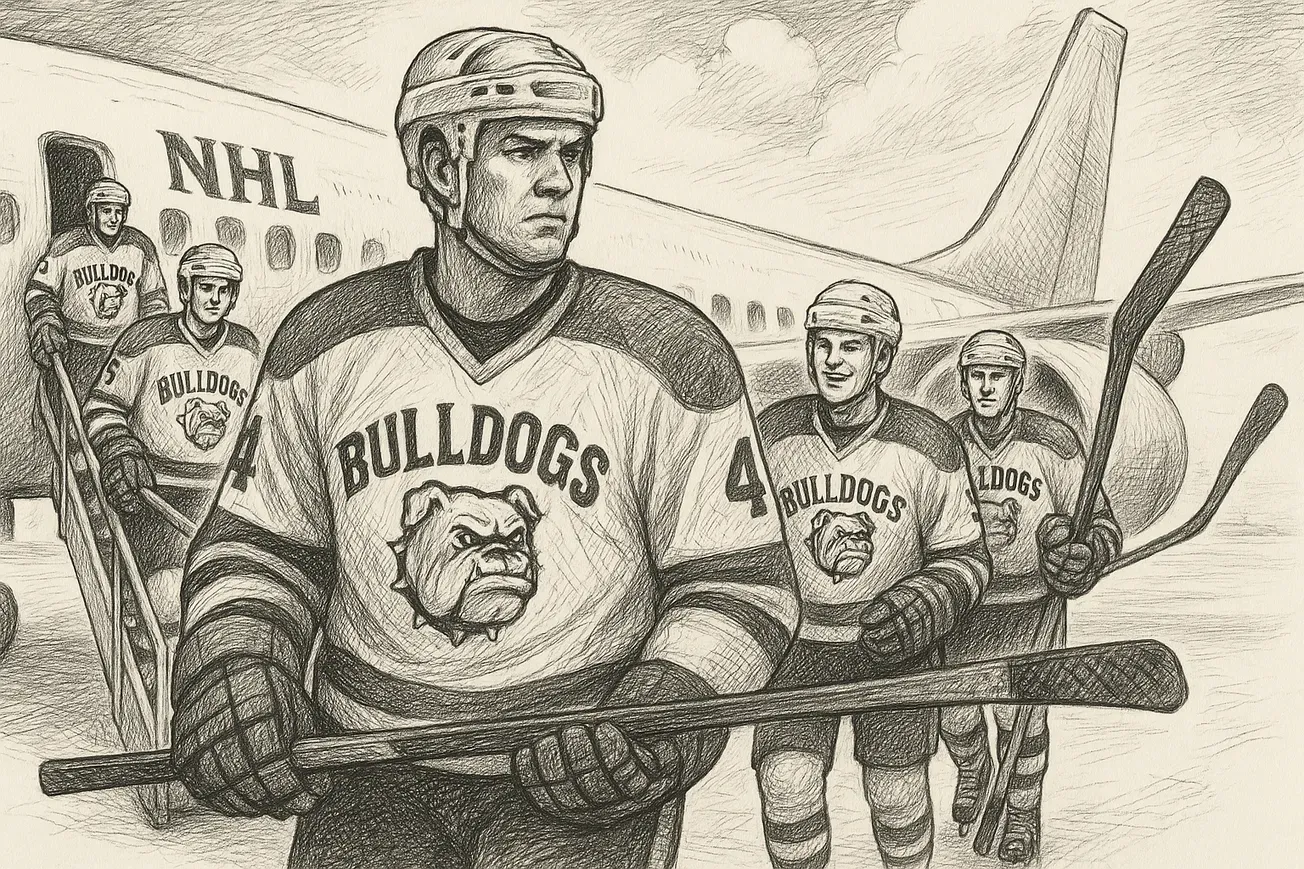
IF ANYONE WONDERED whether Minnesota Duluth was reloading or rebuilding for 2026-27, Monday’s men's hockey signing class answered the question with a blast of certainty. The Bulldogs aren’t patching holes — they’re stacking elite prospects at every position.
UMD announced six signees for next season, and it reads like a blueprint for possible sustained success: two Hermantown-born forwards with championship bloodlines, a gold-medal defenseman from Superior, a pair of high-end blueliners from major junior and the USHL, and a Swedish goaltender posting video-game numbers.

This is what a reload looks like.
Start with Victor Plante, maybe the most familiar name in the class. Yes, he’s the younger brother of current Bulldog rock stars Zam and Max Plante — the top two scorers in college hockey right now — but Victor is carving out his own path with USA Hockey’s National Team Development Program. He plays with the same vision and pace that made Zam and Max instant-impact players in Duluth, and likely has the highest upside of the brothers.
He also carries the family legacy: Derek and Kristi Plante were standout Bulldog athletes. That’s not pressure — that’s pedigree.
Then there’s Kade Kohanski, another Hermantown grinder-turned-playmaker who already owns a Minnesota state championship next to the Plantes and Ty Hanson. He’s putting up strong numbers with the USHL’s Lincoln Stars and plays the kind of north-south, competitive game that fits UMD’s DNA.
Superior’s Jackson Marthaler brings size, reach and international polish. He won gold at the 2024 Winter Youth Olympic Games and is logging heavy minutes with the NTDP. He’ll be the ninth Superior product to play for the Bulldogs.

And the Bulldogs didn’t stop close to home.
Red Deer’s Keith McInnis, a 6-foot-1 defenseman leading his WHL club in scoring from the back end, adds mobility and shot-making. Carter Murphy of the Youngstown Phantoms — the USHL’s Defenseman of the Week earlier this fall — brings quarterback ability, international experience and a calm puck game.
The class closes with a future anchor in goal: Carl Axelsson, a 6-foot-4 Swede who’s 10-1-0 in Muskegon with a .930 save percentage. He’s also a second-generation Bulldog; his dad Niklas played here in the mid-1990s. If you’re sensing a theme, you’re not wrong — the Bulldogs are leaning into bloodlines that run deep.
Taken together, this isn’t a developmental class. It’s an impact class.
UMD is betting on players who have won, produced, and competed on the biggest stages available to them — from the Hlinka Gretzky Cup to the WHL to the NTDP. And they’re surrounding their future core with the kind of balance you rarely see in a single signing haul: scoring up front, size and skating on the back end, and a top-flight goaltender to anchor the whole operation.

For anyone keeping score, Minnesota Duluth didn’t just sign six players.
They signed a future.
. . .
Ford Skytta doesn’t announce himself. He just keeps the Class 1A, top-ranked Hermantown hockey team moving.
On a night when the goals piled up quickly and hats flew freely, in a 9-2, running-time road victory against grossly overmatched Denfeld recently, Hermantown’s senior captain quietly authored four assists, touched nearly every meaningful possession and spent most of the night doing the kind of work that never shows up in headlines — unless you know where to look.

“He’s a four-year guy,” Hawks coach Patrick Andrews said of Skytta. “He came up as a freshman and developed into a great human being and a great captain.”
Skytta plays like someone who understands what this sweater means in his town. He drives wide, puts his shoulder down, hunts the hard areas and keeps the puck moving north.
Andrews calls him a major part of the Hawks’ “go engine,” and it’s not hyperbole.
“He’s fast, he’s really strong,” Andrews said. “He’s getting more confident every game. When he cuts to the net and drives through checks, his upside is really high.”
Skytta knows the Hawks are young. He also knows where they’re headed.

“We’ve shown we have all the firepower to make a run,” he said. “It’s just up to us to do it.”
He doesn’t dodge the Hibbing-Chisholm conversation. Doesn’t pretend January and March aren’t already circled.
“We expect to see them,” Skytta said of the 1A, second-ranked Bluejackets. “And we expect to be ready.”
. . .
Saturday, Jan. 3 is shaping up as one of those long, loud, coffee-fueled days that Hermantown will talk about for decades — usually starting with, “Remember when the new rink opened?”
That’s the day Northstar Ford Arena officially opens its doors, and in proper Minnesota fashion, the place won’t be eased into existence. It’ll be baptized the only way we know how: wall-to-wall hockey, kids racing through hallways in untied skates, parents clutching travel mugs, and a schedule that starts early and refuses to quit.
But this building didn’t just appear out of thin ice.
For years — really, for generations — Hermantown hockey has been doing what it always does: producing teams, players and expectations that punch well above the town’s weight class. This is a program that learned long ago how to win without excess, how to develop kids without shortcuts, how to build habits instead of headlines. The banners didn’t come from shiny facilities. They came from cold rinks, long nights and coaches who believed structure mattered.
And yet, even the most tradition-rich programs eventually need a home that matches what they’ve become.
Northstar Ford Arena is the product of that realization — that Hermantown hockey, from the youngest mites to the varsity regulars, had outgrown the idea of “good enough.” The area around it didn’t suddenly turn into a hub by accident. It evolved because hockey demanded it. Families demanded it. Youth associations demanded it. You don’t run one of the state’s most respected hockey cultures on nostalgia alone.
So now there’s a building that says, plainly: this matters.
The grand opening will feel like a reunion because it is one. The Proctor/Hermantown Mirage girls get the honor of breaking the ice first, junior varsity in the morning, varsity at noon, taking on North Shore in games that already mean something beyond the scoreboard. Somewhere between those contests and the boys taking over later in the afternoon, there will be a ceremony — speeches, smiles, a few thank-yous, and that collective nod that says, “Yeah, we pulled this off.”
Then come the Hawks, with Eden Prairie providing the measuring stick. Boys varsity at 2 p.m., boys JV later in the afternoon, youth games filling the gaps, kids wide-eyed as they watch older players skate onto fresh ice in a brand-new building they’ll someday call their own.

That’s the real significance here.
For Hermantown High School, this arena becomes more than a venue. It becomes a daily standard. A place where expectations walk in the door with you. Where youth players sit in the stands and start counting years instead of seasons. Where routines become traditions, and traditions become legacies.
For the youth programs, it’s validation. Proof that the countless early-morning practices, volunteer hours, fundraising drives and carpool plans weren’t just about getting through another winter. They were about building something permanent. Something that tells an 8-year-old skater, “Stick with this. There’s a future here.”
For the broader community, Northstar Ford Arena is a gathering place — the kind that small towns understand better than anyone. Rinks aren’t just buildings here. They’re living rooms. Story banks. Time machines. They hold memories whether they’re supposed to or not.
One practical note — and this comes from someone who’s seen more than a few grand openings turn into traffic science experiments — parking will matter. There will be no freelancing, no creative curbside interpretations, no “I’ll just squeeze it in here for a minute.” Street parking around the arena is off-limits. Follow the signs. Follow the directions. Look at the parking map before you arrive. Vehicles that test the system may end up with a citation or a short ride they didn’t budget for.

Think of it as the first test of rink discipline.
Bottom line: Jan. 3 isn’t just about opening doors. It’s about opening a new chapter for a hockey community that’s earned it the hard way — through patience, planning and an unwavering belief that doing things right still matters.
Bring your scarf. Bring your voice. Bring your patience.
And if you’re a young player sitting in the stands that day, staring at the ice a little longer than necessary, that’s OK. That’s how this place is supposed to work.