Howie Hanson is Minnesota’s Columnist, writing about power, money, sports and civic life across the state. His daily column is sponsored by Lyric Kitchen . Bar of Duluth.
On March 10, Duluth will find out whether it truly wants professional arena football back — or whether it just likes the idea of it.
The Minnesota Monsters will formally introduce themselves that afternoon at Amsoil Arena, and if you strip away the pep-rally language and the social media hype, what’s left is something far more significant: ownership putting its name, its money and its credibility on the table in public view.
Doors open at 4 p.m. The program begins at 4:25. Three hours later, Duluth will either feel like it just claimed a team — or like it attended another well-produced announcement.
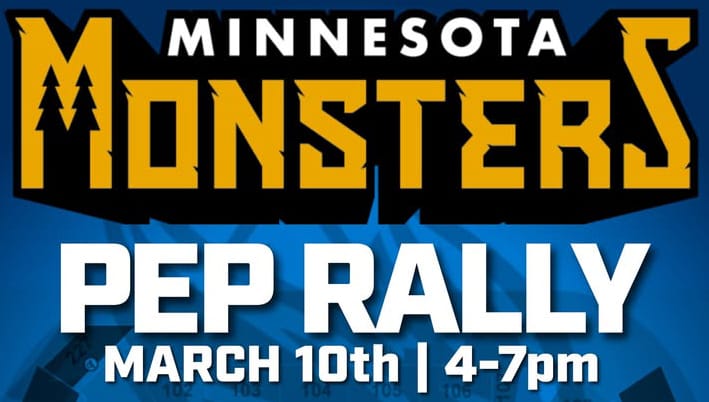
This is the official launch of the Minnesota Monsters as members of the Arena One Football League. That sentence carries weight. League membership means obligations. It means travel budgets, player contracts, insurance, lease agreements and payroll. It means you’re either in or you’re not. There’s no soft opening in professional sports.
Owners Jacob and Brianna Lambert will stand in front of the city. CEO and general manager Meadow Lemon will outline the business plan. Head coach Daron Clark will present the football vision. Select players will be introduced. Uniforms will be revealed. The 2026 schedule will be announced. The website and commercial will debut.
"Brianna and I are building a strong franchise for Duluth," said Jacob Lambert. "We have a vision and lofty goals."
The real headline is the flash sale.
For one night only, every available seat in the building — excluding VIP boxes — will be offered at a flat $200 season-ticket price. Pick your seat. Get your ticket in hand. Lock in opening night. No extensions. No “call us next week.” No hedging. That’s not marketing fluff. That’s a referendum.
Arena football in Duluth has history. Some of it proud. Some of it complicated. Indoor leagues have come and gone across the country for decades, fueled by optimism, tested by economics, often undone by overreach. The smartest owners understand that survival isn’t built on noise; it’s built on cash flow and community buy-in.
March 10 is about buy-in. There’s also a Founders Club promotion — one supporter will win use of the owner’s suite for opening night. Private suite. Premium experience. That’s a nice incentive. But again, that’s not the core story. The core story is whether Duluth believes this can last.
Because professional sports in a market this size require alignment. The building has to work. The lease has to work. Sponsorships have to materialize. Media coverage has to be steady, not cynical. The football has to be entertaining. The payroll has to match revenue. Hope is not a strategy. Energy is not a balance sheet.
If you listen carefully on March 10, you won’t just hear music and applause. You’ll hear signals. How detailed is the business plan? How transparent are the leaders? Do they talk about long-term infrastructure or just opening night theatrics? Do they speak in slogans — or in specifics?
Duluth has grown more sophisticated about sports ownership over the years. Fans understand that a franchise isn’t just a logo and a helmet. It’s a financial engine that must run cleanly and consistently. The Minnesota Monsters are stepping into that reality, not around it.
Arena football, done right, can be electric. The field is smaller. The pace is faster. The scoring is higher. Kids sit close enough to hear the snap count. The building hums differently than it does for hockey or concerts. It’s a controlled kind of chaos that can feel intimate and intense at the same time.
But the romance fades quickly if the fundamentals wobble. That’s why this launch matters. When ownership asks fans to pick their seats at $200, they’re not just selling tickets. They’re asking the city to co-sign the project. They’re saying: Trust us early. Commit early. Help us build this from day one.
In return, Duluth will expect professionalism. Transparency. Stability. A league schedule that holds. A team that competes. A front office that answers the phone in July, not just in March.
There’s nothing wrong with celebration. A launch should feel big. Music, giveaways, photo ops — those are part of the show. Sports are supposed to be fun. But beneath the balloons and lighting cues, the math must work.
The Minnesota Monsters are betting that it will.
On March 10, they won’t just unveil uniforms. They’ll unveil intent. And Duluth will respond the only way that truly matters — not with applause, but with purchases.
Professional sports franchises are built in moments like this. Not when the first touchdown is scored. Not when the first highlight airs. They’re built when fans decide, collectively, that this belongs to them. This is more than a press conference. It’s more than a pep rally. It’s a test of appetite and ambition.
If the seats move, if the flash sale converts, if the community leans forward instead of folding its arms, the Minnesota Monsters will leave that building with something more valuable than buzz. They’ll leave with proof. And in arena football — and in Duluth — proof is everything.