Table of Contents
Arena football league expansion teams make a hundred decisions on their way to opening day — logos, uniforms, venues, marketing, travel — but only a handful shape the identity of their team.
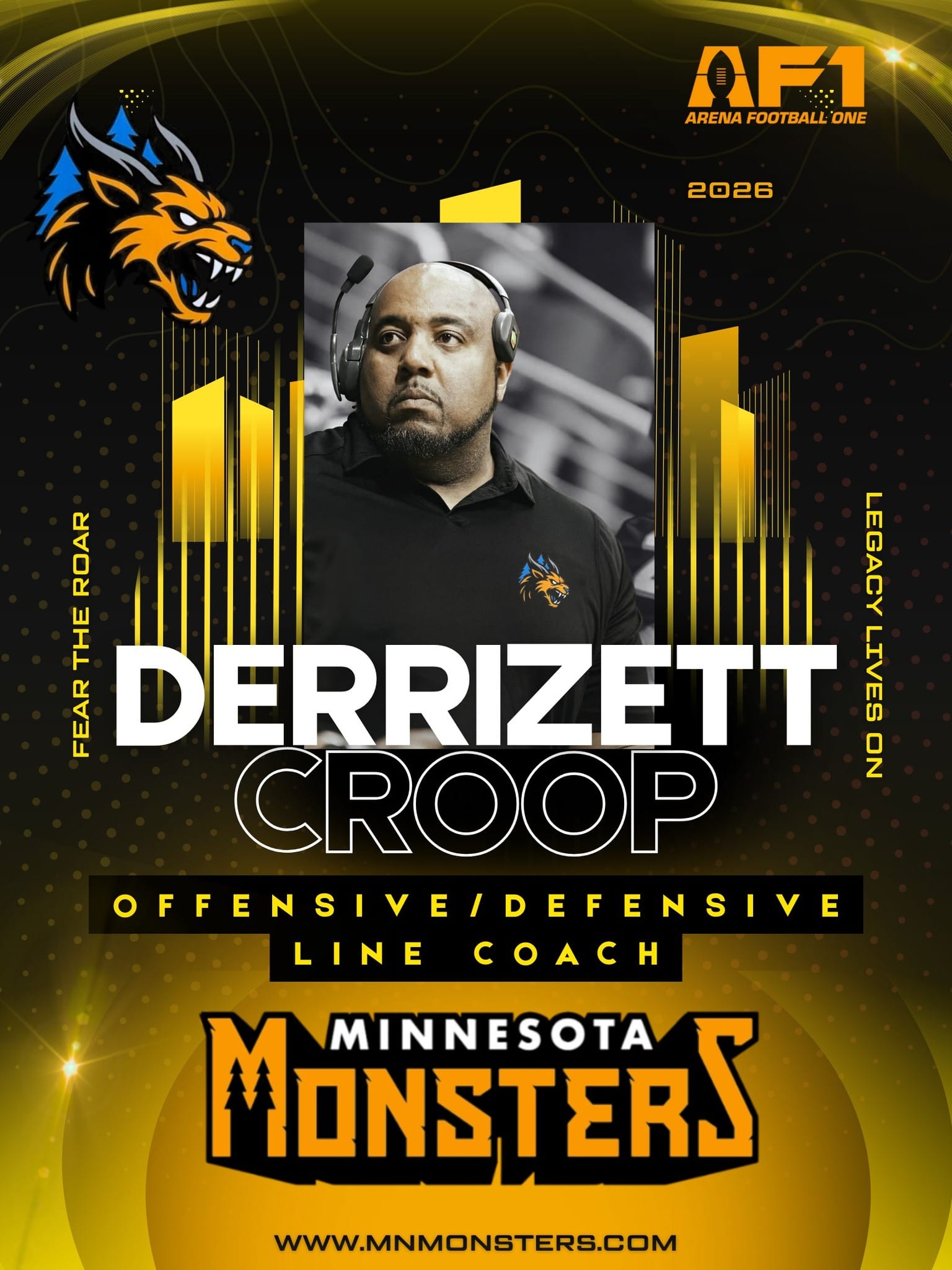
The Minnesota Monsters made one of those decisions today, announcing the hiring of veteran line architect Derrizett Croop as offensive and defensive line coach ahead of their inaugural 2026 AF1 campaign.
In the 50-yard game, where quarterbacks throw in two seconds and defensive linemen strike like sprinters out of the blocks, the trenches are not a subplot — they are the headline. Championships, momentum, and the moments fans remember are born in that first explosive collision.

The Monsters believe Croop is the coach who can build a unit that controls those collisions.
Croop arrives with a reputation as a technician — part teacher, part strategist, fully committed to the leverage, hand placement and body control demanded in arena football’s narrow, unforgiving geometry.
His work has reshaped players, prolonged careers and turned raw athletes into reliable producers in a sport where pads are closer, reads are faster and mistakes are immediately televised on the scoreboard.
Bringing in a coach who understands how to own the line of scrimmage in the various leagues is a massive addition to teams' foundations. Coaches are not simply coaching a position group — they're establishing the DNA of the franchise.
Expansion teams that struggle in the trenches chase the game. They overspend on skill positions, blitz out of desperation, and watch games get away in six brutal, momentum-swinging minutes. The Monsters, by contrast, are signaling something different — a long view, a physical identity, a team willing to win football the hard way.
With Croop coaching both offensive and defensive fronts, Minnesota also gains a unified voice — consistent technique standards, shared terminology and a system built around player development rather than roster churn. It’s a structure more typical of championship builds than first-year experiments.
The Monsters expect to unveil another wave of player signings in the coming weeks as the organization continues its roster construction for 2026. Training camp will introduce the linemen who will become Croop’s first pupils in Minnesota — players tasked with building the firewall that protects the quarterback, the surge that powers short yardage, and the pressure that forces turnovers.
Every expansion franchise talks about culture. Few define it with a hire this clear.
The Monsters didn’t just add a coach. They added an identity. And in the AF1, identity begins up front — where Croop goes to work.