
Table of Contents
By Christopher Ingraham, Minnesota Reformer
Minnesota traffic fatalities fell by about 7% in 2023, according to preliminary data from the Department of Public Safety.
The data show that after spiking in 2021 in the immediate aftermath of the COVID-19 pandemic, by last year roadway deaths had mostly returned to levels seen in the years prior to the pandemic.
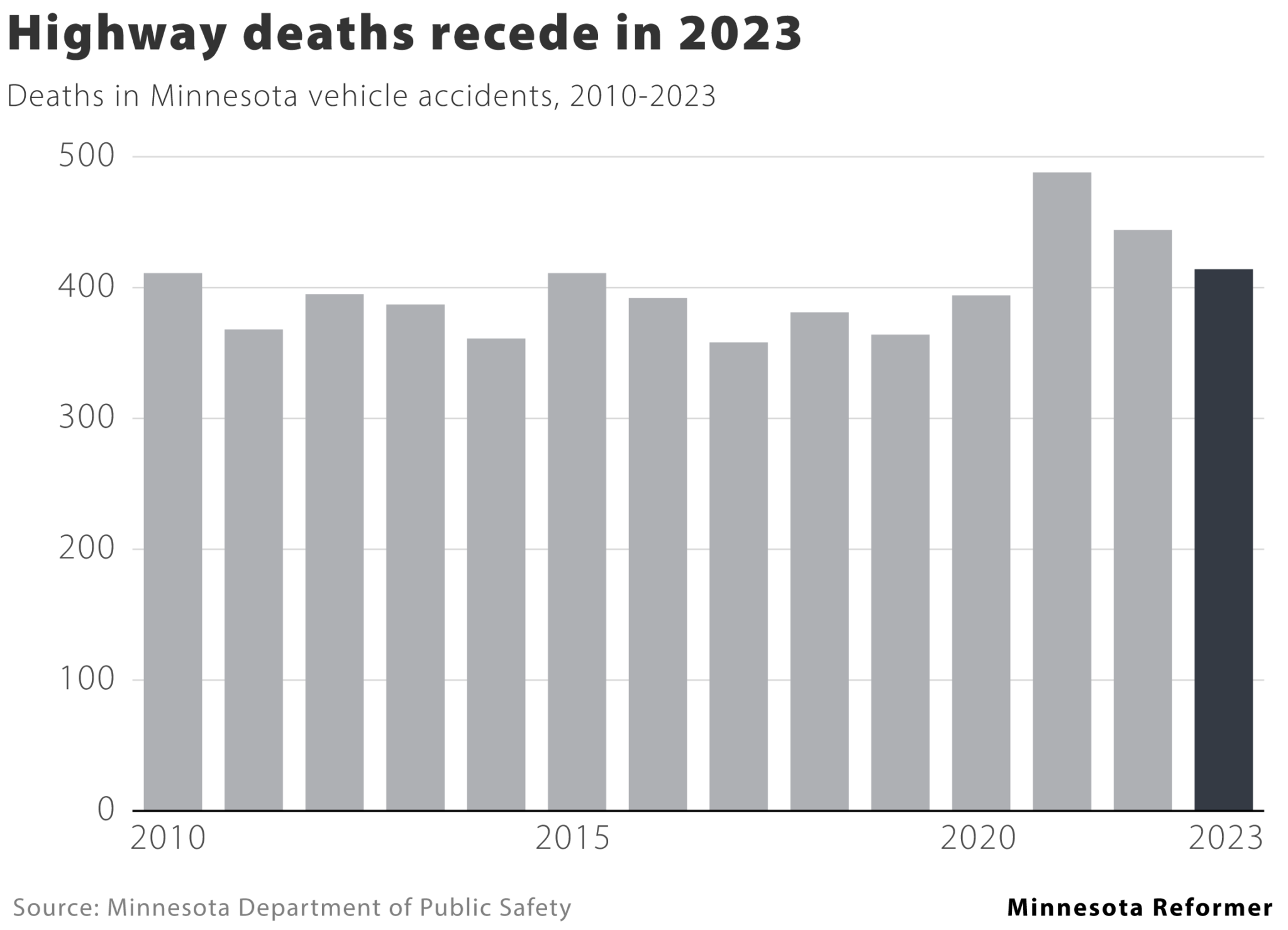
Reporting on traffic fatalities often focuses on immediate year-over-year changes, as in the chart above. That allows policymakers and authorities to focus on specific areas of concern, like distracted driving, pedestrian collisions and blind spots in new vehicle designs.
Most discussion of highway safety in Minnesota, for instance, now centers around the pandemic and the rise of reckless driving that accompanied it. One area of concern that’s not reflected in the chart: so far in 2024, highway deaths are running much higher than last year’s pace. Officials suspect the unseasonably warm weather has played a role.
But like most states, Minnesota has been collecting data on roadway deaths for decades. Zooming out to view the totality of the data paints a somewhat different picture than the one above.
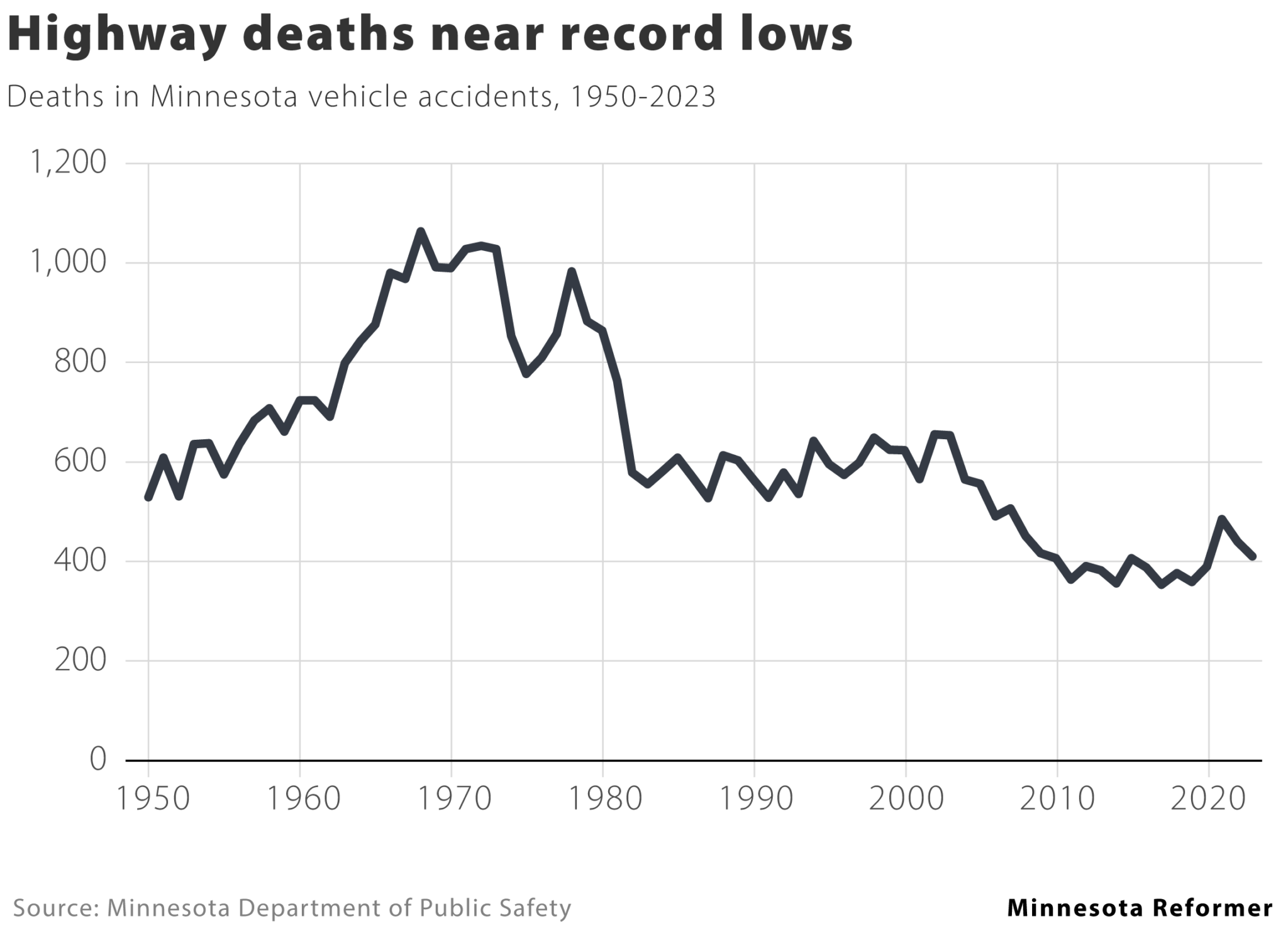
The long-term chart emphasizes how much safer cars and their drivers are now than they were 20, 40 or even 60 years ago. The 414 highway deaths in 2023 are nearly 40% lower than the total in 2003, and an astonishing 61% reduction versus 1968, the year Minnesota highway deaths peaked.
Consider, too, that there were 2 million fewer people living in Minnesota in the late 1960s, and that the number of drivers and registered vehicles in the state more than doubled over the same period. The chart above actually understates the improvements in highway safety that have occurred since then.
One way to correct for this is to calculate the number of deaths per millions of vehicle miles traveled in a given year. This eliminates differences that are simply a function of population growth or changes in driving habits.
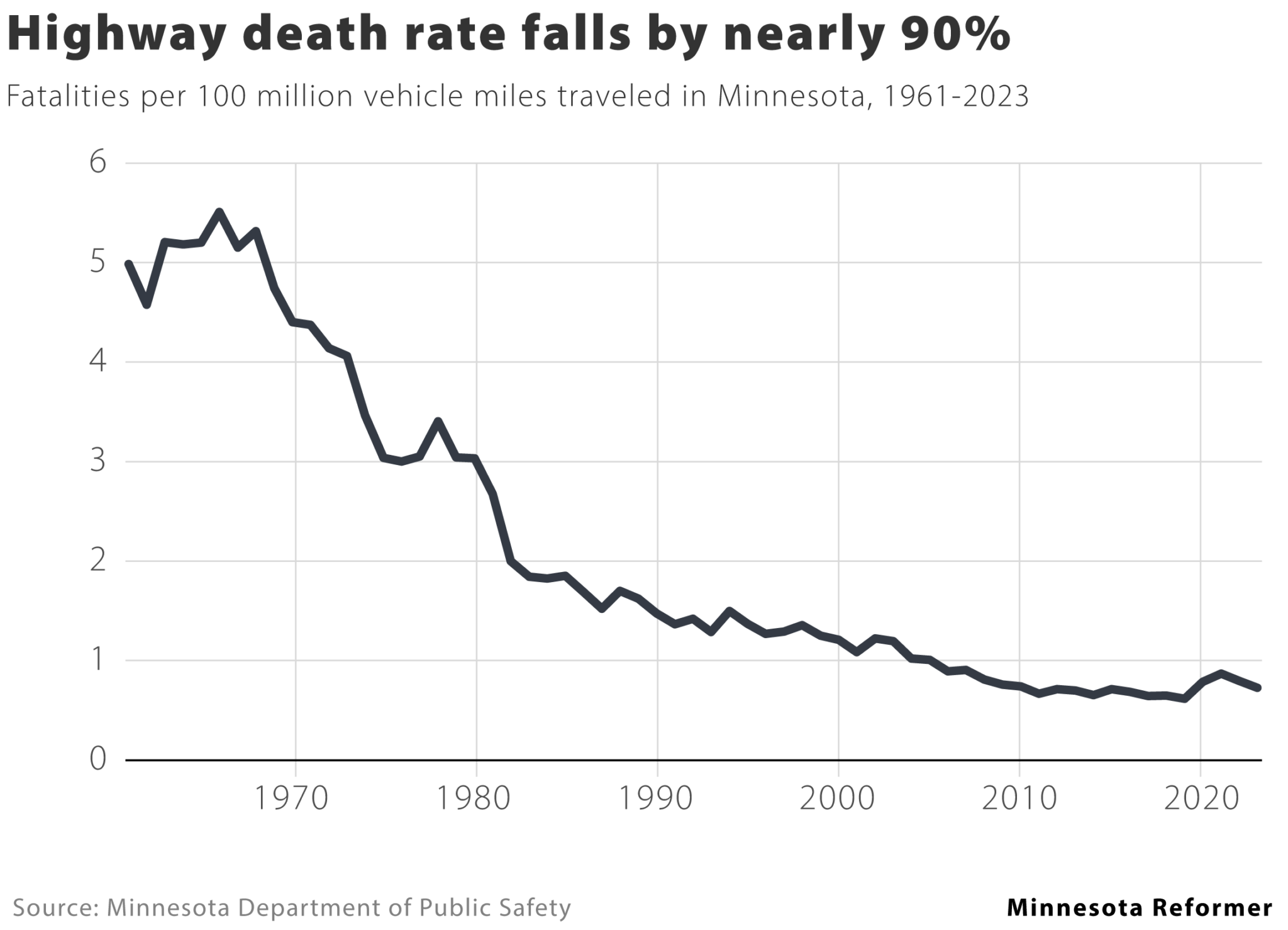
This calculation shows that a Minnesotan’s odds of dying in a car accident have decreased by nearly 90% since the late 1960s. The pandemic-era spike in mortality is very real, but it’s dwarfed by the radical reductions in roadway lethality that occurred in earlier decades.
In terms of vehicle miles traveled, Minnesota has the third-lowest rate of roadway deaths in the nation. Only Massachusetts and Rhode Island roads are safer, according to U.S. Department of Transportation statistics.
Minnesotans are less than half as likely to die in a car accident than residents of South Carolina, the state with the highest fatality rate. It’s a remarkable feat considering Minnesota also has one of the largest road networks in the country, behind only Texas, California, Illinois and Kansas.
This chart prompts different questions than the one at the top of the article. What did drivers, law enforcement authorities and policymakers do to bring about the dramatic reductions in death from the 1960s through the 1980s? Why did mortality continue to steadily fall through the early 2010s?
Policy history offers some clues. The National Highway Traffic Safety Administration was established in 1970 and has worked with Congress to create and continually improve automobile safety standards. The Federal Highway Administration has worked to make roadways better designed and safer. States cracked down on drunk driving in the 1970s and seatbelt use in the 1980s and beyond.
The result is a massive regulatory success story that’s easy to overlook. And it’s one that may hold valuable lessons for policymakers interested in driving highway deaths all the way down to zero.
Minnesota Reformer is part of States Newsroom, a nonprofit news network supported by grants and a coalition of donors as a 501c(3) public charity. Minnesota Reformer maintains editorial independence. Contact Editor J. Patrick Coolican for questions: info@minnesotareformer.com. Follow Minnesota Reformer on Facebook and Twitter.