Listen to this story
Audio reading for accessibility.
Ready to play.
Table of Contents
By Madison McVan, Minnesota Reformer
Early education providers and teachers from the Iron Range piled on a bus headed south on Monday morning, shuttering their childcare centers for the day so they could lobby lawmakers at the state Capitol in the final week of the legislative session.
Lawmakers have all but crushed the hopes of child care advocates with a minimalist session, but advocates continue to push for increased spending as part of the Day Without Child Care, a national campaign coordinated by the progressive organization Community Change.
“We’re closer to closing our centers permanently than people think,” said Amanda Reed, the director of two child care centers in Virginia, Minn.
As independent child care providers struggle to make ends meet, Minnesota families are paying some of the highest rates in the country — and early education staff make far less than the cost of living. Across the state, there is a shortage of child care slots and a need for new providers to enter the industry.
The coalition’s highest priority this session was a bill to establish the Great Start Child Care Affordability Program, which would have subsidized child care costs for families making less than 150% of the state’s median income. If fully funded — the bill’s authors estimate it would cost around $500 million per year — it would cap qualifying families’ child care expenses at 7% of their household income and stabilize income for child care providers.
The bill received hearings in both chambers but will not pass this session due to the cost.
With tighter budgets looming on the horizon, DFL leadership — including Gov. Tim Walz —have taken a more cautious approach to spending this year; of the $540 million supplemental budget agreement, around $59 million was earmarked for spending on children and families.
Which means neither parents nor child care workers can expect much help in the foreseeable future.
Cody Lupich, a school-age teacher and classroom lead at Iron Range Tykes in Mountain Iron, said his $16 an hour wage is above average for the industry and region — but he’s about to start a third job in order to save up for a down payment on a home.
“I’m here today because this is a job I want to stay in for a long time,” Lupich said.
Last year, the DFL-controlled Legislature spent more than $1 billion on early education, including about $575 million to continue a federal COVID-era program that boosted teacher pay.
“The Great Start compensation supports have been fantastic. We needed the funding. We still need the funding,” said Pat Ives, director of Kiddy Karousel child care center in Hibbing.
Ives listed off institutions that receive public funding: the Minnesota Zoo, the Science Museum of Minnesota, public schools and community colleges.
“Why isn’t child care on that list?” she asked.
(Child care does receive significant public spending, but not nearly enough to ensure families aren’t paying more than 7% of their income on child care, which is a goal set by the federal government.)
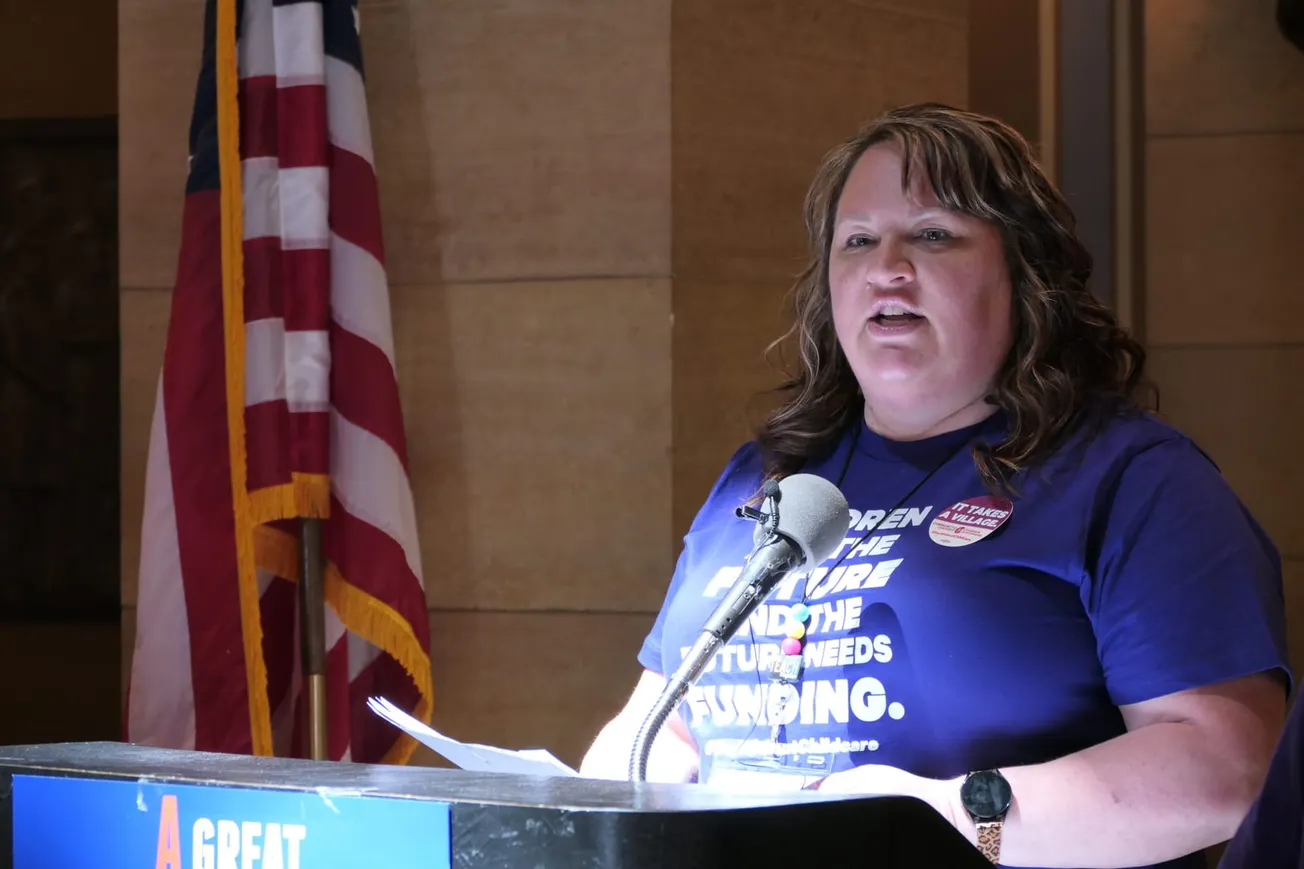
At a rally in the Capitol rotunda, Rep. Carlie Kotyza-Witthuhn, DFL-Eden Prairie, promised the child care workers and advocates that she would continue pushing for the Great Start Child Care Affordability Program.
Many advocates wore purple shirts — representing the mixing of red and blue — calling not for “living wages” but “thriving wages” for child care workers.
Minnesota Reformer is part of States Newsroom, a nonprofit news network supported by grants and a coalition of donors as a 501c(3) public charity. Minnesota Reformer maintains editorial independence. Contact Editor J. Patrick Coolican for questions: info@minnesotareformer.com. Follow Minnesota Reformer on Facebook and Twitter.