

Howie's daily online column is powered by Lyric Kitchen · Bar
SUPERINTENDENT WAYNE WHITWAM NEVER arrived in Hermantown looking to make noise.
“I did a lot of research before I applied to come to Hermantown,” he said. “The district was in a good financial position, strong performance academically and it was a destination district with waiting lists for open enrollment. Hermantown is where I wanted to be superintendent.”
That opening matters. It signals intent. Whitwam did not inherit a broken system and promise to fix it. He chose a strong one — and accepted the harder task of sustaining it without breaking what already worked.

Hermantown Community Schools operates in a rare space in public education: a district expected to perform at a high level year after year, with little tolerance for drift and even less for disruption. Leadership here is not about reinvention. It is about stewardship.
Three years into his tenure, Whitwam anchored that approach in a long-range framework.
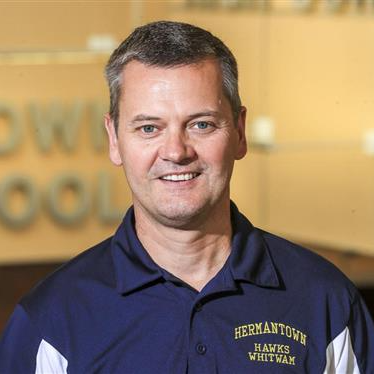
“Three years ago we pulled together 30 community members and staff to create a new strategic plan called a ‘Blueprint for Success,’” he said. “With community input we determined what the district would focus on for continuous improvement. My role is to make sure the areas identified get time, resources and support devoted to accomplishing those goals.”

That plan was not built behind closed doors, and it was not written to sit on a shelf. It was designed to narrow priorities and discipline decision-making — a necessary move in a system where schools are routinely asked to do more than their mission allows.
“We have accomplished much of the areas identified and will need to gather input again as we move forward,” Whitwam said.
That admission is telling. It reflects a leader comfortable acknowledging progress without inflating it — and willing to reopen the process rather than declare victory.
One of the most consequential changes under Whitwam has happened quietly, inside classrooms and staff meetings.

“I am very proud of the PLC (Professional Learning Community) time that we have created for staff,” he said. “This is a time for them to collaborate and reflect on their craft. Rather than shutting their door it is having open conversations about what you are doing, how you are measuring progress and discussing how we can meet student needs.”
That shift — from isolation to shared accountability — is the kind of structural improvement that does not trend on social media but steadily raises instructional quality over time.
The same philosophy applies to career preparation. Rather than treating workforce development as a slogan, the district invested in leadership and access.

“The district wrote and received a grant to hire Scott Larson to take our CTE program to the next level,” Whitwam said. “Scott has done a great job getting students out in the community to see what jobs are available in the Northland. This is our future workforce and we want them to know firsthand the possibilities that are available.”
That sentence — this is our future workforce — captures a central truth of public education in Minnesota. Schools do not just prepare students for tests. They prepare communities for what comes next.
Whitwam’s administration has also focused on partnerships that reinforce the school system’s role as a civic anchor.
“We are proud to have worked collaboratively with the city and the community to build a new arena and keep an SRO officer in our schools,” he said. “We also partnered with the PTO to replace the playground. A new elementary will be sometime in the future plans, but for now we will work to maintain our current buildings in a way that represents our community and makes us proud.”

That is not flashy capital-campaign rhetoric. It is maintenance, cooperation and realism — the kind of language that signals fiscal discipline rather than ambition untethered from capacity.
Even branding, often dismissed as cosmetic, has been treated as an extension of identity rather than marketing gloss.
“Branding and market is one of our goals and we have worked to promote our primary school logo,” Whitwam said. “Sarah (Turcotte) has done an incredible job on our website.”
In public education, trust is built through repetition of performance, transparency and follow-through. Whitwam’s leadership reflects that understanding. He has avoided the temptation to overpromise, resisted reactionary pivots, and kept the district’s focus on instruction, people and systems.
There are no grandstanding moments in this work. There rarely are. But Hermantown Community Schools continues to set a standard — academically, operationally and culturally — that many districts chase and few sustain.
That does not happen by accident.
It happens when leadership knows that the most effective progress is often quiet, deliberate and rooted in purpose — and when a superintendent understands that the job is not to chase attention, but to earn trust.
Right here in our own backyard, Hermantown is showing what high-functioning K-12 public education in Minnesota can look like when stability is treated not as complacency, but as strength.