Howie Hanson is Minnesota’s Columnist, writing about power, money, sports and civic life across the state. This column is sponsored by Lyric Kitchen . Bar of Duluth.
Minnesota Republicans face a familiar but unforgiving reality as they sort through a crowded field of gubernatorial hopefuls: winning more counties is no longer enough.
To seriously challenge Amy Klobuchar in the 2026 governor’s race, the GOP nominee must do something Republicans have struggled to do consistently for more than a decade — expand their coalition into the suburban counties that now decide statewide elections.
This is not a matter of ideology or enthusiasm. It is a matter of arithmetic.
The modern Minnesota electorate is concentrated, suburbanized and increasingly efficient for Democrats at the top of the ticket. Republicans can — and do — dominate large swaths of Greater Minnesota. But those counties, taken together, no longer contain enough voters to overcome decisive losses in Hennepin and Ramsey counties unless the GOP nominee also performs well in the suburban ring.
That structural reality narrows the list of Republican candidates who plausibly align with the map.
It does not eliminate competition. But it does expose which campaigns are running with gravity — and which are running against it.
Scott Jensen: proven strength, proven ceiling
Scott Jensen enters the race with one advantage no other Republican can claim: he has already been the nominee.
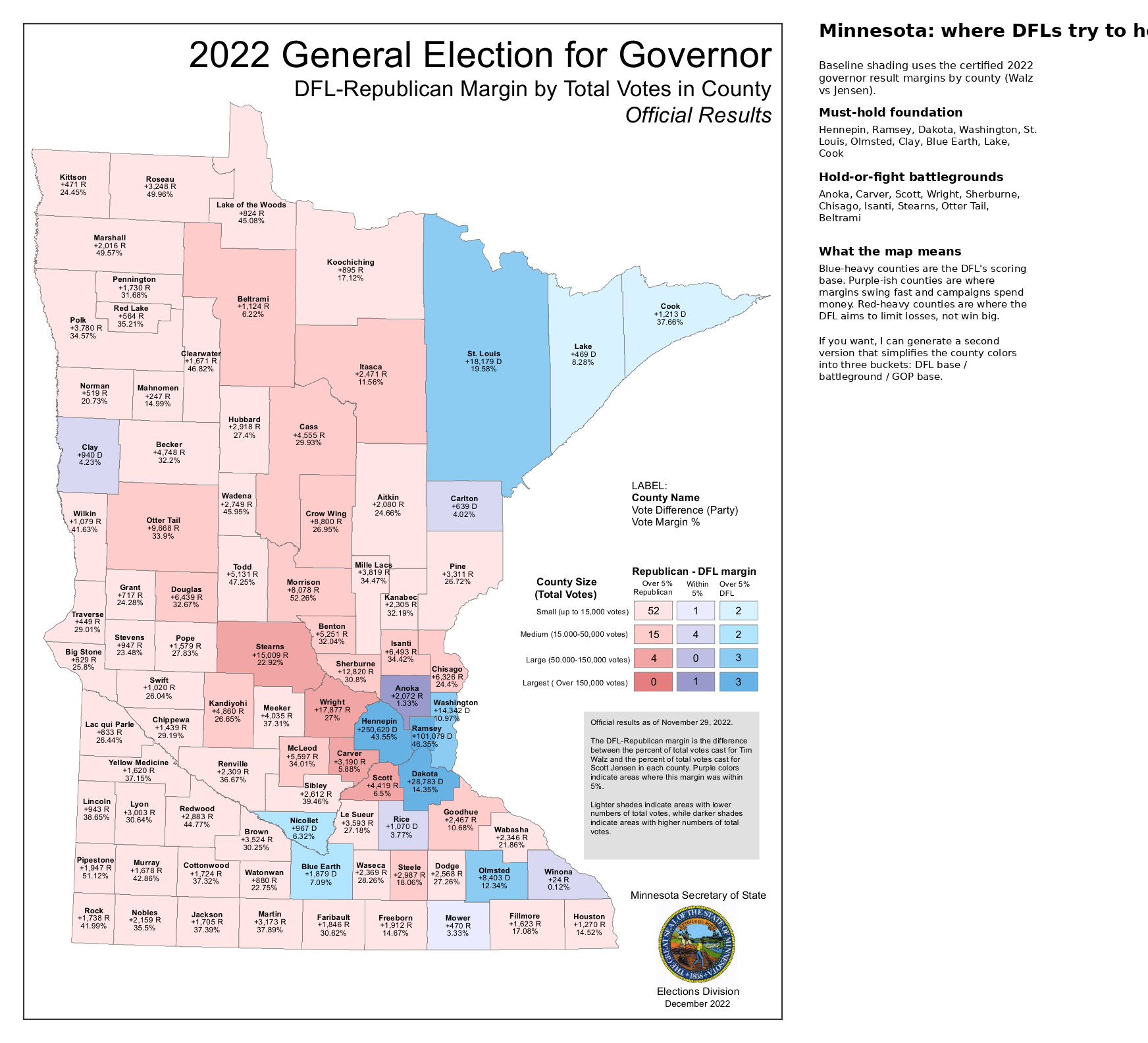
His 2022 gubernatorial campaign offers a complete case study. Jensen carried the vast majority of Greater Minnesota counties and consolidated the Republican base effectively. He lost, however, because the margins against him in the metro were overwhelming — particularly in Hennepin County, where his deficit alone exceeded the statewide margin.
That result did not happen because Jensen failed to turn out rural voters. It happened because Minnesota elections are now decided by where voters live, not how many counties a candidate wins.
The question for Jensen in 2026 is not whether he can repeat his rural performance. It is whether he can materially improve in the suburbs — especially in Anoka County, the single most important swing county in the state.
If Jensen can flip Anoka, hold Wright and Scott counties comfortably, and reduce the Democratic margin in Dakota and Washington counties, he becomes a serious contender. If he cannot, the map closes quickly.
Early polling suggests Jensen remains competitive within the Republican primary electorate and remains the closest-tested Republican to Klobuchar in hypothetical matchups. That reflects familiarity, not inevitability.
His challenge is execution, not motivation.
Lisa Demuth: the suburban theory candidate
If Minnesota Republicans are serious about expanding their coalition, Lisa Demuth represents the clearest expression of that strategy.
Demuth’s profile is oriented toward suburban and exurban voters — the exact places Republicans must perform better if they are to overcome Democratic metro margins. She does not need to win Hennepin or Ramsey counties. No Republican does. She needs to limit losses there, while flipping or narrowly winning the suburban counties that now serve as electoral hinge points.
This is a harder path than it sounds.
Suburban voters are less predictable, more message-sensitive and less tolerant of ideological rigidity. They reward tone, competence and stability — traits that do not always dominate Republican primary campaigns.
Demuth’s task would be to survive the primary without being pulled too far from the center, then pivot credibly to a general electorate that has favored Democrats at the statewide level for years.
If Republicans are going to solve their Minnesota problem, this is the type of candidate they eventually must nominate.
Whether the party is ready to do so remains an open question.
Kristin Robbins and Kendall Qualls: expansion candidates, scale questions
Kristin Robbins and Kendall Qualls fall into a similar analytical category.
Both offer profiles that, in theory, could appeal beyond the GOP’s rural base. Both emphasize coalition-building rather than grievance politics. Both would likely focus heavily on suburban messaging.
The obstacle is not concept. It is scale.
Running a competitive statewide campaign against a candidate with Klobuchar’s infrastructure, fundraising capacity and name recognition requires rapid organizational growth. It requires disciplined messaging. It requires resources.
Without early consolidation or donor alignment, expansion candidates risk being squeezed between a motivated base candidate and the realities of a short primary calendar.
Still, if the Republican primary electorate signals fatigue with losing statewide races the same way, these candidacies cannot be ignored.
Why the rest of the field struggles against the map
Other Republican candidates may generate attention, enthusiasm or regional loyalty. But when their strategies are tested against the county-by-county math, most paths collapse quickly.
Candidates who rely almost entirely on rural turnout face a hard ceiling. Rural Minnesota is already voting Republican at near-maximum efficiency. There is limited room to grow.
Candidates who frame the race primarily around national grievances often struggle in the suburban counties where elections are decided. Those voters are not disengaged. They are discerning — and frequently decisive.
This is not a moral judgment. It is an empirical one.
Minnesota does not reward candidates who win arguments. It rewards candidates who assemble coalitions.
What a real Republican breakthrough would look like
If Republicans are to seriously threaten Klobuchar, the signs will appear early — and at the county level.
They will not appear in crowd sizes or social media engagement.
They will appear if:
- A Republican nominee wins Anoka County outright
- Keeps Klobuchar under 55 percent in Dakota County
- Narrows the Democratic margin in Washington County
- Holds Carver, Scott and Wright counties by comfortable margins
- Limits losses in Hennepin County to under 30 points
That combination would not guarantee victory. But it would force Klobuchar to campaign defensively — something Democrats rarely have to do in Minnesota gubernatorial races.
Absent those signals, the race will likely follow a familiar script.
Where the race stands now
Today, Klobuchar remains the clear favorite. Not because she is unbeatable, but because she occupies the center of Minnesota’s most reliable statewide coalition.
Republicans are still deciding whether they want to challenge that coalition — or simply run against it again.
The difference will determine whether 2026 is competitive, or merely contested.