
Howie Hanson is Minnesota’s Columnist, writing about power, money, sports and civic life across the state. This column is sponsored by Lyric Kitchen . Bar of Duluth.
The Right to Pause, by Duluth, Minnesota author Ashlie Castaldo, is not a book that asks to be finished. It asks to be trusted.
I read it not as a detached observer, but as someone who has navigated periods of poor mental health — which makes the author’s restraint, rather than her reassurance, the most notable feature.
That distinction matters, especially in a culture that treats endurance as virtue, availability as kindness and productivity as proof of worth. The book, a yearlong collection of brief, neurodivergent-affirming reflections, resists that entire economy. It does so quietly, without slogans or scolding, and without pretending that rest is a lifestyle upgrade rather than a survival skill for many people.
The author’s central assertion — that neurodivergence is a valid and valuable way of experiencing the world — is neither radical nor reckless. It is, at this point, clinically grounded and culturally overdue. What distinguishes The Right to Pause is not the claim itself, but the restraint with which it is made.
This is not a manifesto. It is not a productivity hack in softer language. It does not offer a “system.” It offers permission — and that may be why the book will resonate most strongly with readers who have spent years being praised for their resilience while quietly burning out.
The structure is deceptively simple. Each entry is brief and self-contained. There is no narrative arc demanding completion, no promise that progress accrues by staying on schedule. Readers are explicitly encouraged to skip freely, to return when needed, and to trust their own sense of what feels supportive. That design choice is not incidental. It mirrors the book’s worldview: capacity fluctuates, attention wanes, rest does not need to be earned.
This is a book that refuses the lede — on purpose.
The reflections are framed as affirmations, but that word may mislead readers accustomed to cheerleading or forced optimism. These are not declarations of triumph. They are calibrations. They speak to pacing, to clarity, to honest capacity. They resist the language of self-improvement in favor of self-recognition.
That distinction is important, particularly in the neurodivergence conversation, where well-intentioned advocacy sometimes veers into romanticization. The Right to Pause avoids that trap. It does not argue that neurodivergence is a superpower. It does not deny disability, impairment or struggle. Instead, it affirms legitimacy — the idea that experiencing the world differently does not require correction to be meaningful.
This is where the book is strongest.
Neurodivergent readers are often caught between two unsatisfying narratives: one that frames difference solely as pathology, and another that insists difference must be reframed as advantage to be acceptable. This book rejects both. It locates value not in output, but in humanity. Not in endurance, but in self-trust.
The tone is calm, relational and attentive. There is no urgency. No call to optimize. No implied deadline for healing. That absence may frustrate readers seeking tools, strategies or policy critique. But it will likely feel like relief to those who have spent years contorting themselves to meet invisible expectations.
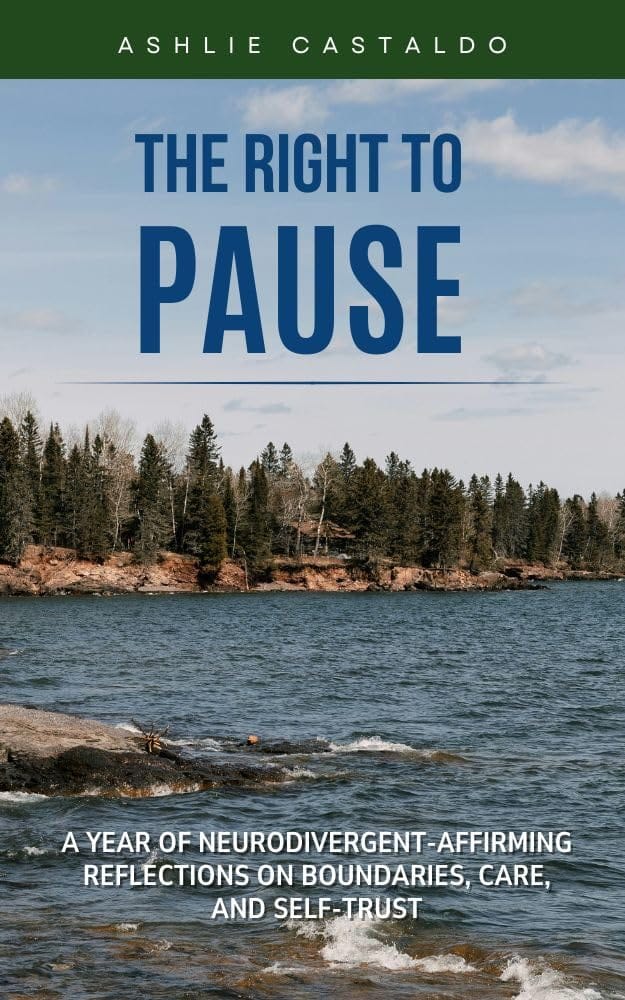
The book’s intended audience is clear: readers who have been praised for endurance, availability and adaptability. That praise, the author suggests, often comes at a cost. Being “the reliable one” can become a trap. Being adaptable can become a slow erasure of boundaries. Being praised for coping can delay recognition of harm.
In that sense, The Right to Pause is less about neurodivergence alone than about a broader cultural failure to respect limits. Neurodivergent people are simply among those who feel that failure most acutely.
The author’s emphasis on boundaries is notable for what it does not do. Boundaries are not framed as ultimatums or moral superiority. They are framed as sustainability. As information. As necessary conditions for care that lasts.
That framing aligns with contemporary trauma-informed practice, which recognizes that nervous systems do not respond to exhortation. They respond to safety. Slowing down, noticing what is present, responding with care — these are not indulgences. They are regulatory acts.
Still, it is worth naming what the book does not attempt.
This is not a systemic critique of how workplaces, schools or institutions fail neurodivergent people. It does not address economic precarity, access to accommodations, or the uneven distribution of who gets to pause and who does not. Readers looking for policy analysis or social argument will not find it here.
That omission is not a flaw so much as a boundary — one the author appears to understand and respect. The book does not claim to solve structural problems through personal reflection. It confines itself to language, tone and permission.
Language matters, particularly for readers who have spent years overriding internal signals because those signals were inconvenient or misunderstood. The book repeatedly returns to the idea of “honest capacity” — a phrase that quietly dismantles the moralization of fatigue. Capacity is not framed as something to be pushed through. It is something to be named.
In journalism terms, this is a book that privileges source material over spin. The primary source is the reader’s own experience. The author does not argue with it. She does not correct it. She does not ask it to justify itself.
That restraint may also be the book’s limitation.
For some readers, especially those newly grappling with neurodivergence, the lack of guidance may feel unmooring. There are no checklists. No diagnostic explanations. No external benchmarks. The book assumes a level of self-awareness and autonomy that not every reader may have access to, particularly those in crisis.
But the book does not pretend to be for everyone. It is explicit about its invitation: engage gently, skip freely, trust yourself. That honesty is refreshing in a marketplace crowded with promises.
The assertion that rest does not need to be earned is perhaps the book’s quietest and most radical claim. In a culture that treats exhaustion as evidence of commitment, that sentence alone will land with force for some readers. It reframes rest not as recovery from failure, but as a condition of staying whole.
For neurodivergent readers, who often expend extra energy navigating environments not designed for them, that reframing can be corrective. It interrupts the internalized belief that needing rest is a personal shortcoming rather than a predictable response to sustained demand.
Importantly, the book does not instruct readers to withdraw from the world. Pause is not equated with disappearance. Boundaries are not framed as isolation. Care remains relational — it simply includes the self.
That balance is difficult to strike, and the book mostly succeeds.
From a journalistic standpoint, The Right to Pause will not generate controversy. It is not polemical. It does not provoke. It does not argue. That may limit its reach beyond its intended audience. But it may also be why it will endure for those it finds.
This is a book readers will keep nearby rather than display. It is designed to be returned to, not conquered. Its success should be measured not in how often it is quoted, but in how often it interrupts an unnecessary push.
In a time when even rest is being optimized and branded, The Right to Pause offers something quieter and rarer: language that does not demand improvement.
It affirms neurodivergence as a valid and valuable way of experiencing the world not by insisting on upside, but by refusing to deny reality. Capacity fluctuates. Limits exist. Care must be sustainable. None of that requires permission — but many readers have never been given language that says so.
This book offers that language, gently, without pressure.
For readers who have learned to disappear behind competence, that may be enough.