
Howie's daily column is powered by Lyric Kitchen Bar in Downtown Duluth. Contact Howie at HowieHanson@gmail.com
Years from now, historians likely will not view Donald Trump as a traditional Republican president, conservative icon or even merely a disruptive political figure. They will study him as something far larger and far more consequential — the man who permanently shattered America’s post-Cold War political order and forced the country into a painful public argument about nationalism, media power, borders, class resentment, cultural identity and the meaning of American citizenship itself.
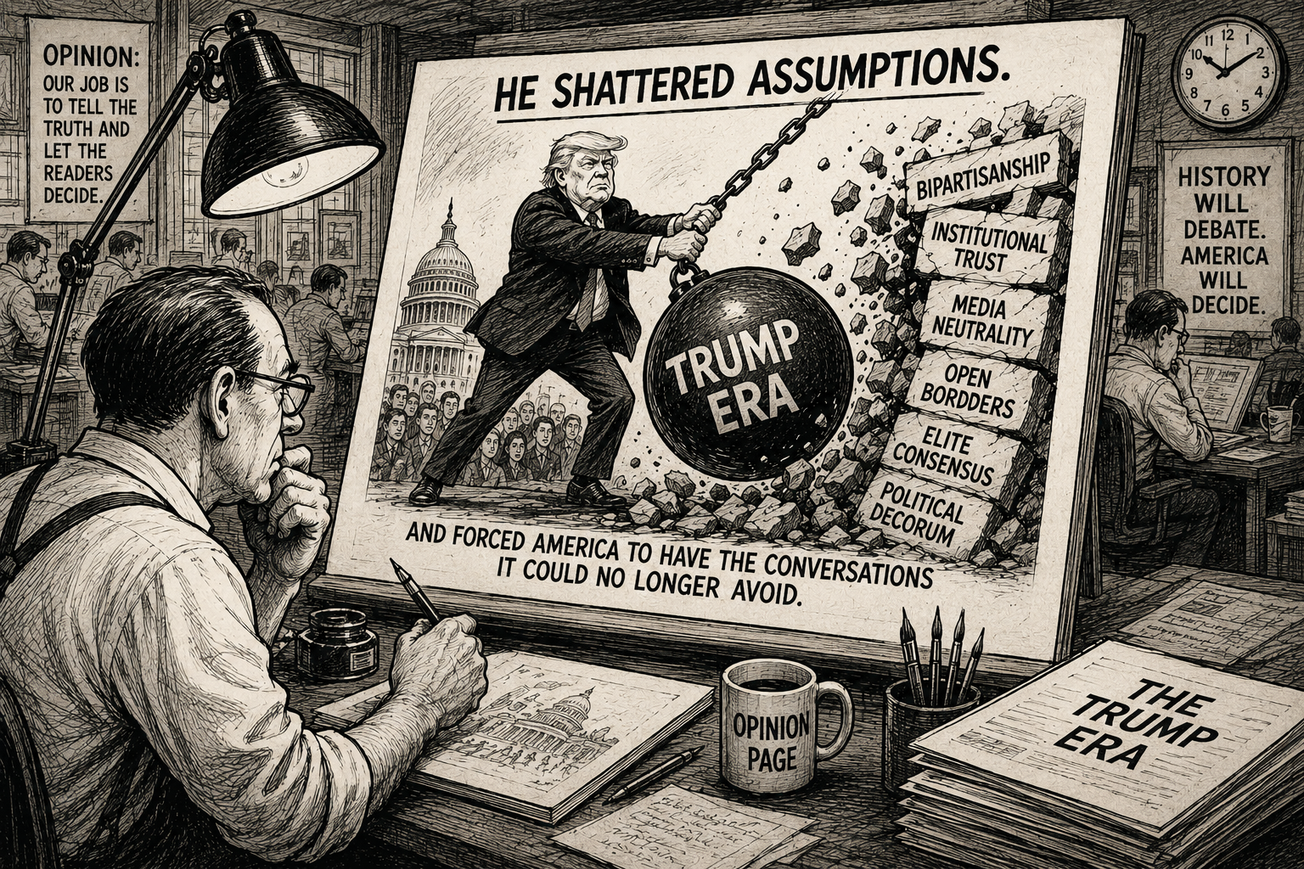
Trump did not simply win elections. He detonated assumptions.
For decades before Trump descended the escalator inside Trump Tower in 2015, both political parties quietly operated inside the same broad governing framework. Republicans and Democrats fought publicly, of course, but there remained an underlying bipartisan consensus supporting global trade, expanding international alliances, large-scale immigration, institutional trust, corporate influence, expanding federal bureaucracy and carefully managed political language. Americans were permitted to argue around the edges, but not challenge the structure itself.
Trump challenged the structure itself.

That is why the American establishment — political, academic, media and corporate — reacted to him with a level of hostility rarely witnessed in modern U.S. history. To Trump supporters, he represented long-overdue rebellion against elite management of the country. To his critics, he represented a direct threat to democratic norms, constitutional stability and civic decency. Both sides, in their own way, understood the stakes correctly. Trump was not simply another president cycling through Washington. He was a political wrecking ball aimed directly at the assumptions governing American life since roughly the early 1990s.
A quarter-century from now, historians likely will conclude that Trump exposed realities many Americans already sensed but felt afraid to say publicly. Millions of working-class voters believed the country’s economic system increasingly rewarded multinational corporations while hollowing out industrial towns across the Midwest. Millions believed immigration policies were poorly managed and politically protected from honest debate. Millions believed media organizations increasingly functioned as ideological participants rather than neutral observers. Millions believed cultural institutions looked down on traditional religious, rural and working-class Americans with open contempt.
Trump did not invent those frustrations. He harnessed them.

His political genius rested not in discipline, organization or philosophical sophistication. In truth, Trump often governed chaotically, spoke recklessly and displayed astonishing personal indiscipline. He routinely distracted himself with personal feuds, social-media warfare and needless provocations that weakened his broader political position. Historians almost certainly will criticize him heavily for inflaming national tensions, eroding public trust in institutions and governing through perpetual conflict rather than steady persuasion.
But historians also may conclude something deeply uncomfortable for Trump’s critics: many of the issues he forced into public debate eventually became unavoidable national conversations anyway.
Border security hardened politically. Skepticism toward China expanded dramatically across both parties. Distrust of corporate media accelerated. Concerns over social-media censorship grew bipartisan legs. Questions involving national identity, biological sex, immigration volume, urban disorder and elite cultural power became unavoidable center-stage debates instead of topics whispered privately at family gatherings.

Even many Democrats eventually adopted portions of Trump’s language on trade, manufacturing, industrial policy and border enforcement, although often without admitting how dramatically the political landscape had shifted beneath them.
That may become Trump’s greatest long-term political achievement. He moved the center of gravity itself.
Presidents often are remembered for legislation, wars or economic conditions. Trump likely will be remembered for changing permission structures. Before Trump, many Americans believed certain opinions carried severe social penalties even when large portions of the population quietly agreed with them. Trump bulldozed through those boundaries with little concern for elite approval. His supporters viewed that as courage. His opponents viewed it as dangerous demagoguery. Twenty-five years later, historians may decide it was both.
None of this means Trump will escape harsh historical judgment.

The Jan. 6 Capitol riot will remain a permanent stain on his presidency. Historians almost certainly will criticize his refusal to concede the 2020 election gracefully and his relentless attacks on election legitimacy. Many scholars likely will argue Trump weakened public faith in democratic institutions during one of the most polarized periods in modern American history. Others will point toward his harsh rhetoric, personal cruelty and tendency to reduce opponents into enemies rather than fellow citizens.
But history rarely evaluates consequential leaders in simplistic moral categories. The most transformational presidents often leave behind deeply divided legacies because transformation itself is disruptive. Andrew Jackson, Franklin D. Roosevelt and Richard Nixon each permanently altered American political life while remaining deeply controversial figures long after leaving office. Trump belongs somewhere inside that complicated category of presidency where historical importance overwhelms personal likability.
The deeper truth is this: Trump revealed an America that already existed.

The anger was already there. The distrust was already there. The economic frustration, cultural resentment, institutional skepticism and media fragmentation already existed beneath the surface long before Trump capitalized on them politically. America did not suddenly become divided because Donald Trump arrived. Donald Trump arrived because America already was divided.
Twenty-five years from now, historians may ultimately describe Trump less as the disease and more as the diagnosis.
That conclusion will infuriate millions of Americans on both sides of the political divide. But history has a habit of cooling emotional arguments long enough to identify structural truths. Trump’s presidency represented the moment millions of Americans openly rejected the managerial consensus that had dominated modern American politics for decades. Whether one views that rejection as patriotic correction or reckless populism likely will depend heavily on personal ideology.

Either way, the political system that existed before Trump is probably gone forever.
And history may remember that as the true beginning of the Trump era.