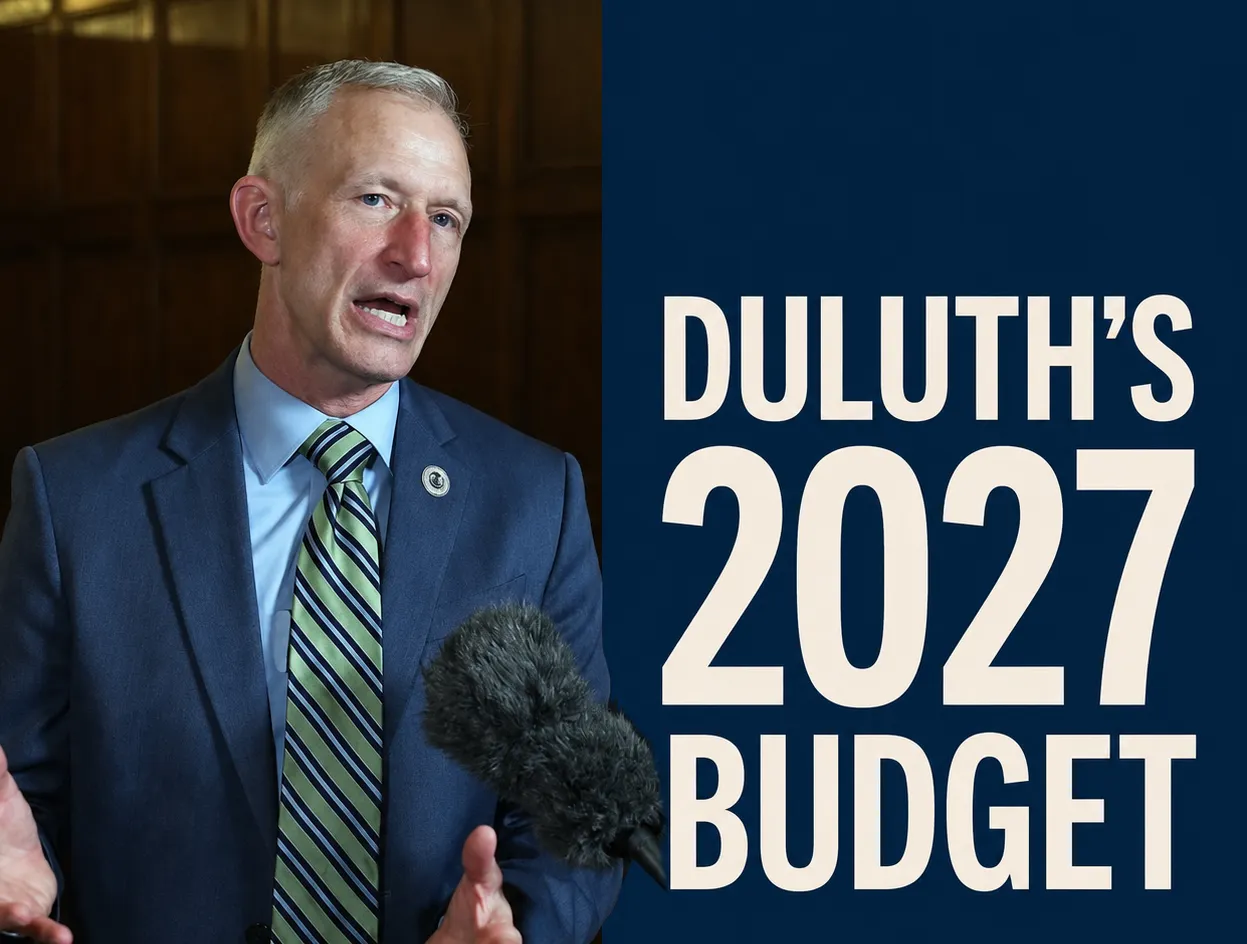
The Roger Reinert administration is using selective language, deferred costs and divided responsibility to control how the public understands a budget problem partly created by decisions the administration itself negotiated.
The clearest description is this: Duluth does not have a mysterious 2027 budget crisis. It has a bill coming due.
What the record establishes
The city recognizes seven labor organizations. Three law-enforcement agreements run through 2026, while the Basic, Confidential, Fire and Supervisory agreements run through 2027. Most were approved during Reinert’s first 13 months in office. The administration negotiated and recommended them, but the City Council authorized them, often unanimously. Responsibility belongs to both branches—not Reinert alone.
The largest unit’s contract is especially important. It provides:
. A 4.5% increase in 2025.
. A 6.5% increase in 2026.
. A new 4% step for eligible employees in 2026.
. A 6% increase Jan. 1, 2027.
. An additional 0.5% market adjustment July 1, 2027.
. A new 4% longevity award in 2027 for employees reaching 24 years.
Those are not simply cost-of-living adjustments. They include general wage increases, market adjustments, steps and longevity pay. Calling the whole package “COLA” makes a negotiated compensation package sound like an automatic inflation calculation.

The city’s own 2026 budget calls the labor agreements “the most significant challenge in coming years” and estimates that they will add approximately $9.9 million in personnel costs over three years. That same budget shows General Fund salaries and benefits rising $5.21 million in 2026. Total General Fund spending rose only $3.79 million because other operating costs were reduced.
That distinction matters. The city did not make the labor increase disappear. It absorbed part of it by squeezing other accounts.
Where the political manipulation occurs
The first technique is anchoring. Reinert is establishing the $5.5 million deficit months before submitting his budget. By repeating that revenue will grow only 1% while expenses rise 5.5%, he conditions residents to expect either higher taxes or service reductions. Later, if the administration reduces the gap to $2 million or $3 million, it can present the result as a managerial victory.
The “1% growth” figure also needs to be described accurately. Reinert reportedly said city revenue is expected to grow approximately 1%. That is not necessarily the same as 1% economic growth, 1% tax-base growth or 1% growth in property valuation. Those are different measurements. A politically astute official should insist that City Hall define precisely what is growing by 1%.
The second technique is externalizing responsibility. Reinert talks about inflation, gasoline prices, weak revenue growth and other forces City Hall cannot control. Those pressures are legitimate, but the labor agreements were deliberate local decisions. The fair criticism is not that employees were undeserving. It is that the city made permanent compensation commitments without publicly identifying an equally permanent revenue source.

The third technique is the levy-percentage game. In September 2025, Reinert called his proposal an “inflation-only” 2.7% levy. But after adding 1.4% in new tax-base growth, the proposed total increase was approximately 4.1%. The council ultimately adopted an increase reported at approximately 4.9% gross, while City Hall described it as a 3.5% net levy increase. Every figure had an accounting explanation, but each produced a different political impression.
The fourth technique is positioning the council as the spender. Reinert proposed a lower preliminary number, and councilors later added $330,000—$280,000 for salary and benefit support and $50,000 for boards and commissions. Afterward, the mayor emphasized that the council had increased his levy and increased the projected 2027 deficit from $5.4 million to $5.8 million.
That is a politically useful arrangement: the mayor receives credit for restraint, councilors restore politically popular spending, and the council owns the final increase. The official budget book documents the $330,000 difference.
The fifth technique is presenting a restricted choice. Reinert is already emphasizing that police and fire consume approximately half the budget and streets and utilities another quarter. Parks and libraries are then described as secondary. If three-quarters of spending is treated as untouchable, the entire $5.5 million problem is forced onto the remaining quarter. That makes reductions to parks, libraries and neighborhood services appear unavoidable—even before payroll, management structure, overtime, consultants and other operations are fully examined.

The political drift
The drift is in responsibility, language and time.
The labor votes occurred in 2024 and 2025. The largest financial effects continue into 2027. By the time residents see the resulting property-tax bill, public discussion has drifted away from the original contracts and toward the annual levy. The raises become “existing obligations,” while parks, libraries and other services are forced to compete for what remains.
There is another coming issue: the three law-enforcement agreements expire at the end of 2026. Their previous raises remain embedded in the salary base, but their 2027 terms are not yet established in the posted contracts. The administration must disclose what wage assumption—if any—is included for new police, lieutenant and command-staff agreements. Watch carefully for contracts that provide moderate increases in 2027 but larger increases in 2028 and 2029, after the mayoral election.

What Reinert is likely to sell
The likely administration narrative is already visible:
. The deficit declined from $7.3 million to $5.5 million, demonstrating progress.
. City Hall protected residents from a much larger levy.
. Inflation, fuel, medical benefits and slow growth—not policy decisions—are driving the problem.
. Police, fire and streets must be protected.
. Parks, libraries and “legacy functions” must be reconsidered.
. Regional partnerships and tax-base growth offer the long-term solution.
. Any increase beyond the mayor’s recommendation belongs to the council.
That is a coherent political message: responsible restraint in the face of unavoidable arithmetic.

What a politically savvy councilor should sell
The strongest countermessage would not be anti-worker or reflexively anti-tax. It would be budget honesty:
“Duluth’s deficit is not an act of God. It is the difference between commitments already made and recurring revenue the city failed to produce.”
A councilor could demand that the administration publish, before recommending a levy:
. A complete bridge from the 2026 budget to the 2027 projected deficit.
. The 2027 cost of wages, steps, longevity, benefits and overtime for each bargaining unit.
. The wage assumptions for the three expiring police agreements.
. Every one-time revenue source used to balance 2026.
. Gross levy growth, net levy growth, total levy dollars and the effect on a median-valued home.
. Savings from every vacancy, consolidation and administrative reduction.
. Three alternatives: tax-only, cuts-only and a blended plan.
The 2027 story is not merely about a $5.5 million deficit. It is about who made the decisions, who benefited from delaying their political cost and who will finally be asked to pay.