

Howie's daily column is powered by Lyric Kitchen Bar in Downtown Duluth. Contact Howie at HowieHanson@gmail.com
The most important sentence buried inside Tuesday night’s Minnesota Star Tribune layoff story was not the part about 15-percent workforce reductions. It was not the newsroom shrinking from roughly 200 journalists to about 175. It was not even the sobering reminder that America’s newspaper industry has lost roughly 75 percent of its jobs over the past two decades.
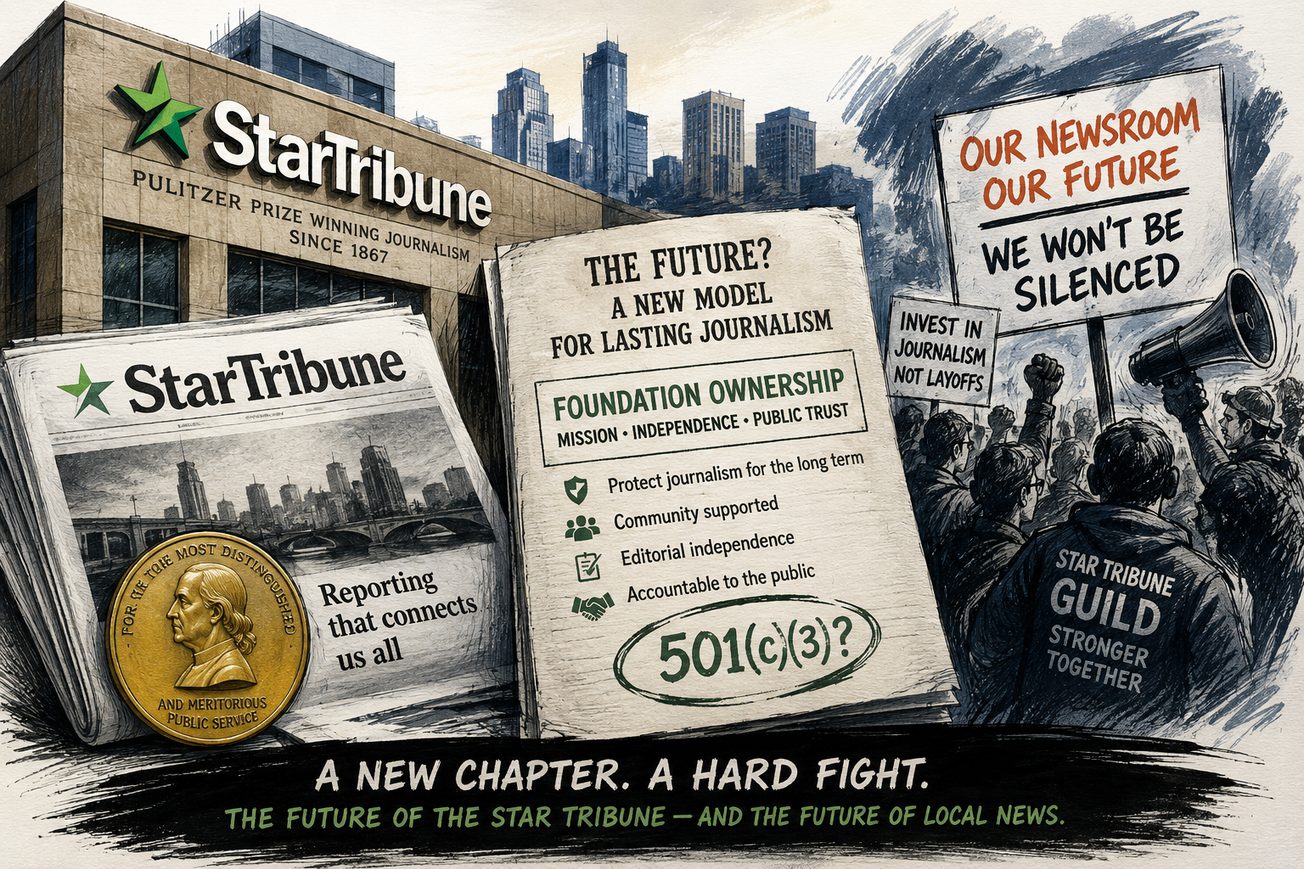
The sentence that mattered most was the quiet acknowledgment that the Minnesota Star Tribune may someday move under foundation ownership.
That is not some accounting footnote buried inside a corporate memo. That is a flashing signal about where serious metropolitan journalism in America may be headed next.
And frankly, it may be one of the smartest long-term conversations happening anywhere in Minnesota media right now.

The public often sees newspaper layoffs as isolated management failures. Sometimes they are. Sometimes executives make poor bets, over-expand, chase trendy products, hire too many layers of management or misread digital behavior. Those things happen. But the larger truth is far uglier and far more structural than most readers realize.
The traditional newspaper business model has been slowly collapsing for nearly 25 years.
I have watched classified advertising disappear, afternoon newspapers vanish, family ownership fade away and entire newsrooms shrink into shadows of themselves. Newsrooms once packed with veteran beat reporters, photographers, copy editors and columnists slowly became smaller, leaner and increasingly exhausted operations trying to feed a 24-hour digital machine that never stops demanding more content.
Advertising dollars that once supported large metro newsrooms migrated first to Craigslist, then Google, then Facebook, then social media ecosystems that built billion-dollar empires partly by distributing journalism they did not pay to produce. Artificial intelligence now threatens to accelerate that disruption even further by summarizing reporting without necessarily sending readers back to original news sources.

Meanwhile, readers still demand excellent journalism. They just increasingly expect it delivered digitally, instantly and often cheaply.
That is the economic vice squeezing every newspaper in America, including the Minnesota Star Tribune.
And yet there sits the strange contradiction.
The Star Tribune just won a Pulitzer Prize for its coverage of the Annunciation church and school shooting. The organization continues producing some of the best journalism in the Midwest. It remains one of the largest newsrooms between the coasts. Digital subscriptions reportedly have grown 25 percent in three years.
Still, layoffs arrived anyway. Excellent reporting no longer guarantees economic security.

That single reality may explain the modern newspaper crisis better than any industry white paper, media conference panel or executive memo ever could.
The most revealing part of Publisher Steve Grove’s comments in the story may have been what they quietly admitted without fully saying aloud: perhaps journalism itself is no longer best protected purely as a traditional profit-centered business.
That does not mean the Minnesota Star Tribune is becoming charity journalism. It does not mean newspapers suddenly stop needing revenue, subscriptions, advertising or discipline. But it may mean the future of large civic journalism organizations looks less like privately owned manufacturing companies and more like permanently protected public institutions.
Think hospitals. Universities. Museums. Public broadcasting. Institutions society decides are simply too important to disappear.
The likely structure being explored here is not a pure nonprofit newsroom model like ProPublica. The closer comparison is probably The Philadelphia Inquirer, where nonprofit foundation stewardship helps protect the long-term mission while operational journalism continues functioning commercially.

That distinction matters because it preserves flexibility. A giant metro newspaper still must operate aggressively, compete for readers, innovate digitally and generate substantial revenue. But foundation ownership changes the underlying incentive structure.
Instead of existing primarily to maximize profit margins or future resale value, the organization exists primarily to preserve journalism itself. That is an enormous philosophical shift.
It also could protect Minnesota from the fate suffered by dozens of American cities where hedge funds or private-equity firms stripped newspapers for parts, slashed staffing, sold real estate and left communities with hollowed-out shells barely capable of covering school boards or city hall.
Sole owner Glen Taylor deserves some credit here, whether readers politically agree with him or not.
He purchased the newspaper in 2014 partly because he believed Minnesota needed a strong statewide news organization. According to Grove, Taylor never took profits from the paper and instead continued investing in its future. In today’s media climate, that already separates him from a long list of far more predatory newspaper owners around America.

Still, even civic-minded billionaires eventually age out. Taylor is 85. Succession matters. Stewardship matters. The future matters. And if Minnesota truly wants a statewide news organization capable of surviving another 50 years, then ownership structure suddenly becomes one of the most important journalism questions in the state.
Of course, nonprofit or foundation-backed ownership is not some magical rescue plan floating down from heaven. There are big risks.
Once philanthropic money enters journalism, readers naturally begin wondering whether donors influence coverage. Even if they never directly interfere, perception alone matters. If large foundations, healthcare systems, corporations or wealthy Minnesotans become major financial supporters, critics inevitably will question whether aggressive reporting becomes more complicated.
There also is the danger of institutional softness.
Some nonprofit journalism operations drift into academic, donor-friendly ecosystems disconnected from ordinary readers. Great newspapers are supposed to be competitive, skeptical, noisy and occasionally uncomfortable. Lose that edge and readership declines anyway.

Then there is labor.
The Star Tribune Guild already signaled resistance to the layoffs. And understandably so. Journalists have watched decades of shrinking staffs while still being asked to produce exceptional work under relentless digital pressure.
The union likely cannot stop a legal ownership restructuring if one occurs. But it absolutely can fight staffing cuts, benefit reductions, restructuring plans and contract changes connected to that transition. Those battles could become intense.
Readers, however, may notice surprisingly little at first. The newspaper still arrives. The website still updates. Sports scores still post. Political coverage still lands in inboxes before sunrise. But underneath the hood, the mission subtly changes.

The Minnesota Star Tribune increasingly could begin operating less like a vulnerable private company and more like a protected public institution built for long-term survival.
And honestly, maybe that is where serious journalism in America was always destined to end up once the digital age shattered the old advertising monopoly. Because local journalism is no longer merely a business question. It is now a democracy question.
Who covers city hall when the room empties out? Who investigates corruption? Who explains state budgets? Who sits through six-hour school board meetings? Who tells Minnesota’s story with enough scale and seriousness that the rest of the country still notices this place exists?
Those questions do not disappear simply because Facebook captured the ad market.
What happens next at the Minnesota Star Tribune matters far beyond one newsroom in Minneapolis. It may become one of the clearest signals yet about how major regional journalism survives the next generation in America. Not as a dying factory. Not as a billionaire toy. But as an institution Minnesota ultimately may decide is still worth protecting.