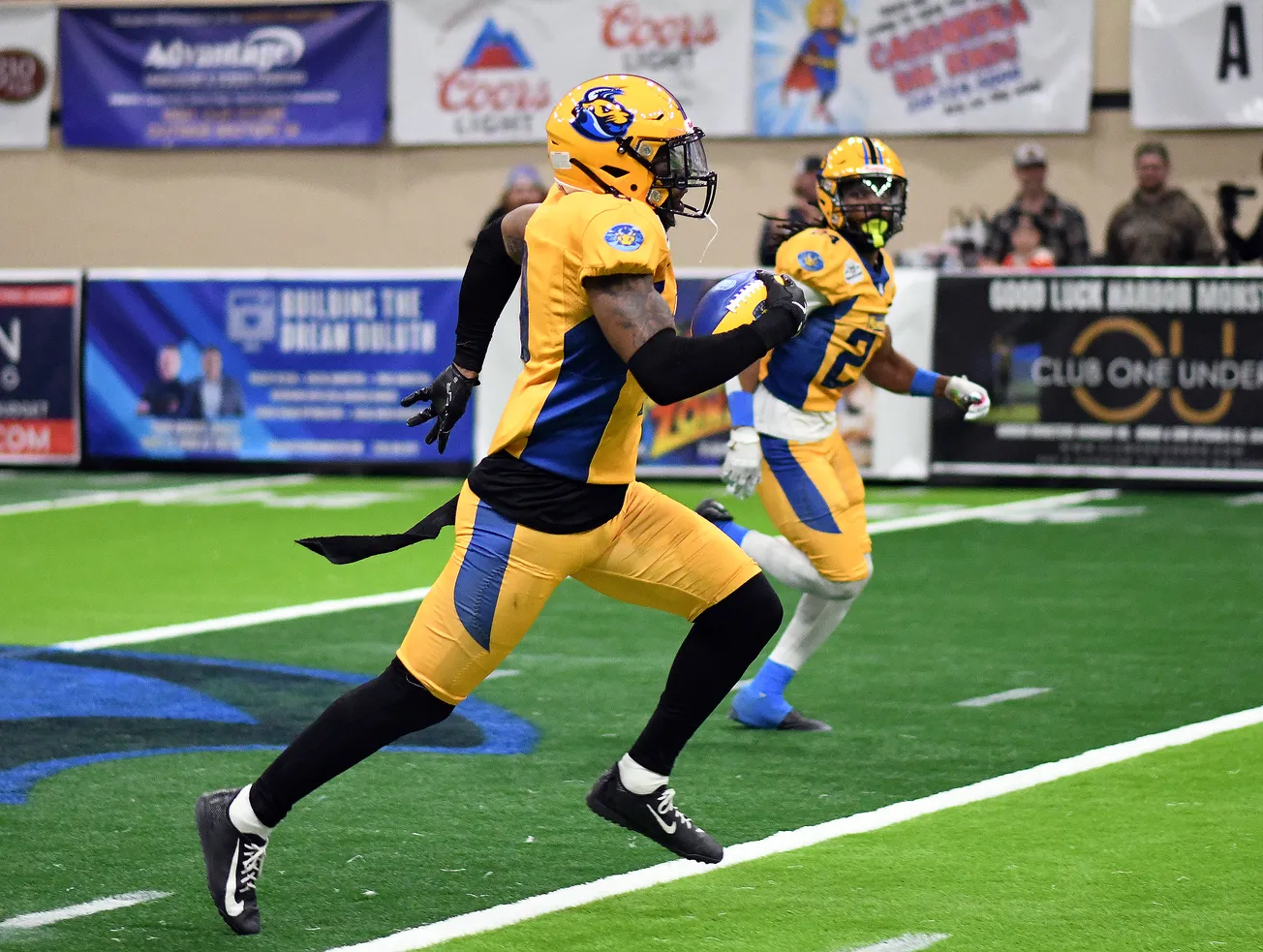
A six-part daily column series on the state of arena football — from the sport’s bruised past to its uncertain future — with a sharp focus on AF1, the upstart league the Duluth-based Minnesota Monsters will join when they relaunch in Spring 2026.


Howie's column is powered by Lyric Kitchen · Bar | eMail Howie
Arena football has never lacked for bold ideas. It has lacked follow-through.
The trail of folded leagues, vanished teams and unfinished seasons stretches back more than 30 years, a reminder that the 50-yard game is thrilling to watch and brutally difficult to build into a business.
Arena Football One — AF1 for short — believes it can change that.
The league launched in 2025 with eight teams, a steady hand of veteran operators, and a promise that it has studied every mistake this sport has made. And there have been many. The original Arena Football League expanded too fast. Its second incarnation over-spent and collapsed. The smaller regional leagues that followed often operated without capital, strategy or discipline.

AF1 is trying to prove that there’s still room for stable, professional arena football in mid-sized American markets — if the game is built more deliberately, more honestly and more humbly than the leagues that came before it.
Its first season offered a glimpse of what that might look like.
AF1 brought back the classic 50-yard game, complete with the rebound nets and the faster tempo that defined the original AFL in the late 1990s and early 2000s. That decision was deliberate. League executives believe that the traditional arena game — not a modified hybrid — is the version fans still connect with, especially those who watched the sport’s peak years.
But the nostalgia stops there. AF1 isn’t trying to replicate the old AFL’s expensive playbook. It isn’t chasing national television contracts. It isn’t planting teams in major markets simply for visibility. The league knows it doesn’t have the financial cushion to pretend it’s something it’s not.

What AF1 is really selling is credibility, a currency that has been in short supply in arena football for decades.
The league’s operators talk constantly about “capital discipline,” “ownership vetting,” and “manageable geography” — phrases that rarely appeared in press conferences during the sport’s boom-and-bust years. AF1 requires its teams to be financially cleared well before the season begins, reducing the risk of midyear collapses. It groups franchises regionally to limit travel, sidestepping the budget spikes that historically sank even strong teams. It encourages shared resources, centralized operations and a league structure built around business stability, not flashy announcements.
It is arena football built with guardrails.
That method feels almost radical in a sport accustomed to optimism outweighing reality. For decades, leagues established schedules before confirming ownership. They promised national exposure before securing local sponsorships. They expanded to unfamiliar cities without financial backing. They burned arenas, stiffed players and tanked credibility.
AF1 is trying to flip that script.
The league leans on a more grounded approach: build slowly, operate transparently and sell the product city by city, not in grand national declarations. In its first season, several teams reported steady attendance, meaningful community engagement and growing partnerships with local businesses — small victories, but victories nonetheless in a sport where expectations must be measured.
The on-field product has also been strong. Many AF1 rosters included former FBS players, NFL practice-squad veterans and CFL alumni. The skill level was noticeably high for a new league. Quarterback play — the lifeblood of the arena game — ranged from competent to standout, creating a product that felt authentic rather than developmental. Fans recognized the pace, the scoring rhythm, the compressed-field tactics and the signature moments that defined the original AFL.
AF1 still faces plenty of pressure.

The arena football audience is fragmented after years of instability. Sponsors are cautious. Many markets have seen arena teams come and go, leaving fans skeptical. The league must prove — repeatedly — that it will finish seasons on time, pay its players, and return for Year 2 and Year 3. That, more than highlight-reel touchdowns, determines whether AF1 becomes a real fixture or fades into the long list of leagues that arrived with hope and disappeared quietly.
And then there is the IFL — the sport’s most stable league and the model AF1 must indirectly compete with. The IFL has years of credibility, solid ownership and a proven business structure. AF1 offers a different style of game, but the comparison is unavoidable. The challenge isn’t overt competition; it’s establishing its own identity while earning the same trust the IFL has spent nearly two decades building.
AF1 believes it can get there by doing the one thing every arena league promises and few deliver: sticking around.
If AF1 survives long enough, builds a strong enough reputation and proves itself reliable in the eyes of players, coaches, sponsors and arenas, it could legitimately stake a claim as the country’s top traditional arena-rules league. It has already separated itself from the semi-pro chaos found at the lower tiers of the sport. Its early operational discipline is real, not cosmetic. And for the first time in years, there is a sense that a new arena league might actually be built on a foundation strong enough to endure.
No one in the sport expects AF1 to replace the heyday of the old AFL. But that isn’t the goal. The goal is survival, stability and credibility — three words that have defined the sport’s failures far more often than its successes.

If AF1 can deliver even two of them consistently, the league will already be accomplishing something remarkable.
And if it delivers all three, the 50-yard game might finally have the comeback it has been waiting decades to see.
Howie, 71, is a veteran Duluth print journalist and publisher of HowieHanson.com, which he has operated for 21 years. He is the region’s first and only full-time online daily columnist, covering local news, politics, business, healthcare, education and sports with an independent, community-centered voice. Hanson has spent more than five decades reporting on issues that shape the Northland.