
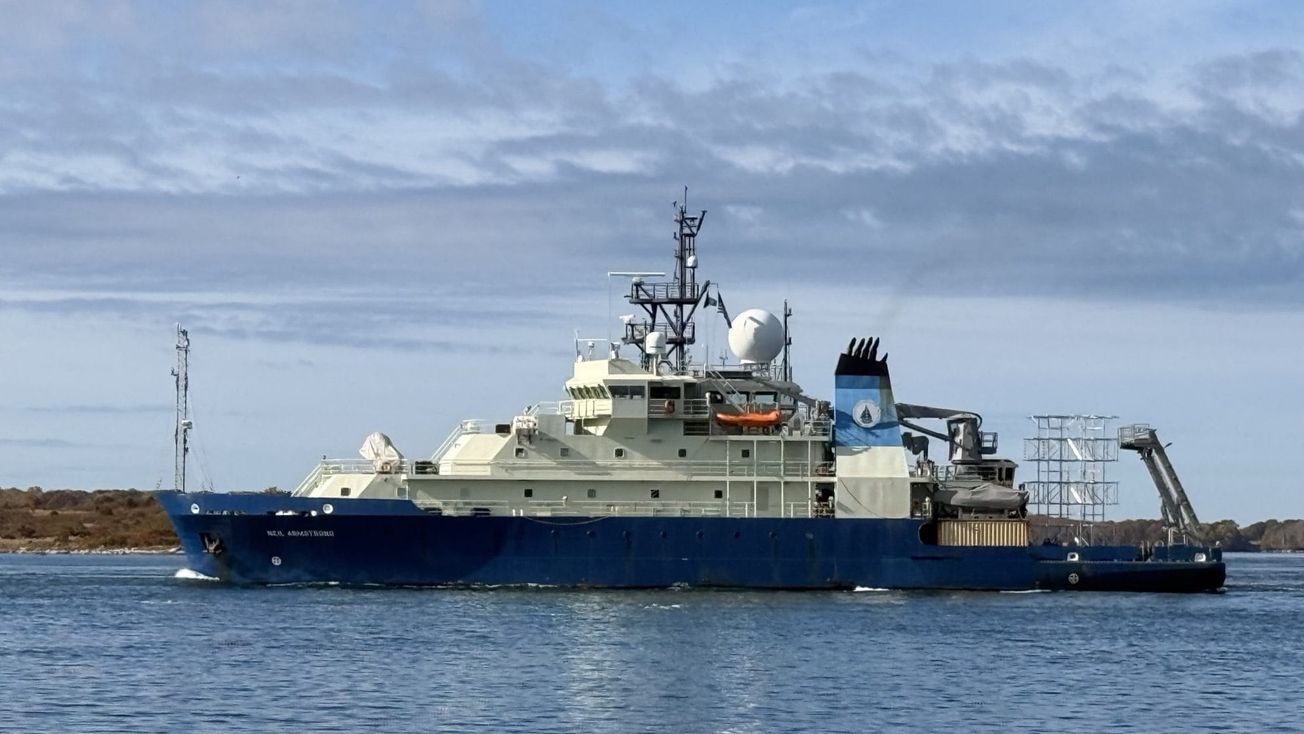
An oceangoing research ship is expected in Duluth on Monday to help scientists search beneath Lake Superior for particles so elusive they usually pass through matter undetected. The 238-foot Neil Armstrong is making its first voyage through the Great Lakes to support a University of Minnesota Duluth-led neutrino experiment.
The project aims to accomplish something researchers say has never been done: detect laboratory-produced neutrinos in a large natural body of water. Instruments positioned offshore near Two Harbors will look for evidence of particles sent north through the Earth by Fermi National Accelerator Laboratory in Illinois, according to UMD.
Operated by the Woods Hole Oceanographic Institution, the Neil Armstrong left Massachusetts on Oct. 28 for a roughly 2,531-nautical-mile trip. Its assignment includes lowering five detector frames onto the lakebed and installing fiber-optic connections to shore. Each equipped frame weighs about 8,000 pounds, requiring precise placement in the water.
UMD’s deployment plan calls for the ship to use Berth 11 at Duluth’s Clure Terminal Expansion pier before carrying the equipment to the research site. Each frame will hold 18 spherical optical modules, with cables connecting the instruments to equipment near the Two Harbors water treatment plant.
The experiment depends on faint flashes of blue light produced when particles resulting from a neutrino interaction move through water. Sensors will relay those signals to shore, allowing researchers to distinguish the laboratory beam from background activity. Daylight can overwhelm the flashes, so the Lake Superior detectors will operate at night; researchers anticipate detecting several beam neutrinos per day of beam operations.
The undertaking combines particle physics with the practical challenges of moving heavy scientific equipment through unfamiliar waterways. Kent Sheasley, one of the ship’s captains, said preparations include accounting for freshwater buoyancy, narrow passages, wave conditions and regional weather.
“In addition to our own expertise, we’re also consulting with local ship pilots who navigate these areas all the time,” Sheasley said in a Woods Hole announcement.
Known as the Experimental Neutrino Detector project, the research is sponsored by the Defense Advanced Research Projects Agency in cooperation with federal energy laboratories. A related experiment in Lake Vermilion will test a different detector design, extending Minnesota’s longstanding role in neutrino research into its lakes.