Table of Contents
Minnesota’s two state political conventions this weekend feel less like ordinary endorsement gatherings and more like moments from earlier American political transition periods — those strange hinge points when voters begin pulling away from the political systems that governed them for decades, but nobody fully understands what comes next.
The better historical comparison may not even be modern Minnesota. It may be 1968 Chicago. Or 1980 Republican America. Or even the old Farmer-Labor civil wars that once nearly split Minnesota politics apart from the inside. Because what’s happening now inside both parties is not really ideological purity testing. It’s institutional stress.
The DFL convention in Rochester has echoes of the old Democratic conventions of the late 1960s and early 1970s — the period when establishment liberals suddenly found themselves being challenged by younger activist coalitions demanding moral urgency over cautious pragmatism. Back then, the Democratic Party was fracturing over Vietnam, civil rights and generational power.
Today’s DFL fractures revolve around culture, class, race, economic identity and how aggressively progressivism should govern. Different issues. Same emotional architecture. The establishment wing wants electability. The activist wing wants transformation.
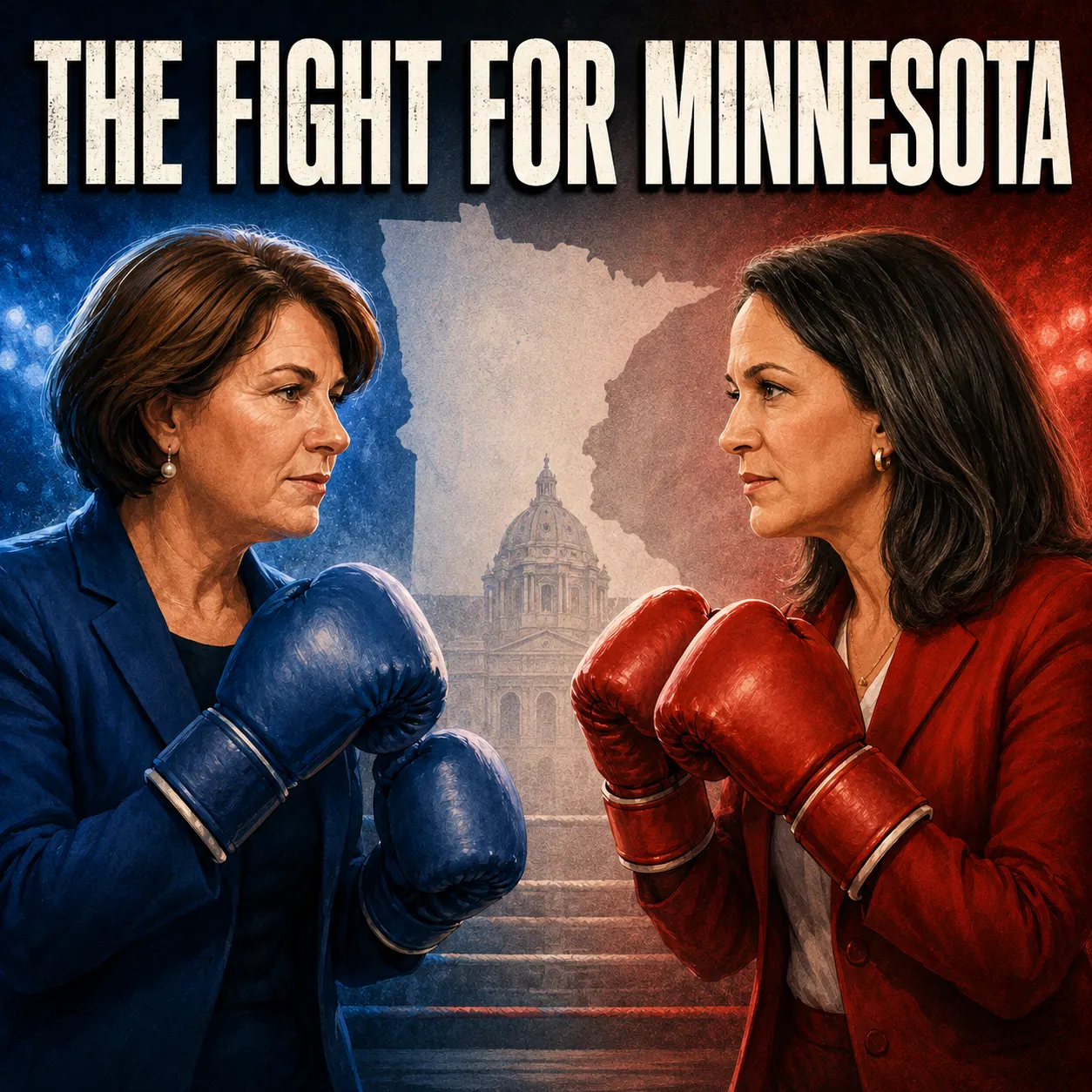
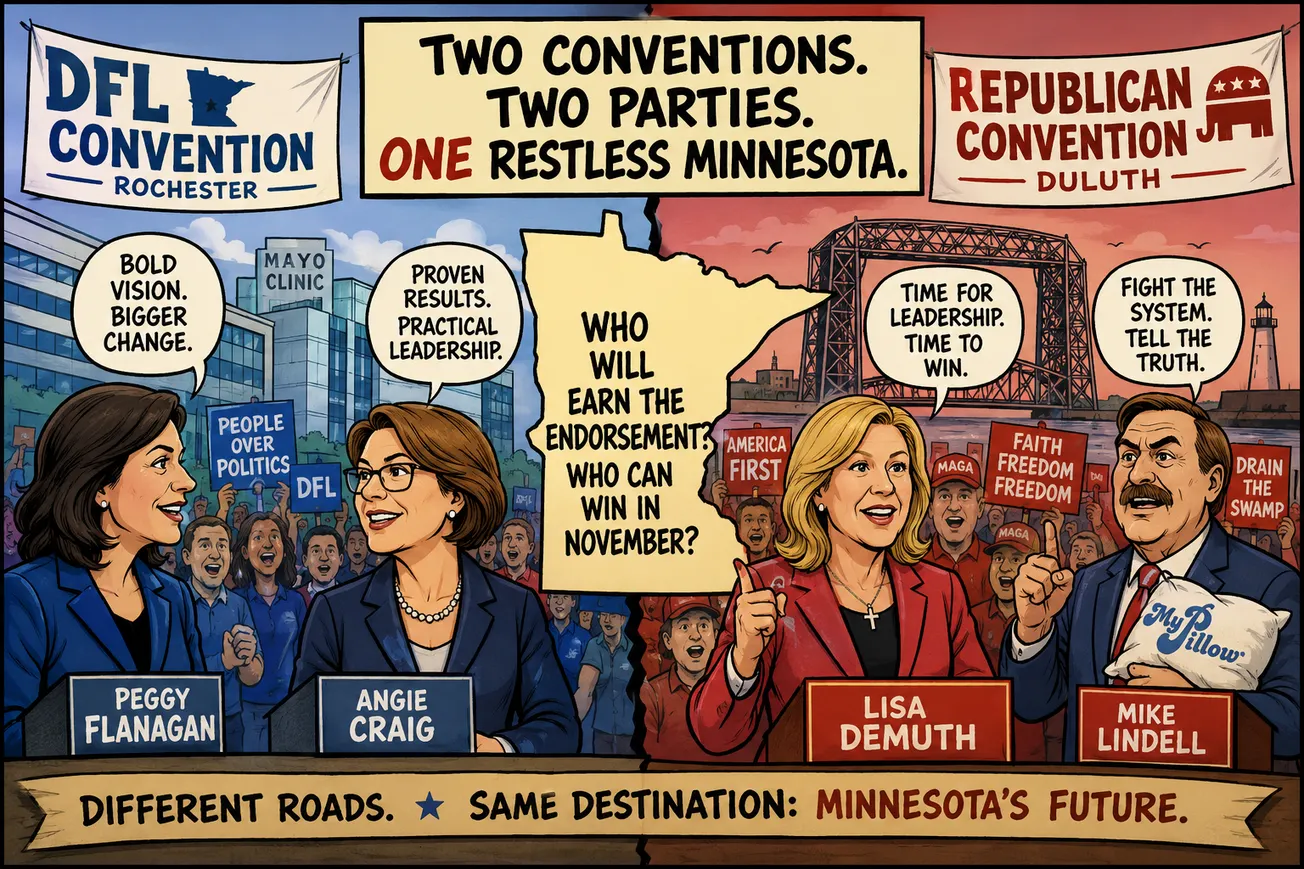
That tension now sits directly underneath the Peggy Flanagan-versus-Angie Craig divide.
Flanagan resembles the modern descendant of the movement-oriented coalition that increasingly dominates convention politics — passionate, organized, younger and deeply invested in ideological clarity.
Craig represents the older Minnesota DFL governing tradition — pragmatic, suburban, coalition-focused and calibrated toward general-election math.
And hovering above all of it, like a seasoned political weather satellite, sits Amy Klobuchar.
Klobuchar’s role this weekend feels historically similar to the old institutional Democratic figures who survived political realignments by refusing to fully belong to either ideological camp. Not unlike Hubert Humphrey during portions of the DFL’s post-Farmer-Labor transition years. Humphrey understood something modern activists often dislike hearing: Movements excite conventions. Coalitions win states.
Klobuchar has built an entire career around that principle.
Now head north to Duluth, where Republicans gather in a mood that feels remarkably similar to the Republican Party of 1980. Not identical politically. Emotionally.
Ronald Reagan’s Republicans arrived in 1980 convinced the country itself had grown exhausted with institutional liberalism, cultural uncertainty and economic anxiety. Minnesota Republicans now believe something similar is happening again. The Duluth convention has the feeling of a party that believes history may finally be turning back toward them after years wandering through the wilderness.
That’s why Lisa Demuth matters. She resembles the type of stabilizing candidate political parties often elevate during transitional periods — credible enough for moderates, conservative enough for activists and disciplined enough not to self-destruct on television. That’s an important detail because the Republican Party nationally has spent nearly a decade rewarding emotional intensity over governing discipline.
Minnesota Republicans increasingly appear tired of losing beautifully. They want somebody who can actually win.
Which brings us to Mike Lindell.
Every political era eventually produces a candidate who functions more as emotional symbolism than electoral strategy. In some ways, Lindell resembles the outsider-populist figures who emerged during periods of institutional distrust throughout American history — George Wallace in 1968, Ross Perot in 1992, even parts of Donald Trump’s 2016 rise.
Not because the ideologies are identical. Because the emotional fuel is similar: Distrust. Alienation. Rage toward elites. Belief that institutions are fundamentally dishonest.
Lindell still taps directly into that emotional current.
But Minnesota Republicans face the same question Republicans nationally have wrestled with for years: Can populist fury win a convention while simultaneously losing a statewide electorate? That tension may define the entire weekend in Duluth.
And there’s another historical comparison worth mentioning. Oddly enough, both conventions also resemble the final years of Minnesota’s old Farmer-Labor era before the 1944 merger that created the DFL itself. Back then, Minnesota politics fractured between ideological activists and practical coalition-builders. The state eventually fused its competing wings together because survival demanded it.
Now both parties again appear internally divided between their emotional wings and their governing wings. Which is why these conventions feel historically important. Not because endorsements themselves matter that much anymore. Truthfully, they don’t. Modern candidates raise money independently. Build personal media brands. Ignore party structures when necessary. Run around conventions instead of through them.
The old smoke-filled-room system is gone. But conventions still reveal the emotional truth of political parties.
And the emotional truth in Minnesota right now is this: The DFL fears losing working-class and regional voters permanently. Republicans fear nominating candidates who thrill activists but collapse in the suburbs. Both fears are real.
And both conventions this weekend may tell us which party understands its own problem better.
Howie is Minnesota’s Columnist, writing about statewide power, politics, business, sports and civic life. His daily column is powered by Lyric Kitchen Bar of Downtown Duluth.