Table of Contents
The Spirit of Duluth Invitational Hockey Tournament was created because Duluth wanted to return a favor. For years, the city’s traveling youth teams accepted invitations to tournaments across Minnesota and Canada without possessing enough artificial ice to host an event of comparable size. Nearly fifty years later, the Spirit has become one of Minnesota’s largest and most enduring youth hockey tournaments, drawing players, coaches and families to Duluth during a December weekend when its hotels, restaurants and arenas become part of the experience.
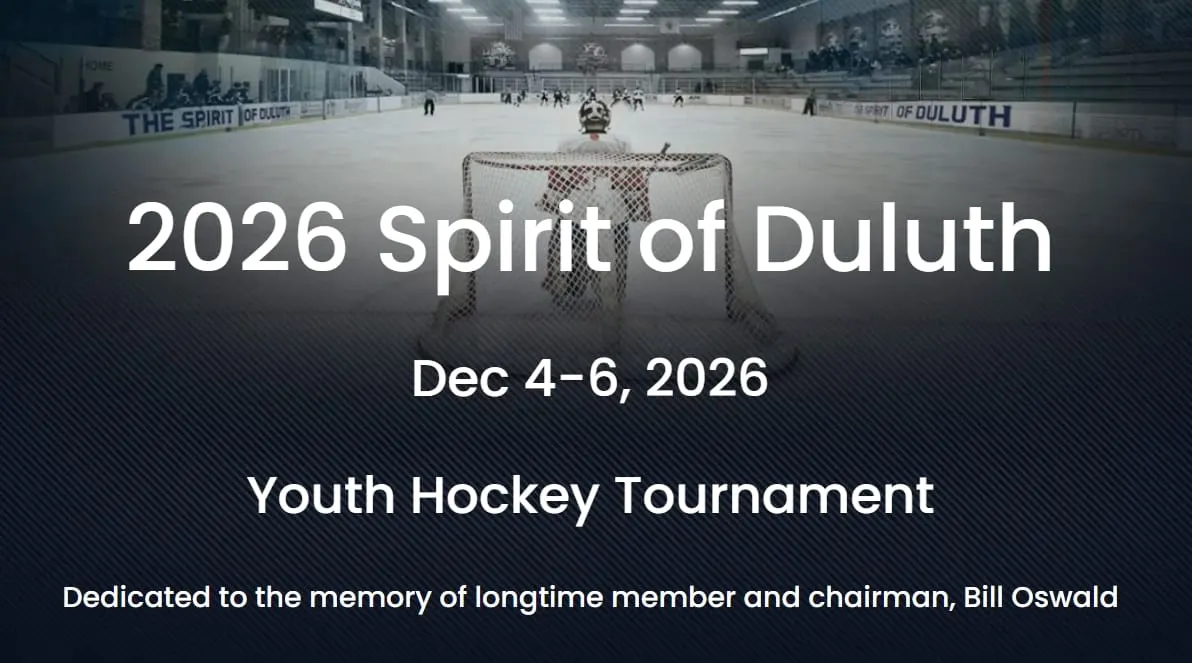
The 49th-anniversary tournament is scheduled for Dec. 4-6, with 52 boys teams expected to compete in four divisions: eight at Junior Gold A, 16 at Bantam AA, 16 at Peewee AA and 12 at Squirt A. Every team will be guaranteed at least four games, with some playing five, in a round-robin format leading to championship play.
Games are scheduled for Sill and Seitz arenas at the Duluth Heritage Sports Center, Mars Lakeview Arena on the Duluth Marshall campus, Fryberger Arena, DECC Arena and SAHA Arena in Superior. At a minimum, the four-game guarantee requires 104 games over three days, illustrating why the tournament depends on every available sheet of ice and why the continued availability of DECC Arena remains important to the event’s future.
The Spirit began in 1977, after artificial ice was installed at Peterson Arena in 1975 and the Pioneer Hall Annex opened two years later. Don Holm, Norm Mangan and Mike Savard met at Savard’s home that spring to discuss creating a major traveling-team tournament. Mangan proposed the name Spirit of Duluth, drawing from Spirit Mountain and the renewed civic energy surrounding the city.
The original tournament brought together Peewee, Bantam and Midget teams from Minnesota, Wisconsin, North Dakota, Colorado and Canada. Its organizing principle was simple but significant: guarantee teams meaningful competition against opponents they would not ordinarily see. Its round-robin format, community volunteers and multi-arena schedule became the foundation of a tournament that has survived changing age classifications, arena conflicts and nearly five decades of youth hockey evolution.
The 2026 field will continue that tradition. Rosemount returns as the defending Junior Gold champion, while Minnetonka won the 2025 Bantam AA championship, Osseo-Maple Grove captured Peewee AA and Hastings won Squirt A. The tournament’s alumni list includes players who later reached college, Olympic and professional hockey, including Phil Kessel, Matt Cullen, Mark Parrish, Robb Stauber, Sean Hill, Derek Plante, Neil Pionk, Dominic Toninato, Darby Hendrickson, Toby Petersen and Dave Spehar.
The tournament is dedicated to the memory of longtime committee member and chairman Bill Oswald. During the 2025 event, organizers also honored founding members Dick Stewart and Don Holm and longtime tournament medic Bob Noldin. The Bantam divisions were named for the four men in recognition of their service to youth hockey.
The tournament’s impact extends beyond the rink. A University of Minnesota Duluth Labovitz School study estimated that Duluth Amateur Hockey Association operations generate approximately $10.3 million in annual economic activity, with tournaments and games involving out-of-area teams accounting for about $5 million. Spirit organizers have estimated that their tournament alone contributes more than $1.5 million to the local economy while helping fund Duluth traveling teams.
Those numbers provide necessary context for the future of the DECC Arena ice sheet.
The arena’s original ice plant, installed when the building opened in 1966, was shut down in 2023 after a safety assessment determined it had exceeded its mechanical lifespan. The city committed up to $200,000 in federal pandemic-relief money for a temporary chiller, preserving the sheet for youth hockey and figure skating. The DECC board later approved another temporary chiller rental in 2025 at $16,750 per month, plus a one-time $12,000 glycol expense, while longer-term facility work continued. DECC board records described the equipment as a temporary ice-making solution.
DECC Arena is listed among the sites for the 2026 Spirit, but the broader question has not disappeared: What would happen to the tournament if that sheet were no longer available?
The consequences would be immediate. Losing the DECC would remove one of the six ice sheets listed for the 2026 tournament. Organizers would have to find dozens of replacement ice hours, extend an already demanding schedule, send teams farther from central Duluth or reduce the field. Games already can begin at 8 a.m. Friday and Saturday, and tournament rules require rest periods between games while accounting for officials, medical personnel, resurfacing and volunteers moving among arenas.
There is little unused capacity in that schedule. Compressing more than 100 games onto five sheets would likely mean earlier starts, later finishes and increased travel between Duluth and Superior. If replacement ice could not be secured at Amsoil Arena or another regional rink, the tournament might have to eliminate teams, reduce divisions or reconsider its four-game guarantee. Any of those outcomes would weaken one of the event’s greatest selling points.
The economic consequences would follow the hockey consequences. Fewer teams would mean fewer hotel rooms, restaurant meals, retail purchases and family visits to attractions such as Bentleyville. It also would mean less tournament revenue supporting Duluth’s traveling programs.
The city and DECC face legitimate financial and operational questions. DECC Arena is a multipurpose building capable of hosting conventions, concerts, trade shows and other sports, and permanent refrigeration infrastructure requires a considerable investment. But Duluth also must recognize that an ice sheet serving major tournaments is economic infrastructure. Its value cannot be measured solely by hourly rental revenue.
That does not necessarily mean DECC Arena must remain a hockey rink indefinitely. It does mean Duluth should not lose the sheet before a dependable replacement exists. Removing it without replacement would force one of the state’s signature youth tournaments to become smaller, more difficult to schedule and potentially less attractive to elite programs.
The Spirit of Duluth was born when the city finally accumulated enough artificial ice to welcome the hockey world here. Nearly fifty years later, the lesson remains unchanged: A great hockey tournament requires more than tradition, volunteers and willing teams. It requires ice. Duluth should make certain the Spirit never has less of it.