
The future of television is becoming less about making screens thinner and more about making every image look closer to what our eyes see in the real world. After decades of incremental improvements, RGB LED technology may represent the most meaningful step forward for the television industry since high-definition replaced standard definition.
Walk into an electronics store today and the choices can feel overwhelming. LED. QLED. Mini-LED. OLED. MicroLED. Every manufacturer promises deeper blacks, brighter whites and more immersive entertainment. Most consumers eventually give up trying to decipher the alphabet soup and simply buy whatever looks best within their budget.
That confusion may soon begin to clear.
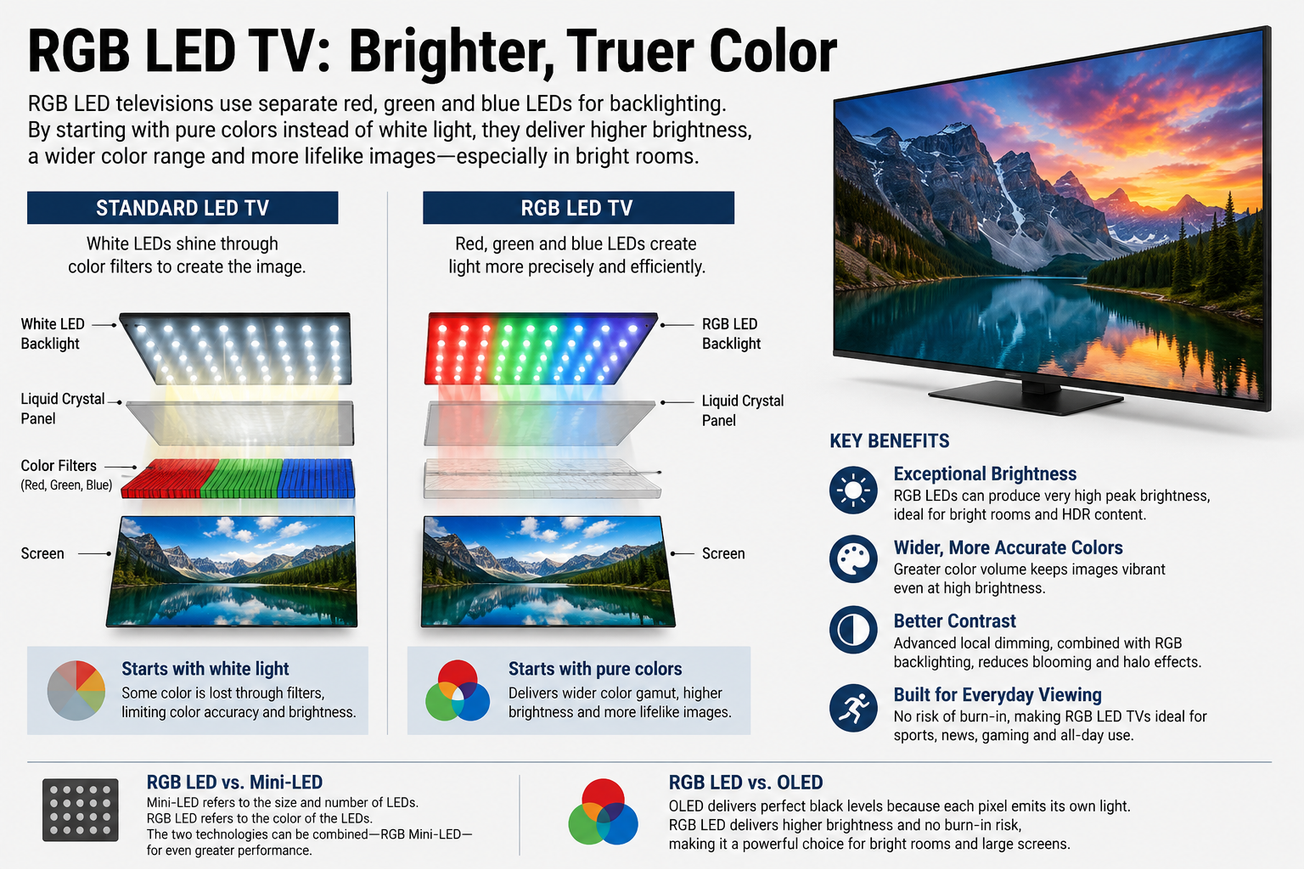
RGB LED televisions are emerging as one of the industry's most intriguing technologies because they address a fundamental limitation that has existed in LCD televisions for years. Instead of relying on conventional white LEDs to illuminate the display, RGB LED televisions use separate red, green and blue light sources. It sounds like a subtle engineering change. In reality, it has the potential to transform how television images are produced.
The difference is remarkably simple. Traditional LED televisions begin with white light that must pass through filters to create color. RGB LED televisions begin with the colors themselves. By generating red, green and blue light independently, the display can reproduce a wider range of colors while maintaining exceptional brightness. The result is a picture that appears richer, more natural and more faithful to the original image captured by the camera.
That improvement matters whether someone is watching the final minutes of a Super Bowl, a Minnesota Twins game on a sunny afternoon, a nature documentary filmed in the Amazon rainforest or a favorite Hollywood film. Grass looks greener without appearing artificial. Skin tones become more lifelike. Bright sunsets retain their subtle shades instead of washing into orange. Snow-covered landscapes reveal detail instead of becoming featureless white fields.
Brightness has quietly become one of the most important measures of television performance. Many homes today feature open floor plans with large windows that flood living rooms with natural light. A television that struggles in a dark home theater may look completely different during a bright Saturday afternoon. RGB LED technology is designed to solve that challenge by producing significantly greater brightness while preserving color accuracy, allowing viewers to enjoy vivid images regardless of the lighting conditions.
Sports fans, in particular, stand to benefit.
Fast-moving action exposes every weakness in a television. Footballs disappear into shadows. Hockey pucks vanish against dark boards. Baseballs become difficult to track during twilight innings. A brighter, more color-accurate display helps preserve the small visual details that make sports enjoyable, particularly on today's increasingly popular 75-, 85- and even 98-inch screens.
Unlike OLED televisions, RGB LED displays also avoid concerns about permanent burn-in, an issue that occasionally surfaces after years of displaying static graphics such as news logos, sports scoreboards or video game interfaces. For households where the television serves as the center of daily entertainment, news, gaming and streaming, that added peace of mind may prove attractive.
None of this suggests OLED televisions suddenly become obsolete. They remain the standard for perfect black levels because every individual pixel creates its own light and can shut off completely. In a dark home theater, OLED still produces an image that many videophiles consider unmatched.
Technology, however, rarely stands still.
The television industry has always advanced through competition rather than permanence. Plasma once represented the future before fading away. Rear-projection televisions filled family rooms before flat panels replaced them. High-definition gave way to 4K, which now shares showroom space with 8K displays. Each generation builds upon the strengths and limitations of the last.
RGB LED appears positioned to become the next chapter in that evolution rather than its conclusion.
Major manufacturers are already investing heavily in the technology because it offers an appealing combination of premium picture quality, exceptional brightness and manufacturing practicality. As production expands and prices decline, RGB LED televisions could become increasingly common in living rooms across America over the next several years.
Consumers need not rush to replace a perfectly good television tomorrow morning. Most current premium displays remain outstanding products capable of delivering years of enjoyment. But anyone planning a new home, renovating a family room or preparing for the next television purchase would be wise to pay close attention to RGB LED as models become more widely available.
The best consumer technology does not overwhelm us with specifications. It quietly disappears, allowing us to become immersed in the game, the movie or the story unfolding before us. The screen itself fades into the background because the image feels effortless and authentic.
That has always been the industry's ultimate goal.
RGB LED technology suggests television manufacturers may be closer than ever to achieving it.