By Michelle Griffith, Minnesota Reformer
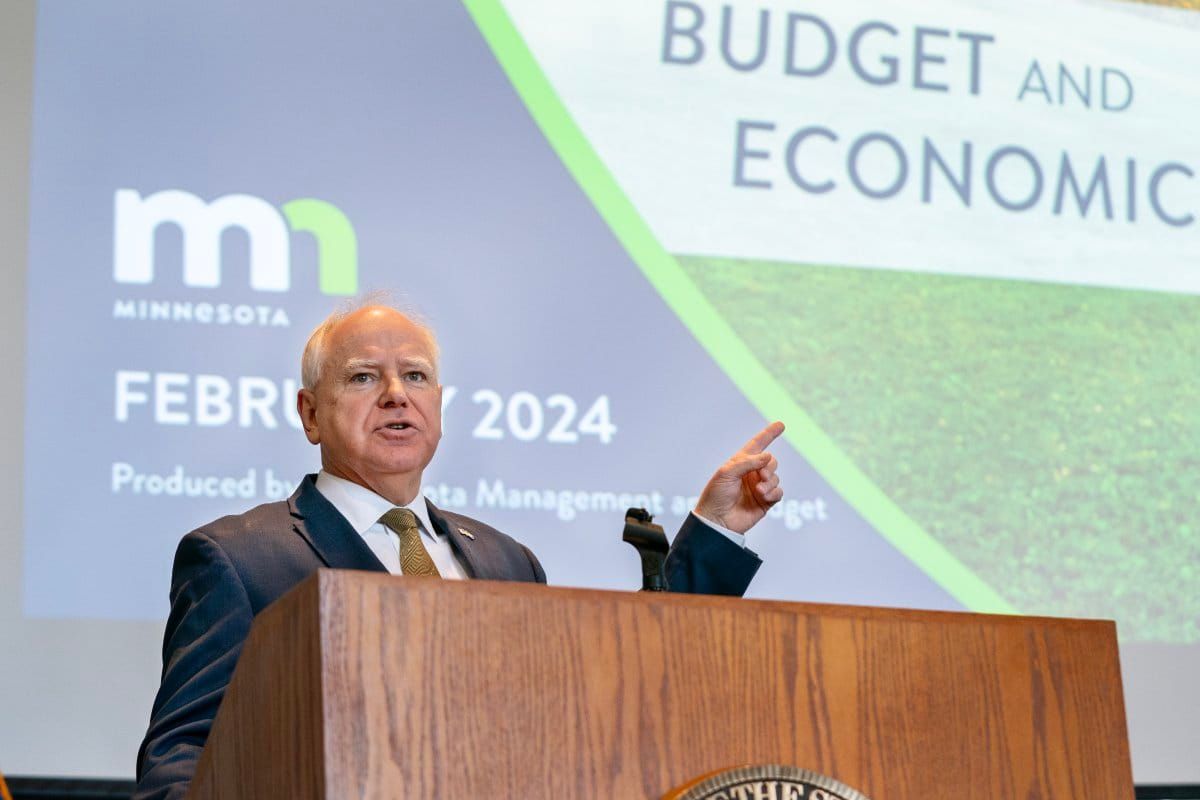
After last year’s ambitious $72 billion, two-year budget, Gov. Tim Walz on Monday released a plan for a relatively lean update, with $226 million in new spending this year.
With an eye toward the November elections, Walz may be taking a tempered approach to assuage the suburban moderates that Democrats need to retain control of the Minnesota House, but he’s unlikely to satisfy progressive lawmakers and advocacy groups hoping for more on child care, education and other priorities.

Lawmakers in even years like this one often pass a supplemental budget, which is an adjustment to the two-year budget they’re required to pass in odd years.
Walz said his proposal for this year’s supplemental budget is intentionally small and will keep Minnesota on “solid fiscal footing.” The Democratic-Farmer-Labor governor also continued to advocate for a $989 million infrastructure package funded with borrowed money, known as a “bonding bill” around the Capitol.
“We captured those generational fixes (last year) and, in many cases, after years of gridlock,” Walz said. “This is a year to focus on bonding, small supplemental and make sure we’re fiscally sound.”

The state’s budget agency projected last month that lawmakers will have a $3.7 billion budget surplus to work with this year. If lawmakers were to take up Walz’s supplemental budget proposal, the state would be sitting on a $2 billion surplus going into the next budget cycle. The state still faces a looming “structural imbalance” in future years, as spending is forecast to outpace revenue, but the $2 billion surplus could cover the projected $1.5 billion imbalance.
Walz was asked why he would leave $2 billion on the bottom line knowing that DFL lawmakers would likely call him a “cheapskate,” as one reporter put it.
“It comes back to the fact that we are not in a budget year. We are in a bonding year, and that we have got a responsible budget and we’re starting to see growth come out of those decisions,” Walz said. “We will have an opportunity when we come back next January in a budget year to flesh those out.”

The DFL-controlled Legislature may use Walz’s plan as a blueprint, but ultimately they get to make the budget decisions, risking only an unlikely veto.
DFL lawmakers so far this 2024 session have proposed a slew of expensive spending proposals, including $500 million for a child care subsidy program and a $120 million infusion for the state’s emergency medical services.
The governor’s supplemental budget includes neither.
Walz’s most expensive item is a new “Child Tax Credit Payment Protection Pilot,” a $45 million program to enhance last year’s child tax credit.

Under this new program, families could opt in to receive advance payments of the child tax credit. Those who qualified for the child tax credit one year would be guaranteed to receive up to 50% of the amount for each child in the next tax year, without a tax penalty even if their income goes up. This means that people who have their income increase from one year to the next won’t have to owe money next tax year because of the credit.
For example, if a mother with two children qualified for the full $3,500 child tax credit one year, and the mother’s income increased so the rate of the tax credit she would receive in the next year would only be $1,000, she wouldn’t have to pay back $750 when she files her taxes.
The idea is to encourage people to advance their careers without fear of losing an important cash benefit.

Walz is also proposing $16 million for emergency ambulance aid. Lawmakers have proposed $120 million. Asked about the difference, Walz said the $16 million was meant to address the most pressing issues first.
“I think the bill that is being proposed addresses the longer term needs. I think those are valid concerns. I think we’re triaging in a non-budget year to deal with the things that need to be dealt with right now,” Walz said.
The governor’s $989 million infrastructure package is funded with mostly general obligation bonds and “focuses on safe drinking water, transportation, housing and critical state infrastructure,” a governor’s office release states.

Minnesota Reformer is part of States Newsroom, a nonprofit news network supported by grants and a coalition of donors as a 501c(3) public charity. Minnesota Reformer maintains editorial independence. Contact Editor J. Patrick Coolican for questions: info@minnesotareformer.com. Follow Minnesota Reformer on Facebook and Twitter.