
Skip to content

City of Duluth labor deals collide with 1% growth, squeezing the 2027 budget

All seven city employee labor agreements were approved after Mayor Roger Reinert took office in January 2024.
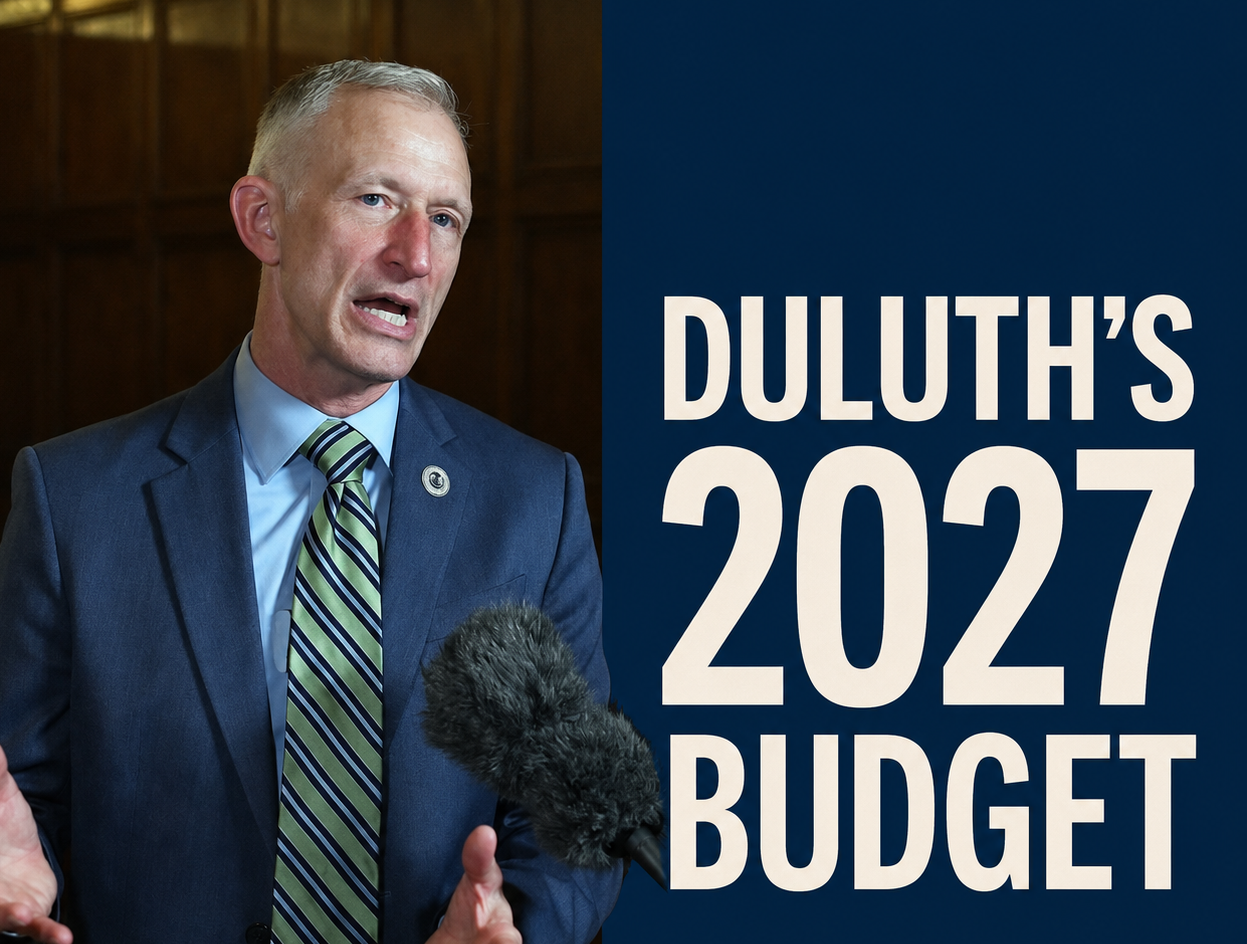
Mayor Roger Reinert’s warning that Duluth revenue is expected to grow only about 1% next year is accurate in a narrow but important sense: It describes growth in recurring General Fund revenue outside property taxes, not growth in the city’s economy.

That distinction changes how the coming 2027 budget debate should be understood. Duluth is not forecasting that its population, jobs, property values or total economic output will rise only 1%. It is forecasting that the major revenue streams City Hall relies on but cannot readily increase — state aid, sales taxes, fees and other recurring income — will barely move while employee and operating costs climb much faster.

Reinert told WDIO that revenue is expected to grow about 1% while expenses rise about 5.5%, leaving a projected $5.5 million shortfall. The city must set its maximum 2027 property-tax levy in September and adopt a final budget by the end of December.

The adopted 2026 budget supplies the underlying math. After subtracting property taxes and a small use of reserves, the city’s long-range forecast shows recurring non-property-tax General Fund revenue rising from about $85.1 million in 2026 to $86.2 million in 2027. That is an increase of about $1.1 million, or 1.3%.

Total General Fund revenue in the same forecast rises much faster, from $113.2 million to $119.2 million, but only because the model increases the property-tax line from about $28 million to $33.1 million. That roughly 18% modeled increase is not an adopted levy. It illustrates how much pressure would fall on property taxes if revenues and expenses otherwise follow the city’s forecast and no equivalent spending reductions or new money are found.

One percentage point on Duluth’s levy raises roughly $455,000, Reinert has said. Covering a $5.5 million gap entirely with property taxes would therefore require the equivalent of about 12 levy points. The mayor has not proposed doing that, and the final gap will change as the city updates revenues, health-care costs, staffing and other assumptions.

Slow growth is not new

A review of Duluth’s adopted budgets shows that roughly 1% growth in comparable recurring revenue is not a new condition created in 2026. The city’s 2025 long-range forecast projected non-property-tax recurring revenue growth of about 0.9% for 2026 and again about 0.9% for 2027. The current forecast is slightly better, but the expense side has continued to accelerate.

Headline budget totals can obscure that history because they include property-tax increases, transfers and one-time money. Duluth’s approved General Fund was about $99.3 million in 2022, $105.9 million in 2023 and $120.1 million in 2024. The 2024 total included $9.2 million from reserves and about $1.9 million in one-time Cirrus Aircraft proceeds, however, leaving an ongoing budget of roughly $109 million.

The General Fund then was set at $109.4 million for 2025 and $113.2 million for 2026, a 3.5% increase in the latest year. More than half of that increase came from property taxes. Looked at on a recurring basis, city revenue has been growing, but much of the growth has come through the levy rather than an expanding stream of sales taxes, state aid or development-related income.

Duluth’s tax-base data tell a similarly mixed story. New construction added 1.43% to the 2026 levy base, below 1.85% in 2025 but above 1.07% in 2023 and 0.92% in 2024. That is modest growth, not a collapse. Rochester reported 1.77% in new-construction growth for taxes payable in 2026, only 0.34 percentage point more than Duluth.

Population and employment comparisons also resist a simple no-growth label. Census estimates show Duluth’s population increased 1.7% from the 2020 census base to July 2025. Rochester grew 2.4% and St. Cloud 4.4%, while Bloomington declined 1%. Duluth is growing more slowly than two of its closest Minnesota peers, but it is not standing still.

The current labor market is weaker. Federal data for May 2026 show total nonfarm employment in the Duluth metropolitan area down 0.9% from a year earlier. St. Cloud also was down 0.9%, Rochester was down 0.1% and Mankato-North Mankato was up 0.2%. Those figures cover regional labor markets rather than city boundaries, but they show that Duluth’s near-term slowdown is real and not unique.

Why the revenue line barely moves

The first reason is Duluth’s revenue mix. Local Government Aid is the General Fund’s largest source, providing about $35.2 million, or 31% of 2026 revenue. The city says LGA historically has increased less than 1% a year, and its current model holds the payment nearly flat. Duluth cannot increase that aid on its own.

The local sales tax, budgeted at about $18.5 million for 2026, has also lost momentum. Collections were about $19 million in both 2023 and 2024 after rising rapidly during the post-pandemic recovery. The 2025 budget assumed $17.6 million and the 2026 budget assumes $18.5 million. Even when collections hold steady in nominal dollars, inflation reduces what those dollars can buy.

Other indicators point in the same direction. The city’s budget says underlying tourism-tax growth was 0.4% from 2023 to 2024 and 1.4% from 2024 to 2025 after excluding a one-time remittance. Permit activity fell 8% in 2024 and another 7% in 2025, while permit revenue declined 2% and then 9%.

The most direct explanation for the expense spike is the city’s recent labor settlements. Salaries and benefits account for nearly 83% of the 2026 General Fund, and the adopted budget calls the new collective bargaining agreements the city’s most significant challenge in coming years. City officials estimate that the agreements will add about $9.9 million in personnel costs over three years. The long-range forecast assumes salary and benefit costs will increase about 6% in 2027, while medical premiums continue rising about 7.5% a year.

The political timeline is unambiguous. Roger Reinert was mayor when all seven current union agreements listed by the city were approved. The police officer and police lieutenant contracts were approved May 13, 2024; the deputy chief and captain contract Aug. 12, 2024; the supervisory agreement Nov. 25, 2024; the basic and confidential agreements Jan. 27, 2025; and the firefighter agreement Aug. 25, 2025. Reinert took office in January 2024. Former Mayor Emily Larson was not mayor when any of those agreements received final approval.

Responsibility does not rest with the mayor alone. The agreements were negotiated and presented by the Reinert administration as city proposals, then required City Council authorization. The basic, confidential, supervisory, police officer and police lieutenant agreements were approved unanimously, according to the certified resolutions; the records reviewed show the other two were adopted. Reinert personally signed the supervisory agreement, and the resolutions authorized the mayor and other city officials to execute the contracts.

The largest agreement is also the most expensive. AFSCME Local 66 represents nearly 500 workers. Its 2025-27 contract raised the base hourly schedule 4.5% in 2025 and 6.5% in 2026, then provides another 6% on Jan. 1, 2027 and 0.5% more on July 1. Compounded, those scheduled increases lift the base rate about 18.6% over three years. Eligible employees at the former top step also received a new 4% step in 2026, which can push an individual employee’s increase higher.

Other contracts vary. Confidential employees received scheduled increases of 4.5% in 2025, 5% in 2026 and 4.5% in 2027, with part of the first-year increase exchanged for reduced sick leave. Firefighters received 2.5%, 3% and 3%, plus a 4% longevity step for qualifying 20-year firefighters. The three police bargaining groups received base increases ranging from about 8.7% to 14.4% compounded over their 2024-26 terms, along with some market, step or duty-pay changes.

Whether those increases were too generous is a political judgment, not a fact the contracts alone can establish. The administration said the AFSCME settlement was needed to recruit and retain employees in a post-pandemic labor market, and the agreement averted a potential strike after union members rejected an earlier city offer. What the records do establish is that the Reinert administration and the council accepted the long-term cost, and the same administration is now citing that cost as a leading cause of the 2027 deficit.

Police and fire alone account for nearly half of General Fund spending, limiting how much can be cut without affecting visible services. Because most current agreements expire at the end of 2027, the city cannot simply reopen the wage schedules to balance next year’s budget unless the unions agree.

Housing and development constraints also matter, although they do not explain the entire budget gap. Duluth’s steep terrain, aging infrastructure, brownfields and limited supply of easy-to-build sites can make projects slower and more expensive. A 2025 housing analysis found vacancy rates of 1.8% in market-rate housing and 1.1% in affordable and subsidized housing, evidence that the city needs more units to support workers and population growth.

Large projects can take years to affect ordinary city revenue. Construction must be completed and placed on the tax rolls, and tax-increment financing can direct some new property taxes to project costs before the broader tax base receives the full benefit. A project announcement in 2025 or a groundbreaking in 2026 therefore cannot be counted on to close a 2027 operating deficit.

The mayor and city are working on growth

It would be incorrect to conclude that no one has been assigned to economic growth. Reinert made expansion of the commercial tax base, housing development and downtown revitalization part of his five-part governing agenda. The city’s Planning and Economic Development Department, the Duluth Economic Development Authority and state and private partners all work on projects, site preparation, housing, business recruitment and financing.

The administration can point to a substantial pipeline. Sofidel is building a major paper-plant expansion expected to add at least 160 jobs. The Lot D redevelopment proposal would add more than 500 housing units and future hotel space on the waterfront if financing, cleanup and construction proceed. New apartment projects, including Lakeview 333, add housing that can support future population and workforce growth.

But the city’s own performance measures show uneven results. Certificates of occupancy for new housing fell from 604 units in 2024 to 110 in 2025, although large-project timing can produce sharp year-to-year swings. Downtown business incentive projects dropped from 26 to 12. Jobs attributed to city economic-development work increased from 43 to 52, and the city set a 2026 target of 60. Construction-permit valuation fell from $375 million to $325 million.

Not every large proposal has survived. Duluth ended its development agreement in 2025 for the proposed 1,300-unit Incline Village project. The cancellation underscored the difference between projects announced, projects financed, projects under construction and projects completed — distinctions that matter when City Hall presents development numbers as evidence of growth.

The record is therefore neither one of inactivity nor of a broad economic breakthrough. Reinert, city staff and development partners have been pursuing growth, and some major investments are real. But many of the largest projects will not generate unrestricted General Fund revenue soon enough to solve the 2027 problem, and several of the city’s most important revenue streams remain outside the mayor’s direct control.

The central budget question is not whether Duluth grew exactly 1%. It did not, by any comprehensive economic measure. The question is whether recurring city revenue can begin to grow faster than roughly 1% without requiring homeowners and businesses to absorb repeated levy increases.

For the 2027 budget, the answer will have to come from some combination of a higher levy, service or staffing changes, new fees, reserve use, updated state aid, stronger-than-forecast sales taxes or recurring reductions. For the longer term, the city will need development that moves from plans to completed taxable property — and does so fast enough to change the math before costs widen the gap again.

Current labor agreements — approval and wage schedule

All seven agreements were approved after Roger Reinert took office in January 2024. Percentages below summarize general, market or specifically identified base-schedule adjustments; individual employees may also receive step, longevity, duty or specialty pay.

Unit

Council approval

Scheduled wage adjustments

Mayor

LELS 363 — police lieutenants

May 13, 2024

3.5% (2024); 2.5% (2025); 2.5% (2026); current employees placed at Step E

Roger Reinert

LELS 538 — police officers

May 13, 2024

3.5% + 1% adjustment (2024); 2.5% (2025); 2.5% (2026); added first-responder pay

Roger Reinert

LELS 503 — deputy chiefs and captains

Aug. 12, 2024

5.5% (2024); 4% (2025); 4.25% (2026), including market adjustments

Roger Reinert

Supervisory association

Nov. 25, 2024

1.5% (2025); 3% (2026); 3.5% (2027), plus new market-based classification system

Roger Reinert

AFSCME Local 66 — basic unit

Jan. 27, 2025

4.5% (2025); 6.5% + eligible 4% step (2026); 6% Jan. 2027 + 0.5% July 2027

Roger Reinert

Confidential employees

Jan. 27, 2025

4.5% (2025); 5% (2026); 4.5% (2027); part exchanged for sick-leave change

Roger Reinert

IAFF Local 101 — firefighters

Aug. 25, 2025

2.5% (2025); 3% (2026); 3% (2027); qualifying 20-year firefighters gain 4% longevity

Roger Reinert

Comments

Latest

Man arrested on fentanyl, methamphetamine sale allegations

A 54-year-old man was arrested Wednesday after investigators said they observed him selling drugs in the 200 block of No. 2 Alley in Downtown Duluth. Michael Clark was booked into the St. Louis County Jail pending charges of second-degree sale of fentanyl and second-degree sale of

Members Public

Hazardous air quality cancels Park Point 5-Miler

The 55th annual Park Point 5-Miler and 2-Mile Walk scheduled for tonight has been canceled because of hazardous air quality in Duluth and surrounding areas. The sold-out event was scheduled to begin at 6:30 p.m. near the Park Point Beach House and had reached its

Members Public