
Listen to this story
Audio reading for accessibility.
Ready to play.
Table of Contents
ST. PAUL, Minn. — The University of St. Thomas has placed a $183 million investment behind its move into Division I athletics, opening a multipurpose campus arena that gives its hockey and basketball programs a permanent home while expanding the university’s ability to stage major sporting and academic events.
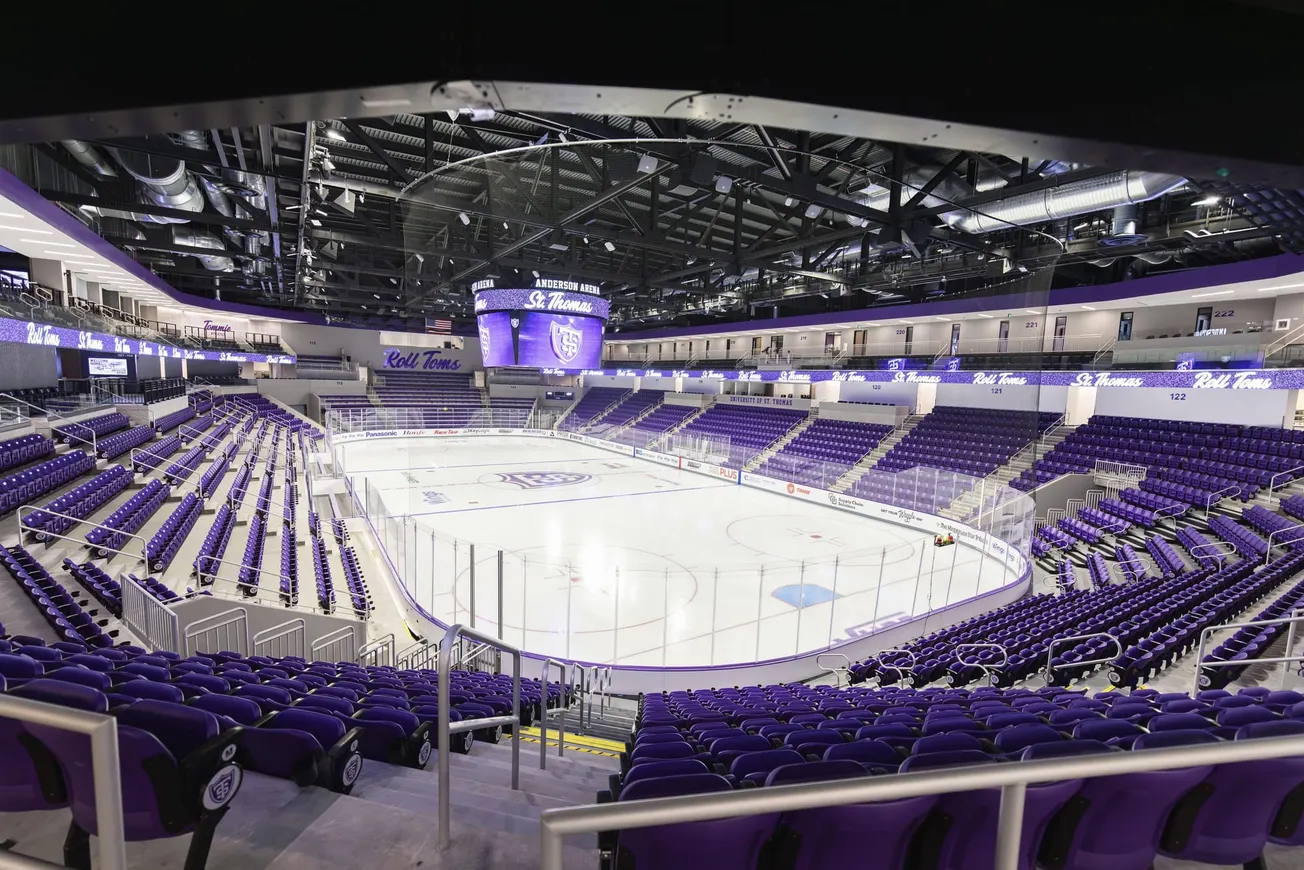
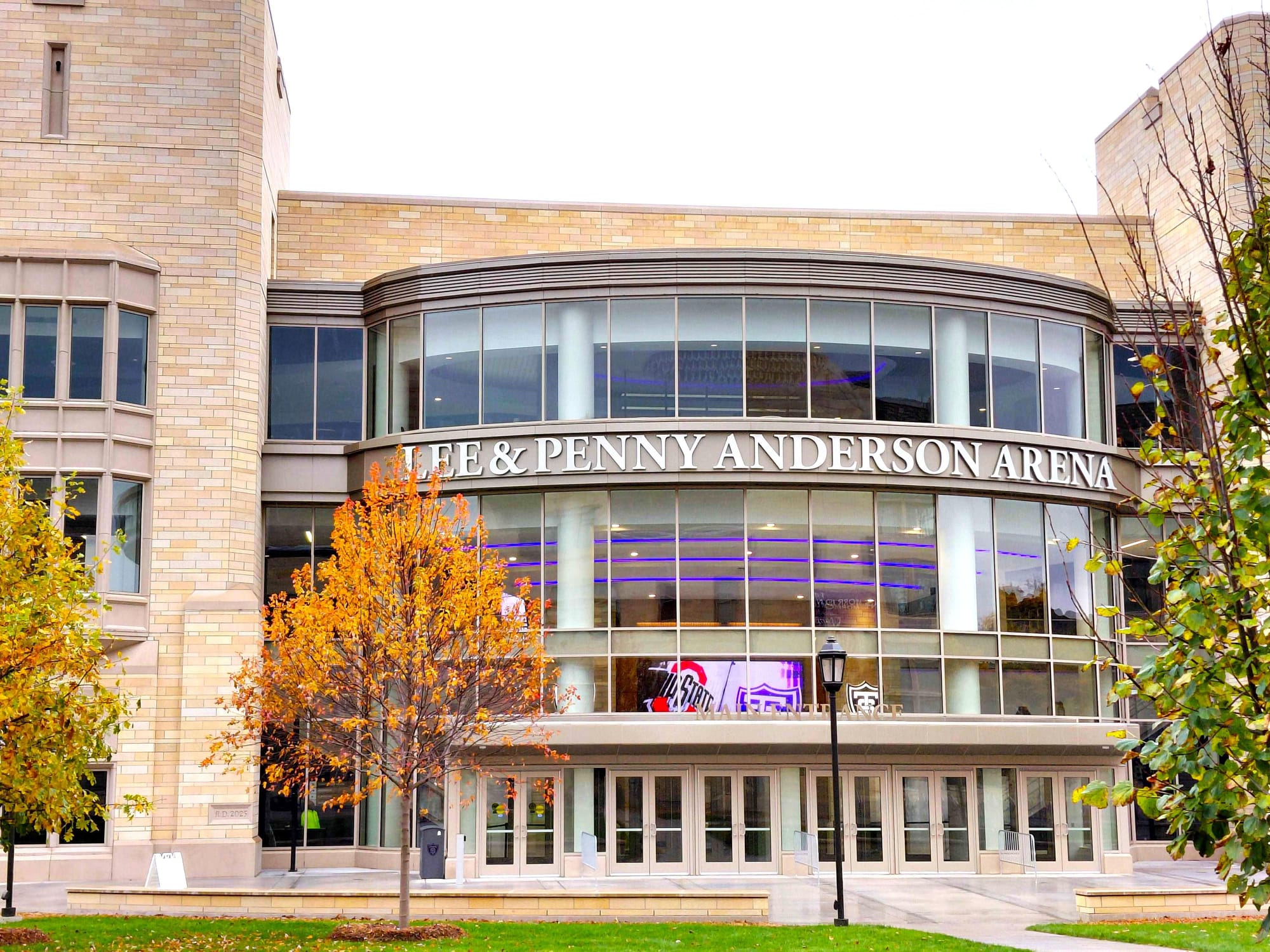
Lee & Penny Anderson Arena opened Oct. 24, 2025, on the university’s south campus in St. Paul. The 253,000-square-foot complex seats approximately 4,000 spectators for hockey, 5,300 for basketball and as many as 6,000 for certain concerts, commencement ceremonies and other events. The university-owned building is located near Summit and Cretin avenues, several miles east of downtown Minneapolis.
The facility is considerably more than a competition arena. It includes a second sheet of ice with spectator seating, two basketball practice courts, locker rooms, team lounges, coaching offices, weight-training and sports-medicine areas, hydrotherapy facilities and expanded nutrition and rehabilitation spaces. It also contains support facilities for the university’s soccer and softball programs.
For spectators, the arena includes a center-hung video board, suites, loge boxes, premium clubs, concessions and a team store. Its Kasota limestone exterior was designed to match the collegiate Gothic architecture found throughout the St. Thomas campus.
The completed project has been listed by St. Thomas at approximately $183 million, an increase from the original $175 million estimate announced in 2023. The university raised more than $131 million for the building through 35 gifts, making it the largest facilities fundraising campaign in school history.
Lee and Penny Anderson supplied the $75 million lead gift. St. Thomas described it as the largest monetary donation ever received by a Minnesota university and one of the 10 largest known gifts to a college athletic program in the country. The university has not publicly provided a detailed breakdown of how the balance of the project cost was financed.
The arena was built as St. Thomas continued its unprecedented transition from Division III to Division I. The NCAA approved the move in 2020 after St. Thomas was removed from the Minnesota Intercollegiate Athletic Conference, where its athletic programs had become dominant. The Tommies began Division I competition during the 2021-22 academic year and became fully eligible for NCAA postseason competition in 2025.
Before Anderson Arena opened, the men’s and women’s hockey programs played at the approximately 1,000-seat St. Thomas Ice Arena in Mendota Heights. The off-campus building was among the smallest used by a Division I men’s hockey program and required players, coaches and students to travel between campus and the rink.
The new arena brought varsity hockey back to the St. Thomas campus for the first time in more than 60 years. The Tommies opened the building with men’s and women’s doubleheaders against Providence. The St. Thomas women lost the first game 7-6 in overtime before winning the second 5-1. The men played Providence to a 2-2 tie in the arena opener and won the shootout.
St. Thomas opened the basketball configuration Nov. 8 with a men’s and women’s doubleheader against Army West Point, the alma mater of Lee Anderson. The Tommies won the men’s game 83-76. The building later attracted a capacity crowd of 5,325 for a men’s basketball game against former Division III rival St. John’s.
Attendance during the arena’s first season demonstrated both its potential and the work remaining to develop a consistent Division I following. The St. Thomas men’s basketball program reported an average home attendance of 2,861, slightly more than half of the building’s basketball capacity. Men’s hockey averaged 2,747 spectators, filling approximately 69% of the available hockey seats.
The arena’s smaller capacity was intentional. St. Thomas designed a campus building that could create a close, loud environment with crowds of 3,000 to 4,000 instead of attempting to fill one of the larger professional arenas in the Twin Cities. The steep student section behind one end of the hockey rink was designed to place students close to the ice and provide the program with a recognizable home-ice identity.
Anderson Arena already has helped St. Thomas attract events beyond its regular home schedule. The building hosted the 2026 WCHA Final Faceoff, the conference tournament for women’s hockey, and has been selected to host the tournament again March 4-6, 2027.
Its importance to the men’s hockey program increases this season. St. Thomas officially joined the National Collegiate Hockey Conference on July 1, becoming the league’s 10th member. The Tommies will play their first NCHC home series Nov. 13-14 against North Dakota, which reached the 2026 Frozen Four.
Omaha, St. Cloud State, Western Michigan, Miami and Arizona State also will visit Anderson Arena during the Tommies’ first NCHC season. St. Thomas will play Minnesota Duluth at Amsoil Arena on Feb. 12-13.
The arena received LEED Silver certification from the U.S. Green Building Council in July. St. Thomas reported that the building was designed to reduce energy costs by 11.9%, while low-flow fixtures, waterless urinals and a connection to the university’s rainwater-retention system reduced indoor and outdoor water use. Construction materials were locally sourced when possible, and waste was sorted to reduce the amount sent to landfills.
The project was not completed without opposition. A neighborhood organization challenged the city of St. Paul’s environmental review, raising concerns about parking, traffic, greenhouse-gas emissions and the effect of large events on surrounding residential streets. The Minnesota Court of Appeals ordered the city to revise its environmental assessment in 2024.
St. Paul completed a second review and again determined that the project did not require a full environmental-impact statement. The Court of Appeals upheld that determination in September 2025, finding that the city had adequately considered the project’s cumulative effects. St. Thomas agreed to monitor attendance, traffic and parking during the arena’s first two years and to use off-site parking, shuttles, public transportation and rideshare incentives for certain large events.
Anderson Arena is not designed to compete with the Xcel Energy Center or other major professional venues. Its importance is more specific: It gives St. Thomas a modern, appropriately sized home as the university attempts to establish itself in Division I hockey and basketball.
The building makes clear that St. Thomas’ move from Division III was not a temporary experiment. The university has built the training facilities, premium seating and on-campus event space required to support its ambitions—and now must develop the attendance and athletic success needed to justify the investment.