
By Christopher Ingraham, Minnesota Reformer
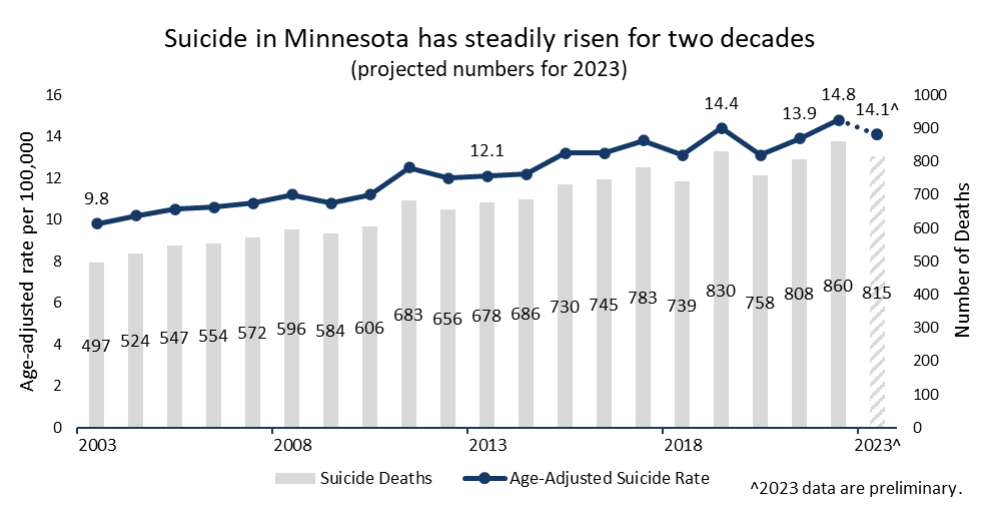
Minnesota’s suicide rate ticked downward in 2023, according to provisional data from from the state Department of Health.
Last year there were 815 suicide deaths in the state, down from 860 the year prior. Adjusting for population, the suicide rate fell from 14.8 deaths per 100,000 in 2022 to 14.1 in 2023.
Whether that decline represents a one-year blip or a durable trend remains to be seen. Like the rest of the country, Minnesota’s suicide rates have been steadily increasing over the past 20 years. The overall state suicide rate remains about one-third higher than it was back in 2003. Data from the Centers for Disease Control and Prevention shows that Minnesota’s suicide rate has closely tracked the national average for many years.
Suicide rates are much higher in parts of greater Minnesota than they are in the Twin Cities metro. In northeast Minnesota counties like Lake and Cook, the suicide rate is three or more times higher than it is in metro counties like Hennepin, Scott or Dakota. Suicide is also relatively uncommon across much of southern Minnesota.
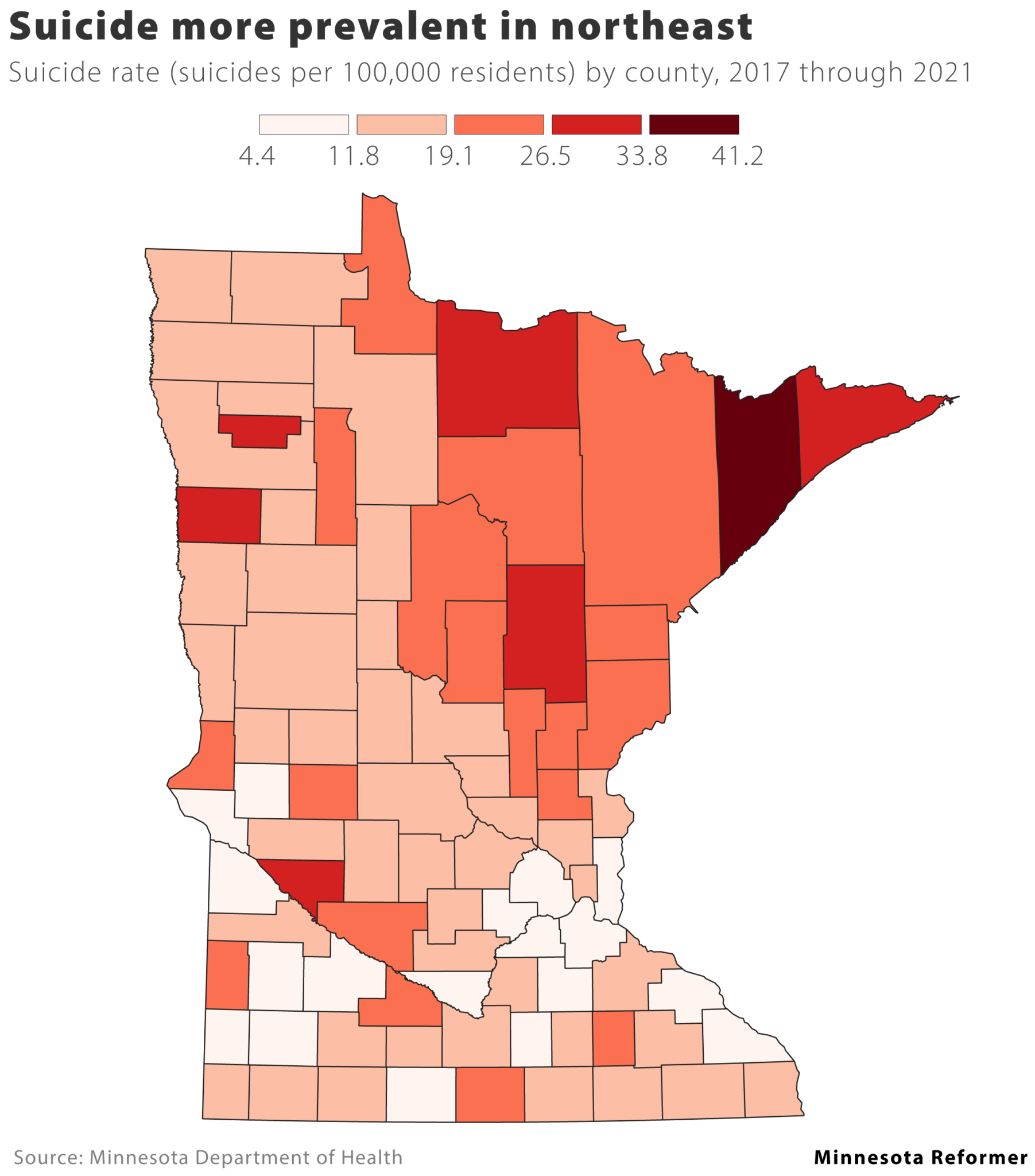
A report earlier this year from the Center for Rural Policy and Development suggested poor access to mental health care, chronic pain from physically demanding jobs, lack of mental health education, stigma around mental health care, and the availability of firearms all factored into higher rural suicide rates.
Suicide rates in Minnesota are highest in middle age, the data show, and between three and four times higher for men than for women. Native Americans are considerably more likely to die from suicide than members of other ethnic groups.
Firearms are involved in nearly half of all Minnesota suicides, reflecting how easy access to guns makes suicide attempts more likely to succeed.
While the role of guns in suicide is a frequent subject of research, another common factor is less studied: alcohol. Close to a third of suicides in Minnesota involve alcohol, according to data previously published by the state. People who commit suicide are roughly twice as likely to have been using alcohol at the time of their death than any other class of drug, and excessive alcohol consumption tends to be more common in upper Midwestern states than elsewhere.
While the data on substance use only goes through 2021, it shows that cannabis is being more frequently used by people who commit suicide. Prior to 2019, marijuana use was typically recorded in fewer than 5% of suicide victims, but by 2021 it was a factor in 16% of suicides. Those numbers track with increasing rates of marijuana use in the state over the same period.
Minnesota Reformer is part of States Newsroom, a nonprofit news network supported by grants and a coalition of donors as a 501c(3) public charity. Minnesota Reformer maintains editorial independence. Contact Editor J. Patrick Coolican for questions: info@minnesotareformer.com. Follow Minnesota Reformer on Facebook and X.