Table of Contents

Howie's daily column is powered by Lyric Kitchen · Bar
ARENA FOOTBALL ONE HAS reached the part of the winter that no fan ever sees, but every successful season depends on.
This is the quiet, grinding stretch where schedules are locked, rosters are hardened, broadcast partners are finalized and front offices find out whether the vision they sold last fall can survive contact with reality.
For the AF1, that work is now largely done.
The league will open its 2026 season April 11–12 with nine teams spread across the country, including two expansion franchises and two returning organizations that bring stability and brand recognition. The master schedule has been published. Training camps are being mapped. Player contracts are being processed. And a combined television and streaming package is expected to be announced before opening weekend.
The Duluth Monsters will join the AF1 starting this spring.

From the outside, it looks like a league simply waiting for kickoff.
Inside, it looks like something far more complicated: a startup maturing into an operating sports league.
The AF1’s most important step this winter was not adding teams. It was publishing a complete, balanced master schedule early enough for teams, sponsors and broadcasters to build around it. In arena football, where travel budgets are thin and venue availability is fragile, the schedule is not just a list of games. It is the spine of the business model.

By getting that done now, the league gave its franchises something they have rarely had in past versions of arena football: certainty.
Teams can sell tickets and sponsorships with real dates. Players can make decisions about relocation and offseason work. Broadcast partners can program windows. And fans, burned by years of folding franchises and disappearing leagues, can finally see something that looks permanent.
That permanence is also why the AF1 chose to move forward with nine teams instead of chasing bigger numbers.
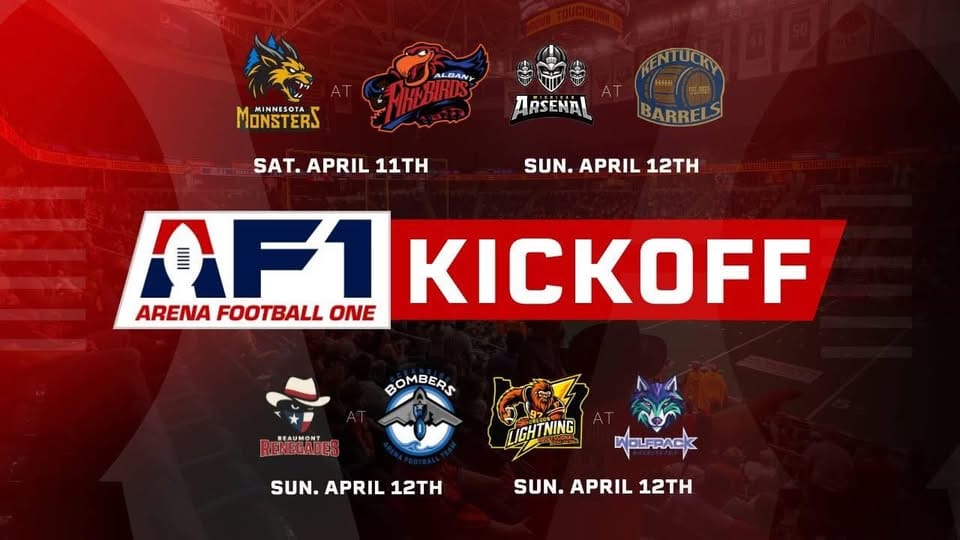
Two expansions give the league growth and new markets. Two established teams give it history, fan bases and operational experience. The rest of the league sits in between, blending startup energy with professional ambition. It is not flashy. It is not risky. It is sustainable — the word that matters most in indoor football.
Behind the scenes, rosters are taking shape in a way that signals another quiet evolution. Teams are no longer throwing together last-minute lineups. They are scouting. They are negotiating. They are targeting quarterbacks, linemen and defensive specialists who fit this league’s faster, more technical version of the game.

The AF1’s 2026 season will not be won by whoever signs the biggest name. It will be won by whoever best understands how to build depth in an 8-on-8 league where one injury can swing a season.
That is why this winter has been filled with small transactions rather than splashy ones. Coaches are filling holes. General managers are stacking practice squads. And owners are finally behaving like long-term operators instead of gamblers hoping to hit a miracle season.
The looming television and streaming announcement may become the league’s most visible milestone yet. It will not just determine how fans watch games. It will determine how sponsors value the league, how players view its legitimacy and how teams recruit talent.

In modern sports, distribution is destiny. The AF1 knows it. That is why it has taken its time assembling a package that combines traditional television reach with the flexibility of streaming. The goal is not to chase one massive deal. The goal is to make every game accessible, measurable and monetizable.
That matters because the league is no longer selling just football. It is selling data, engagement and national visibility to sponsors who want something more than a logo on a dasher board.
What comes next is the hardest part.

From April through the playoffs, the AF1 will have to prove that all this careful winter work translates into packed arenas, competitive games and stable operations. There will be bumps. There always are in arena football. But the league enters 2026 with something it has rarely had before: a credible structure.
Nine teams. A published schedule. A broadcast plan. A national footprint. Those are not the flashy things fans talk about. They are the things that keep leagues alive.
Arena Football One is no longer selling a comeback story. It is selling a season. And for the first time in a long time, it looks ready to deliver one.