Before Duluth taxpayers are asked to pay more to balance another difficult city budget, they deserve a clear accounting of $4,547,400.
That is the amount of recurring annual financial capacity created when Duluth dramatically reduced what its General Fund must provide for retiree health care. It is not money sitting unused in the city's Other Postemployment Benefits trust. It is not a secret account. And it cannot necessarily be swept tomorrow into the General Fund with the stroke of a pen.
But it is real money — $4,547,400 a year — that Duluth taxpayers previously were helping provide for one major obligation and that City Hall subsequently redirected toward capital needs.
That distinction should be near the top of the 2027 budget discussion.
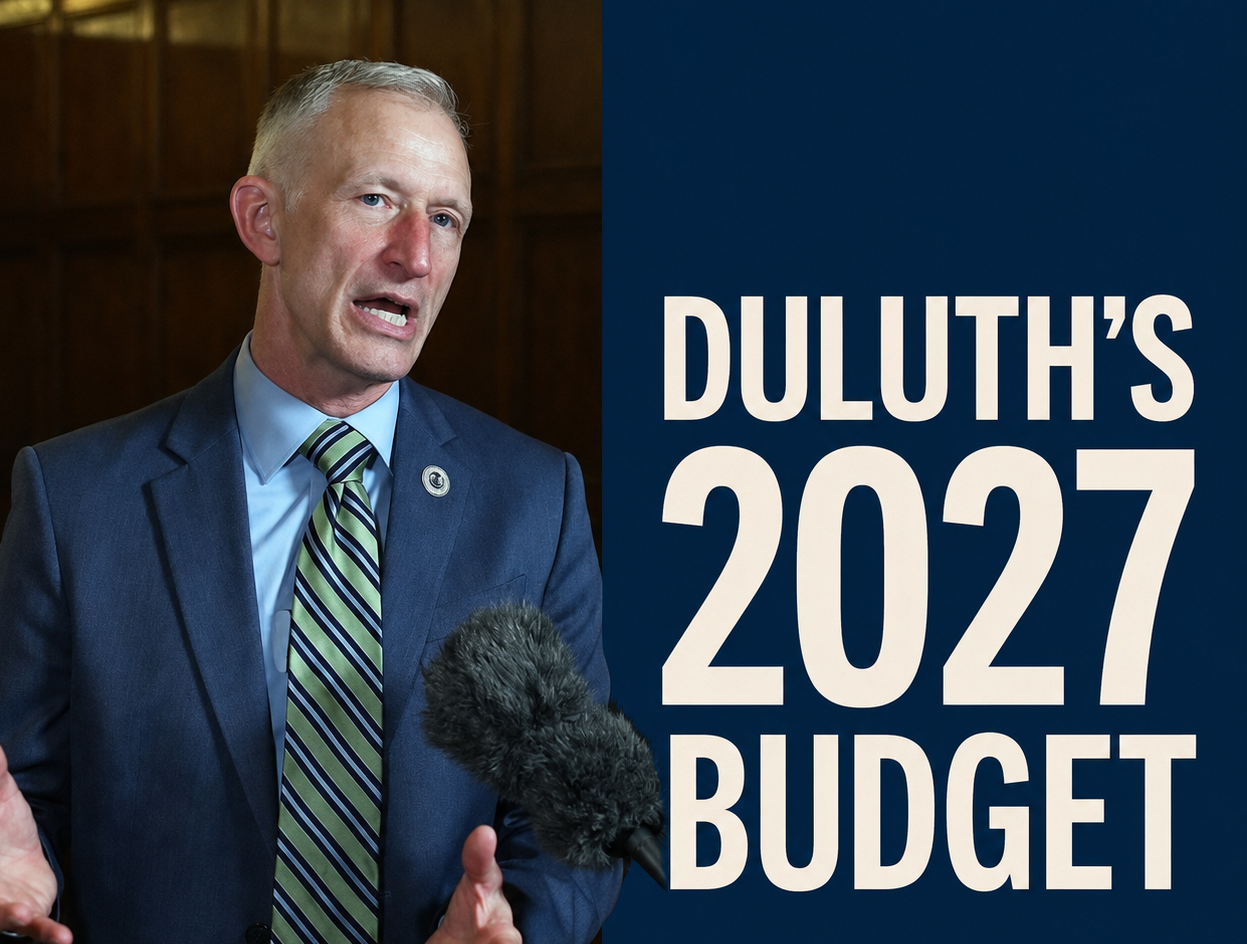
Mayor Roger Reinert is scheduled to present his recommended maximum property tax levy to the City Council's Finance Committee on Sept. 10, followed by the council's budget retreat Sept. 11. Duluth entered this year projecting a $5.8 million General Fund shortfall for 2027 after the council adopted a larger 2026 levy than Reinert had recommended. Reinert now describes the current operating deficit as approximately $5.5 million.
Whichever number becomes the official starting point in the 2027 budget book, the structural problem is substantial. Duluth's expenses have been rising much faster than its recurring revenues. Labor agreements are expected to add approximately $9.9 million in personnel costs over three years, and salaries, benefits, employee medical costs and Fire Department overtime have placed increasing pressure on a General Fund that contained about $113.2 million in ongoing spending for 2026.
Reinert has been consistent about the larger problem.
"The challenges that Duluth faces are real. The math is real," he said during his 2026 State of the City discussion, warning that continuing existing spending patterns ultimately means taxpayers pay substantially more or the city does substantially less.
Fair enough. But the math also includes $4,547,400.

The story began with genuinely good financial news. Duluth spent years building its OPEB trust to meet retiree health-insurance obligations. Strong investment performance and a revised investment strategy allowed the city to reduce substantially the amount it needed to appropriate each year from current revenues. The OPEB trust itself stood at approximately $112 million at the end of 2025 and remains committed to retiree obligations.
That $112 million is not the issue here.
The issue is the recurring General Fund capacity created because Duluth no longer needs to appropriate retiree-health money at its former level. A May 2024 city presentation showed that the General Fund had been budgeting about $7.6 million annually for retiree medical costs and could reduce that amount to roughly $3.1 million. The ordinance ultimately capped the city's annual appropriation at $3.5 million.
Reinert openly proposed what he believed the city should do with the savings. At his April 25, 2024, State of the City address, he said the improved retiree-health position would free approximately $4.5 million beginning in 2025 and recommended using it to finance a consolidated maintenance facility.
"I asked the staff smart enough to find these dollars how we could best use them to support our core city service priorities," Reinert said. "Without hesitation, they said a combined maintenance facility."
The mayor was not hiding his recommendation. But what the City Council actually enacted is important.
On May 28, 2024, councilors adopted Ordinance 24-017-O, later enacted as Ordinance 10884. Its title was bureaucratic enough to make most taxpayers' eyes glaze over: "An ordinance establishing a funding framework that uses both annual appropriations and the OPEB trust fund to pay the cost of other post-employment benefits."
Nothing in that title said the council was establishing a recurring $4.5 million annual capital-funding stream. Nothing in the title mentioned a consolidated maintenance facility.
Yet that was a significant practical effect.
The ordinance provided that beginning Jan. 1, 2025, the reduction in the general-operations share of the levy resulting from retiree health-care savings would be shifted to the capital-project and debt-service portions of the levy and placed in a special-revenue or debt-service fund dedicated to "capital funding needs."

Those words matter: capital funding needs. The ordinance did not specifically say consolidated maintenance facility.
The 2025 city budget, however, was much more direct. It described approximately $4.5 million in General Fund retiree-health savings and stated, "These funds will go towards the long-awaited Consolidated Maintenance Facility."
The 2025 levy contained $4,547,400 for capital funding. The 2026 levy carried another $4,547,400. More than $9 million therefore has been levied through this recurring capital-funding mechanism over two years, although that does not mean $9 million is now sitting untouched in a bank account. Some could be spent, encumbered or otherwise committed.
That is why the first request of Reinert should not be to surrender the money to the General Fund. It should be to account for it. Reinert says he will.
"The 2027 budget book will show the numbers and where the capital improvement fund balance stands," he said, adding that the issue also will be discussed at the council budget retreat.
He strongly rejects the premise that these dollars should be viewed as a reserve for operating expenses.
"These dollars were not set aside as a rainy-day backup to the General Fund," Reinert said. "The City Council dedicated them by ordinance in 2024 for capital needs after we determined the City no longer needed to put nearly $9 million annually toward the outstanding unfunded retiree health-care obligation.
"While the City still has an ongoing General Fund obligation for retirees who earned this benefit, we no longer need to allocate general funds dollars at the previous rate. This was solid work by city leadership to both see and recommend fiscal action."
It was. Getting Duluth into a position where it does not have to continue feeding retiree health care at the previous rate is an accomplishment, not a problem. The disagreement is over what should happen to the savings.
Reinert notes that his administration held the net property-tax impact after new construction growth at zero in 2025, the first such city levy in a decade. He argues that using the retiree-health savings for badly needed capital investment was deliberate fiscal policy, not a budgetary accident.
"Redirecting those dollars to the enormous backlog of aging and deferred capital needs was a deliberate financial decision, and one I continue to strongly support," Reinert said. "As I said in my 2026 State of the City, Duluth has too much of everything, and much of it is too old."

His warning against using capital money to solve an operating problem deserves serious consideration.
"We should not address our current $5.5 million operating deficit by taking money dedicated to capital improvements and using it for ongoing operating expenses," Reinert said. "That simply defers needed and overdue improvements."
The consolidated maintenance project illustrates his argument. Duluth's earlier analysis estimated it would cost approximately $61 million simply to replace separate maintenance facilities at roughly their existing sizes and locations. A later request for proposals used an approximately $75 million overall planning budget covering design, construction, contingencies and putting a new facility into service. That was a planning figure, not a construction bid.
The city's argument for consolidation is legitimate. Its maintenance buildings are aging. Consolidation could provide indoor equipment storage, improve coordination, reduce duplication and address years of deferred maintenance. In December 2024, the council authorized $56,250 for HCM Architects to conduct predesign work, and the 2026 budget said that study was completed in 2025 and identified completing design as a 2026 goal.
"Consolidation of maintenance facility capital assets is a good example: it will eliminate several current failing buildings, provide employees a safer, cleaner and warmer workplace, and make City operations more efficient," Reinert said. "And it is only one of multiple capital needs these funds can address."
Councilor Arik Forsman agrees with the mayor's fundamental position.
"No, I do not believe the council should reallocate the $4.55 million from capital needs to the general fund," Forsman said. "When the council accepted the Finance Department's recommendation to direct retiree health care savings into our capital budget the rationale was strong: Duluth has a significant backlog of aging facilities, fleet, and heavy equipment — like the library, snowplows, maintenance shops, fire halls, etc. The city could increase borrowing to catch up on deferred maintenance, but that would kick the can and place the burden on future taxpayers."
Forsman's alternative is to attack the operating imbalance rather than consume capital resources.
"Instead, the city should once again hold the line, pass a budget at or near inflation, and make the hard choices necessary for long-term fiscal sustainability," he said. "Reallocating those savings to the general fund would be a band-aid."
Forsman identifies what may be Duluth's largest long-term financial problem: expenses rising faster than the city's tax base.
"The root cause of Duluth's fiscal challenges is that our tax base grows at roughly 1% a year while expenses are growing at 5-6%," Forsman said. "We must continue efforts to attract new economic development, such as our recent work modernizing city code to accelerate housing growth, and build our way out of this trajectory, or painful reductions to city services across the board will become inevitable in the future."

That is a powerful argument. Capital neglect is not free. Postponing replacement of failing buildings and equipment merely pushes larger bills into future budgets, often with additional borrowing costs attached.
Councilor Roz Randorf offered what may be the most useful middle ground.
"I am willing to reconsider the allocation," Randorf said, "but I am not willing to pretend that capital investment isn't a core responsibility of the city."
Exactly. Reconsideration does not mean abandonment.
The council could review the policy and conclude that every dollar should remain committed to capital. It could determine the consolidated maintenance facility is the best possible use of the money. It could decide other deteriorating public assets deserve some of it. It could investigate whether Ordinance 10884 should be modified temporarily while Duluth confronts an unusually difficult General Fund year.
The ultimate answer may be no.
But taxpayers are entitled to have the question asked before another levy increase is presented as unavoidable.
There is historical context here that cannot simply be ignored. From the last city levy adopted before Emily Larson became mayor to the final levy adopted during her eight-year tenure, Duluth's city property-tax levy more than doubled, from roughly $20 million to more than $42 million. Retiree health-care obligations were among the significant financial pressures city officials repeatedly had to manage during that period.
For years, taxpayers were told — correctly — that Duluth had expensive obligations that had to be funded. Now one of those obligations can be funded at a substantially lower annual level.
It is therefore reasonable for taxpayers to ask whether at least part of that benefit should eventually flow back to them. Holding a tax increase to inflation may be considerably better than imposing a double-digit increase, but an inflation-sized tax increase is still an increase. If taxpayers helped carry the burden when retiree health-care costs were extraordinarily high, they have every right to ask what relief they should receive when that burden declines.
That does not make Reinert wrong about capital investment. It does not make Forsman wrong about structural deficits. It does not make Randorf wrong that capital investment is a basic municipal responsibility. It means there is a policy choice.
"Importantly, this approach will not require double-digit property tax increases or staff layoffs," he said. "As in the past two budget cycles, a balanced 2027 budget will be achieved through a combination of new growth, an inflation-only levy, and responsible use of existing public resources with which the City has already been entrusted."
That is the mayor's case. On Sept. 10, taxpayers should get to see the numbers behind it.
How much is in the capital fund today? How much of the two years of $4,547,400 allocations has been spent? How much is encumbered? What contractual commitments exist? How much remains available? What does Reinert propose adding in 2027?
Then answer the maintenance-facility questions. What is the current estimated cost? Where will it be located? How far has design progressed? What is the construction timetable? How much would the city have to borrow? How much would consolidation save in future operating and maintenance expenses?
And City Attorney staff should explain publicly what Ordinance 10884 actually permits. If the council wanted to change the allocation, could it? What ordinance or budget action would be required? What commitments already made cannot legally or practically be undone?
The $4.55 million is not hidden. City budgets identify it. The ordinance establishes the funding framework. Reinert publicly advocated the policy from the beginning. The transparency issue is different. There is an enormous difference between putting a number somewhere in a city budget and placing that number squarely before taxpayers as part of a genuine debate over competing priorities.
Duluth needs functioning fire halls, snowplows, maintenance buildings and public facilities. It also needs sustainable city services. And it needs a property-tax structure that residents can afford. Those priorities are now colliding.
So before anyone at City Hall says Duluth taxpayers must pay more, show them the $4,547,400. Show them where it went. Show them what it is buying. Show them what would happen if the policy changed.
Then let the mayor and nine City Council members make their case. The taxpayers already made theirs. They paid the money.