Skip to content

Howie: Reinert must answer Duluth’s $4.5 million budget question

The City of Duluth administration cannot warn taxpayers about a projected $5.5 million deficit while refusing to explain a recurring $4.5 million funding stream redirected from general operations. The account now has nearly $9 million.

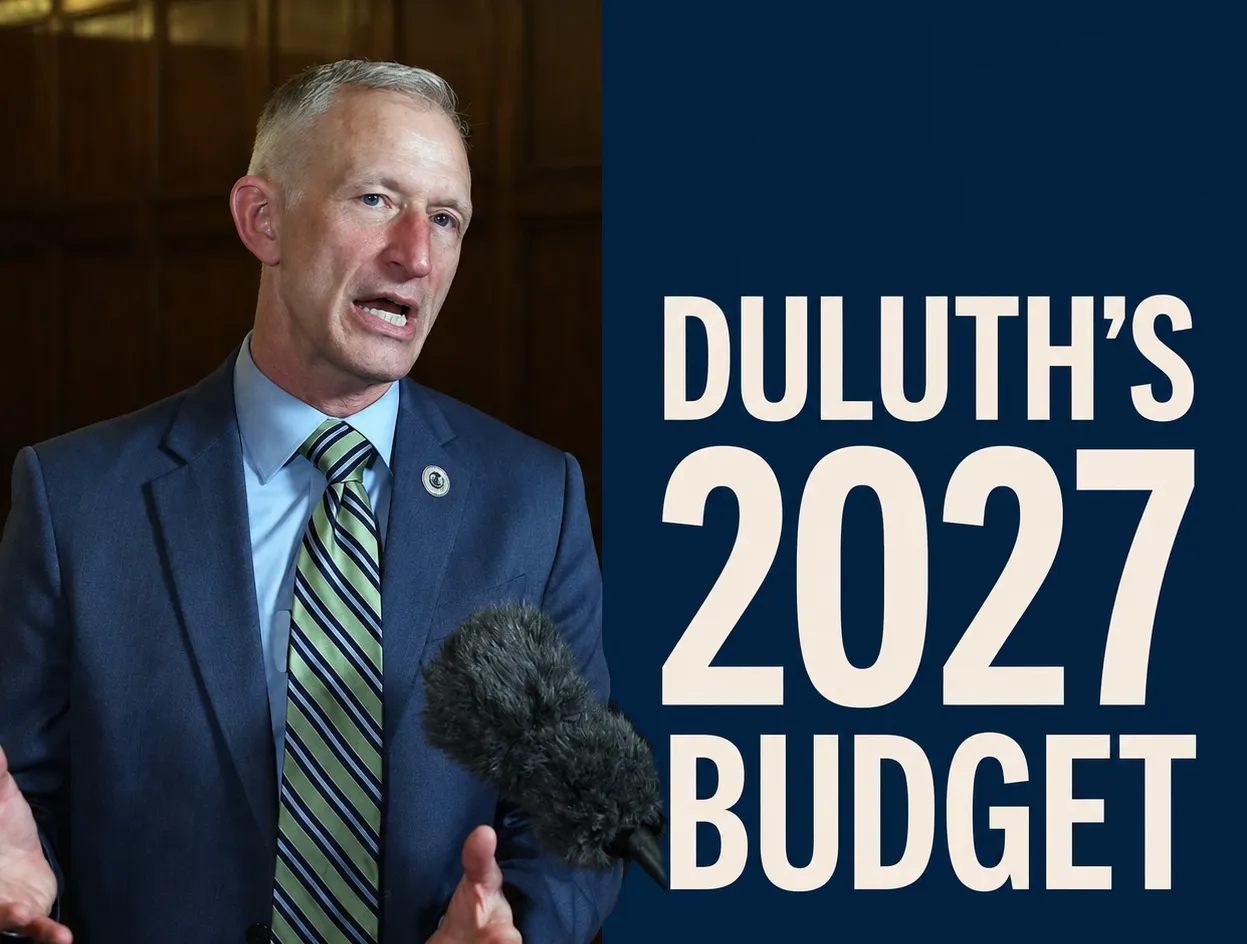
Mayor Roger Reinert’s administration has spent weeks telling Duluth residents that the city is approaching a serious 2027 budget deficit. Revenue is projected to grow by approximately 1% while expenses increase by about 5.5%, producing a projected General Fund shortfall of $5.5 million.

That is the administration’s number. It is not the entire financial story.

HowieHanson.com has reported that the city is realizing approximately $4.5 million in annual savings because of a major change in the way Duluth pays retiree health care costs. The Reinert administration has not publicly responded to that reporting, reconciled those savings with its deficit projection or explained why the money should remain unavailable for the 2027 operating budget.

Its silence is no longer acceptable.

The $4.5 million figure did not come from a political opponent, an anonymous critic or speculative accounting. It came directly from the City of Duluth’s own budget documents.

Duluth established an irrevocable trust in 2007 to help pay its enormous retiree health care obligation, formally known as other post-employment benefits, or OPEB. Years of contributions and investment earnings built that trust to $107.2 million by the end of 2024. The city’s 2026 budget reports that the trust had grown to approximately $112 million by the end of 2025.

That financial progress allowed Duluth to fundamentally change its retiree health care funding formula. Under an ordinance approved in May 2024, the city reduced the annual amount paid through its regular appropriation process from as much as $9 million to $3.5 million. Retiree health care costs above $3.5 million are now paid from the OPEB trust.

The result is stated plainly in the city’s own 2026 budget: Reducing the annual appropriation to $3.5 million saves the General Fund approximately $4.5 million every year. The city’s audited financial report and adopted budget confirm the reduced obligation and the strength of the trust.

What happened to those savings?

They were not allowed to remain in the General Fund to support police, fire protection, libraries, streets and other basic services. Ordinance 24-017-O directed the 2024 savings into a special revenue fund dedicated to capital needs. Beginning in 2025, the ordinance required the reduction in the general-operations share of the property tax levy to be shifted into the capital-project and debt-service portions of the levy.

The administration did not eliminate the taxpayer-supported funding capacity. It reassigned it.

The 2025 budget made that decision unmistakable. It reported that $4.53 million in retiree medical insurance savings had been “realized and repurposed” for the proposed consolidated maintenance facility. The city reduced the general-operations levy and simultaneously created a $4,547,400 capital-funding levy. The budget described the move as transferring retiree health care savings from general operations to capital projects or debt service.

That same $4,547,400 capital-funding levy was continued in the 2026 budget.

This is the missing context in Reinert’s public deficit narrative. Duluth did not simply lose $5.5 million of operating capacity. City Hall made a policy decision to take approximately $4.5 million in recurring retiree health care savings and dedicate the equivalent property tax capacity to capital spending.

That may have been a defensible decision when it was made. Duluth has substantial deferred maintenance needs, and a consolidated maintenance facility may ultimately be a worthwhile investment. Capital projects cannot be ignored indefinitely without creating larger costs.

But capital spending is still a policy choice. It does not become untouchable merely because an earlier council placed it in another section of the levy.

If the city can reconsider parks, facilities, staffing levels, library services, administrative salaries and the property tax levy to address the 2027 deficit, it can reconsider how much of this $4.5 million should remain dedicated to capital projects. The ordinance can be amended. The levy can be restructured. The maintenance-facility schedule can be reconsidered. Capital work can be phased.

Nothing about this funding decision descended from the sky.

The mathematical comparison demands an answer. The city says it faces a $5.5 million General Fund deficit. The recurring capital-funding levy created from the retiree health care savings is $4,547,400. That is more than 82% of the projected shortfall.

If all of that capacity were temporarily returned to general operations, the remaining gap would fall below $1 million. The city would still need to control expenses, address rapidly rising personnel costs and make difficult decisions. But it would not be confronting the fiscal emergency now being presented to taxpayers.

The city’s deficit exists under its current allocation choices. That is materially different from saying Duluth simply does not have the money.

The distinction matters because property owners will soon be told what the administration believes they must pay in 2027. Reinert will present a proposed budget, the council will establish a maximum preliminary levy and residents will again hear that expenses are rising faster than revenues. Department heads may warn about service reductions. Councilors may describe a tax increase as unavoidable.

Before any of that occurs, the administration must answer several basic questions.

How much money is currently held in the special revenue fund created for capital needs? How much of the 2024, 2025 and 2026 funding has been spent, contractually committed or reserved? What is the current estimated cost of the consolidated maintenance facility? What portion of its funding has been secured? Could the project be delayed or constructed in phases? Is any part of the $4,547,400 legally obligated to existing debt, or could the council redirect it through an ordinance and levy change?

Most importantly, why was this recurring financial capacity omitted from the administration’s public explanation of the projected $5.5 million deficit?

The city’s own Finance Department appears to recognize that the issue is unresolved. One of its stated 2026 goals is to “develop a long-term plan for the spending of the annual OPEB funding savings.” That language appears in the adopted 2026 budget.

If the long-term spending plan is still being developed, the administration cannot simultaneously pretend that the money is unavailable for discussion.

Reinert may disagree with the conclusion that some or all of the funding should be returned to general operations. He may argue that the maintenance facility is urgent, that capital spending will prevent larger future expenses or that changing the funding framework would represent poor long-term planning.

Then he should make that argument publicly and support it with numbers.

He should not continue presenting the $5.5 million deficit as an unavoidable financial fact while ignoring the $4.5 million policy decision sitting beside it.

HowieHanson.com first raised this issue because Duluth residents deserve the complete budget picture. They deserve to know not only how much the administration says it lacks, but also how much recurring capacity it has redirected, where that money is going and what alternatives are available.

A budget is not merely an accounting document. It is a declaration of priorities. Duluth’s 2027 deficit discussion must therefore include the decision to place retiree health care savings into capital funding while warning residents that general operations are running out of money.

The administration’s silence does not answer the question. It makes the question more important.

Before Reinert asks residents to accept another property tax increase or another round of threatened service reductions, he must explain Duluth’s recurring $4.5 million. The money did not disappear. City Hall moved it. Now City Hall must tell taxpayers why it cannot be moved again.

Comments

Latest

Chloe Johnson’s national profile grows with elite summer invitations
Chloe Johnson. Howie / HowieHanson.com

Chloe Johnson’s national profile grows with elite summer invitations

Johnson has spent much of the summer competing for All Iowa Attack’s 17U team, regularly playing against athletes two and three years older. At the Nike Tournament of Champions West from July 10-13 in Las Vegas, Johnson averaged 13.7 points, 5.3 rebounds and 4.7 assists over six games.

Members Public