Table of Contents
Downtown Duluth’s five-year revitalization effort is moving from public discussion to a difficult execution phase built around 1,500 new homes, a downtown development corporation and a coordinated system for addressing homelessness.
Downtown Duluth released a community update Thursday detailing the early work of Imagine Downtown, an ambitious plan addressing housing, public safety, homelessness, business development and public spaces. The organization said four working groups are carrying out the plan, but some of its largest initiatives remain in development and will require substantial public, private and nonprofit support.
The central housing proposal calls for creation of a downtown development corporation that could develop property, assemble a pipeline of projects, work with private developers and direct long-term capital toward projects that otherwise would not be financially viable.
The corporation would be expected to lead the effort to add 1,500 residential units downtown, with housing for residents across a range of incomes. The update did not identify a startup budget, funding commitments, governing structure or timetable for establishing the corporation.
The housing group also is examining legislative changes that could reduce development barriers, implementing recommendations from the Duluth Housing Study and planning a housing summit for November.
The scope of the housing goal reflects the depth of the problem. The presentation said Duluth’s affordable-housing vacancy rate stands at 1.1% and more than half of the city’s renters spend over 50% of their income on housing.
Imagine Downtown also outlined a sweeping realignment of services provided by Union Gospel Mission, the Damiano Center and CHUM. Under what the organizations are calling the Pathway Forward Plan, the three longtime nonprofits would operate as a more coordinated system moving people through outreach, triage, shelter, stabilization and permanent housing.
The proposal is intended to expand the system to more than 300 sleeping spaces tailored to different needs and barriers, add 46 permanent supportive-housing units and coordinate three daily meals across the three locations.
The organizations say the changes are needed as chronic homelessness in St. Louis County has increased 157%. The model is designed to reduce duplicated services, improve public accountability and relieve some of the pressure homelessness places on downtown businesses and first responders.
The first phase, covering 2025 and 2026, focuses on planning, fundraising and aligning administrative operations. The second phase, scheduled for 2027 and 2028, calls for CHUM to move toward more private and semi-private shelter accommodations and expand emergency housing for families.
That phase also calls for stronger follow-up services intended to keep people housed after placement. The Damiano Center would expand on-site services while maintaining space for a 120-bed congregate shelter.
The third phase, planned for 2028 and beyond, would include relocating Union Gospel Mission, opening an integrated triage and warming center and adding 40 permanent supportive-housing units. Meal production would be centralized at the Damiano Center and distributed among the three sites.
The update did not provide an overall cost estimate or identify secured funding for the full Pathway Forward initiative.
Other public-safety work is already underway. Imagine Downtown said partners have mapped social-service providers, strengthened coordination and increased some enforcement efforts. A needle-collection program is in progress, and free public health and safety classes are expected to begin this fall. Topics will include the use of naloxone, commonly sold under the brand name Narcan, and basic mental-health response.
The plan also calls for an expanded Clean and Safe Team and greater cooperation among city administrators, police, firefighters, St. Louis County officials, property owners and service providers. Its stated objective is to improve access to help for vulnerable residents while strengthening the public’s perception of safety.
Economic-development work has produced more modest but measurable early results. Seven new retail businesses opened downtown in 2026, according to the update.
The business working group is developing a survey for downtown businesses and preparing a broader attraction and retention strategy. It also plans to resume downtown business pop-ups next summer and is identifying potential spaces for small-business incubators.
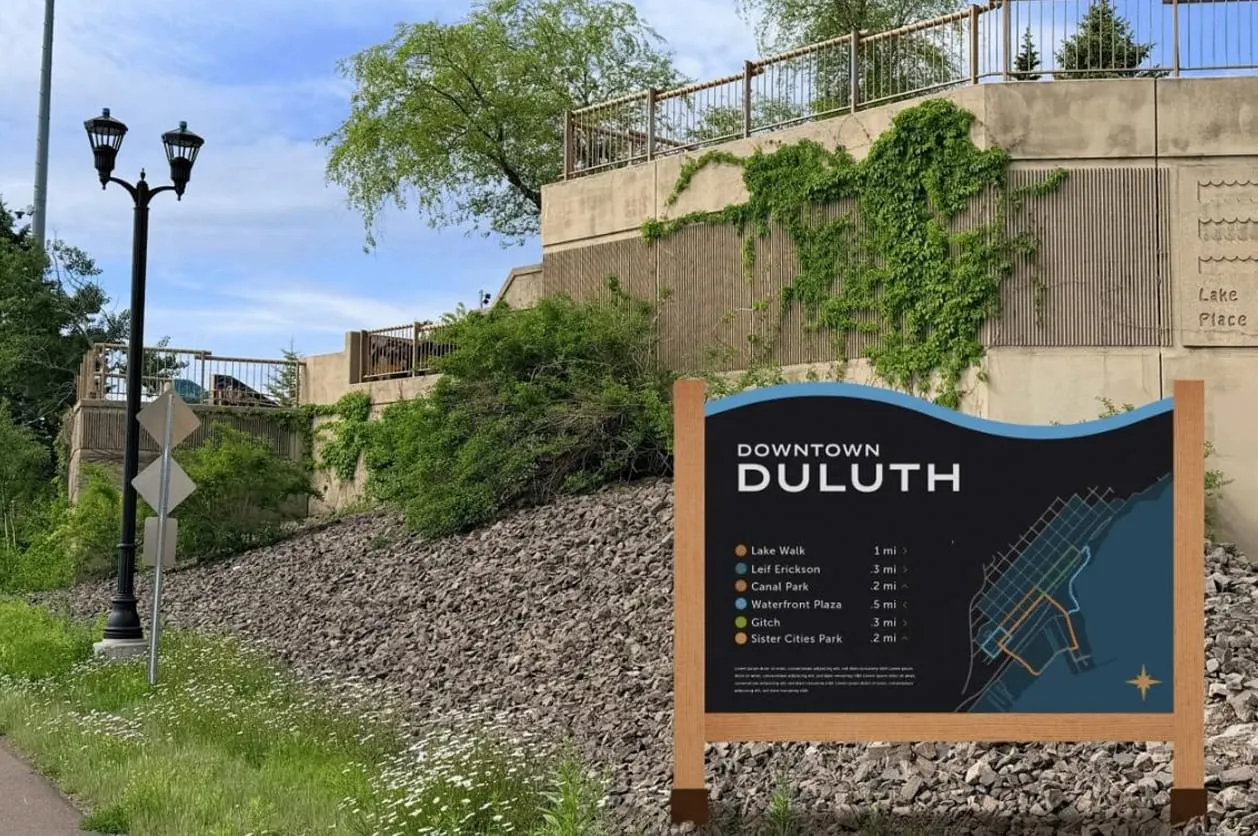
Public-space proposals include a new Downtown Duluth identity, permanent and temporary wayfinding signs, trail markers, improved bicycle and pedestrian connections and a stronger link between downtown and Canal Park.
Concepts presented Thursday include monument signs marking transitions between downtown neighborhoods, directional arrows for businesses and attractions, a Lake Avenue trail station and improvements to the Northwest Passage skywalk connection between downtown and the Duluth Entertainment Convention Center.
The plan also proposes murals inside skywalks, using Northland scenery, seasons, landmarks and culture to make the system more welcoming and recognizable. Temporary signs could be attached to existing light poles while the city and its partners work toward permanent installations.
Some activation work has already begun. First Street Fridays and related grants brought events and activity to First Street, and new Christmas lights have been purchased for downtown. Organizers also are promoting events including Chalk It Up and a proposed SkyRun 5-kilometer race through the skywalk system.
Imagine Downtown was built from more than 18 focus groups, interviews and walking tours, 1,529 online survey responses, 51 ambassador questionnaires, five steering committee meetings and three community open houses.
That process produced a broad community vision. Thursday’s update made clear that its success will now depend on whether the participating organizations can establish the development corporation, finance housing and service expansions and turn conceptual public improvements into completed projects.