Table of Contents
Duluth Public Schools has a serious financial problem. That much is clear from its own financial records. What deserves much closer scrutiny, however, is how the district is explaining that problem to taxpayers as it asks voters to approve two referendum questions on Nov. 3.
Among the explanations the district has offered for its continuing financial difficulties is that state funding has not kept pace with inflation. That is a powerful argument in a referendum campaign because it places a substantial portion of the responsibility outside the district. The implication is straightforward: Duluth schools are struggling financially because the state has failed to increase its support sufficiently as costs have risen. But when the district's own audited financial statements are examined over the last five completed fiscal years, the actual flow of state money into Duluth Public Schools tells a considerably more complicated story.
Total state-source revenue across the district's governmental funds was $91.04 million in fiscal 2021. It increased slightly to $91.44 million in fiscal 2022, climbed to $95.38 million in fiscal 2023, jumped to $110.37 million in fiscal 2024 and reached $115.06 million in fiscal 2025. From fiscal 2021 through fiscal 2025, state-source revenue increased by approximately $24.02 million. That represents an increase of about 26.4%.
That is a substantial increase in state financial support.

The same pattern appears when the examination is narrowed to the General Fund, which is particularly important because that is where the district pays most of the everyday costs of operating the school system. State-source General Fund revenue increased from approximately $86.25 million in fiscal 2021 to approximately $107.45 million in fiscal 2025. That is an increase of roughly $21.2 million, or 24.6%, in four fiscal-year intervals.
Those numbers matter because they provide important context to the district's claim that state funding has failed to keep pace with inflation. Consumer inflation over approximately the same period was considerably less than the cumulative percentage increase in the state-source revenue actually received by Duluth Public Schools. The national Consumer Price Index increased approximately 19% between the 2021 and 2025 annual averages. Duluth's total state-source governmental revenue increased approximately 26.4%.

That does not mean state education funding has been generous in every respect, nor does it mean every Minnesota education funding formula has kept pace with the rising cost of operating schools. There is an important distinction here, and it deserves to be explained clearly.
Minnesota's basic general education formula allowance increased from $6,567 per pupil in fiscal 2021 to $6,728 in fiscal 2022, $6,863 in fiscal 2023, $7,138 in fiscal 2024 and $7,281 in fiscal 2025. That represents an increase of approximately 10.9%, significantly below cumulative inflation during that period. A statement that Minnesota's basic per-pupil funding formula failed to keep pace with inflation over those years is supported by the numbers.
But that is not the same thing as saying state funding to Duluth Public Schools failed to keep pace with inflation.
State funding to a school district consists of considerably more than the basic formula allowance. It includes special education funding, categorical aid, various reimbursements and credits, and other state programs. Those additional funding streams are precisely why the amount of state-source revenue reaching Duluth increased much faster than the basic formula itself.
That distinction should not be buried in a referendum discussion involving millions of dollars and a decade-long commitment from Duluth taxpayers. If the district means that the basic education formula has failed to keep pace with inflation, it should say exactly that. If it means particular state funding formulas have failed to cover particular categories of rapidly increasing costs, it should identify those formulas and costs. A sweeping statement about "state funding" creates a much different impression when the district's audited books show state-source revenue rising from about $91 million to more than $115 million.

The greater concern revealed by the financial statements is not whether Duluth Public Schools received additional revenue. It did. The larger problem is what happened to expenditures while that additional money was arriving.
General Fund revenue increased from approximately $118.86 million in fiscal 2021 to approximately $140.89 million in fiscal 2025. That is an increase of about $22 million, or roughly 18.5%. During the same period, General Fund expenditures increased from approximately $110.79 million to approximately $153.21 million. That is an increase of more than $42 million, or about 38.3%.
That is the number that should command taxpayers' attention.
Spending increased at more than twice the percentage rate of General Fund revenue during that period.
In fiscal 2021, Duluth Public Schools collected approximately $118.86 million in General Fund revenue while spending approximately $110.79 million. Before other financing activity, revenues exceeded expenditures by more than $8 million. Four years later, revenue had increased substantially to approximately $140.89 million, but expenditures had risen even faster, reaching approximately $153.21 million.

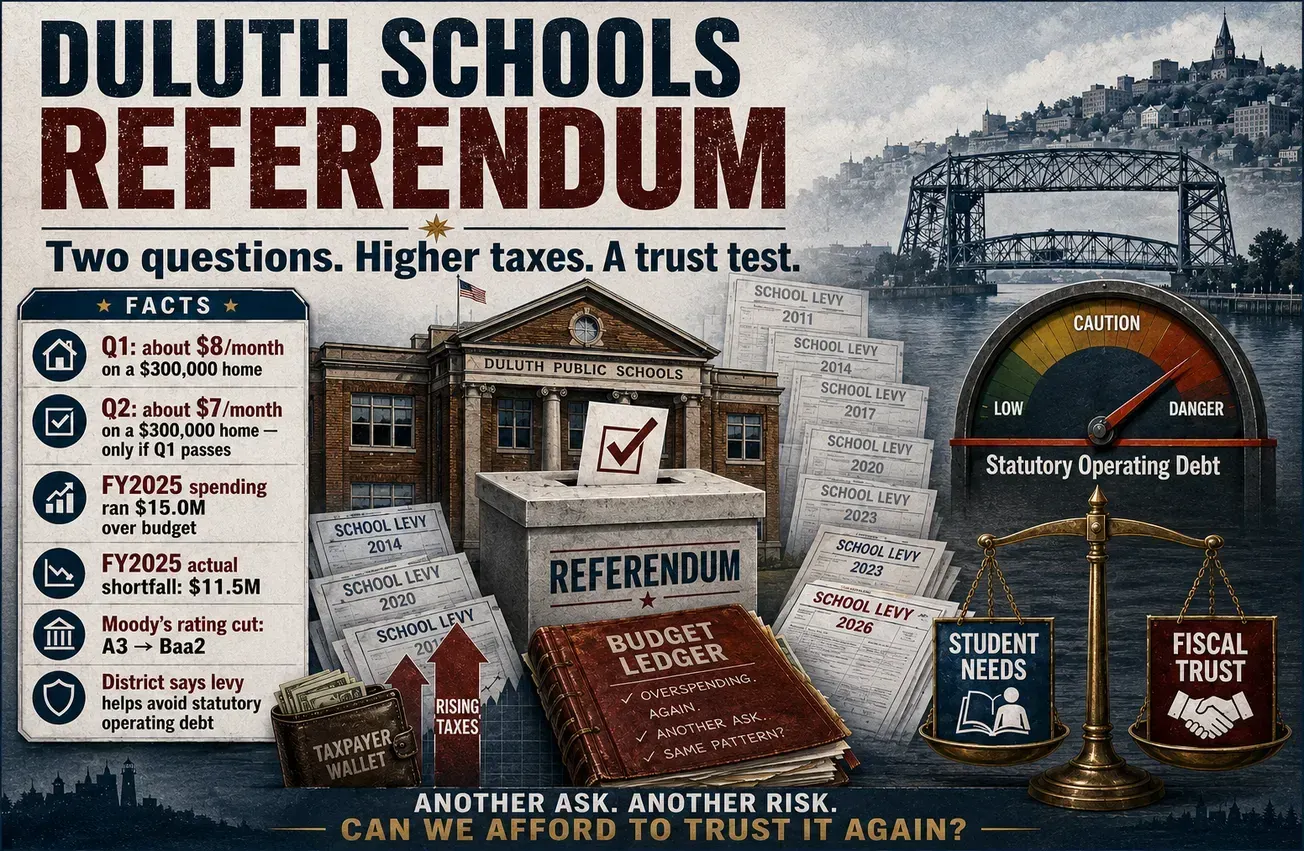
The resulting fiscal 2025 operating gap before other financing activity was approximately $12.33 million.
After other financing activity was included, the General Fund balance declined by approximately $11.53 million during fiscal 2025 and finished the year at roughly $8 million. The district had expected a much smaller deficit in its revised budget. Instead, expenditures and other financing uses significantly exceeded projections, with special education and transportation among the major cost pressures.
Those are serious financial warning signs. They deserve a serious public discussion.
The problem has not disappeared. The district's adopted fiscal 2027 budget projects approximately $154.32 million in General Fund revenue and approximately $158.18 million in expenditures, leaving a projected deficit of about $3.86 million even after millions of dollars in budget reductions. The district's credit rating also has been downgraded as continuing operating deficits, shrinking reserves and rising expenses have increased financial pressure.
None of this should be minimized.
But neither should the financial deterioration be explained simply by suggesting the state failed to provide substantially more money. The state did provide substantially more money. State-source governmental revenue increased by approximately $24 million between fiscal 2021 and fiscal 2025. State-source General Fund revenue increased by approximately $21 million. Yet General Fund expenditures increased by more than $42 million.

That is the financial equation Duluth taxpayers deserve to have explained.
Where did the additional money go? Which expenses increased most rapidly? How much of the increase resulted from special education? How much came from transportation? How much came from salaries, benefits, insurance and contractual obligations? Which costs were unavoidable, which were mandated and which resulted from local budgeting decisions? How much of today's structural deficit can reasonably be attributed to inadequate state formulas, and how much results from district spending increasing far faster than overall revenue?
Those questions are far more useful than a broad statement that state funding has not kept pace with inflation.
There also is another important point of fairness. State revenue did not exceed inflation every single year. Fiscal 2022, in particular, came during an extraordinary inflationary period while Duluth's state-source revenue was essentially flat. The significant increase in state aid came later, particularly between fiscal 2023 and fiscal 2024. It would therefore be equally inaccurate to suggest that Duluth schools enjoyed state funding increases greater than inflation every year.
But over the full fiscal 2021-through-2025 period now available in audited financial statements, the cumulative numbers are difficult to ignore: state-source revenue increased about 26.4%, while consumer inflation increased roughly 19%.
That is why precision matters.

Duluth Public Schools can accurately say its basic per-pupil formula failed to keep pace with inflation over that period. It can accurately say some operating costs have risen faster than revenues. It can accurately say special education and transportation have placed substantial pressure on its budget. It can accurately say continuing deficits and shrinking reserves have created a serious financial problem.
But those are narrower and more informative statements than simply telling taxpayers that state funding has not kept pace with inflation.
The district's own numbers show $91 million in state-source revenue becoming $115 million.
They show General Fund state revenue increasing from approximately $86 million to more than $107 million.
And they show General Fund expenditures increasing from approximately $111 million to more than $153 million.
Put those three numbers next to one another and the central financial question becomes much clearer.
Duluth Public Schools did not arrive at its current financial condition because its revenues stood still. They didn't. Revenue increased substantially, including state revenue. The problem is that spending increased much faster.
That does not by itself tell voters what decision to make on Nov. 3. It does tell them what information they should demand before making it.
A referendum seeking additional public money should begin with a complete accounting of the money already received, how rapidly that revenue increased, how rapidly spending increased and why the gap between the two became so large.
Duluth taxpayers deserve that full accounting.
Especially when the district is asking them for more.