Table of Contents
Duluth Public Schools will need to cut $5 million from its 2027-28 budget even if voters approve both operating levies on Nov. 3. If both questions fail, the district projects $12 million in reductions over two fiscal years, the equivalent of about 120 positions. The figures, released by the district Thursday, put the referendum in stark terms: More money would spare schools some of the deepest cuts, but it would not end the district’s financial problem.
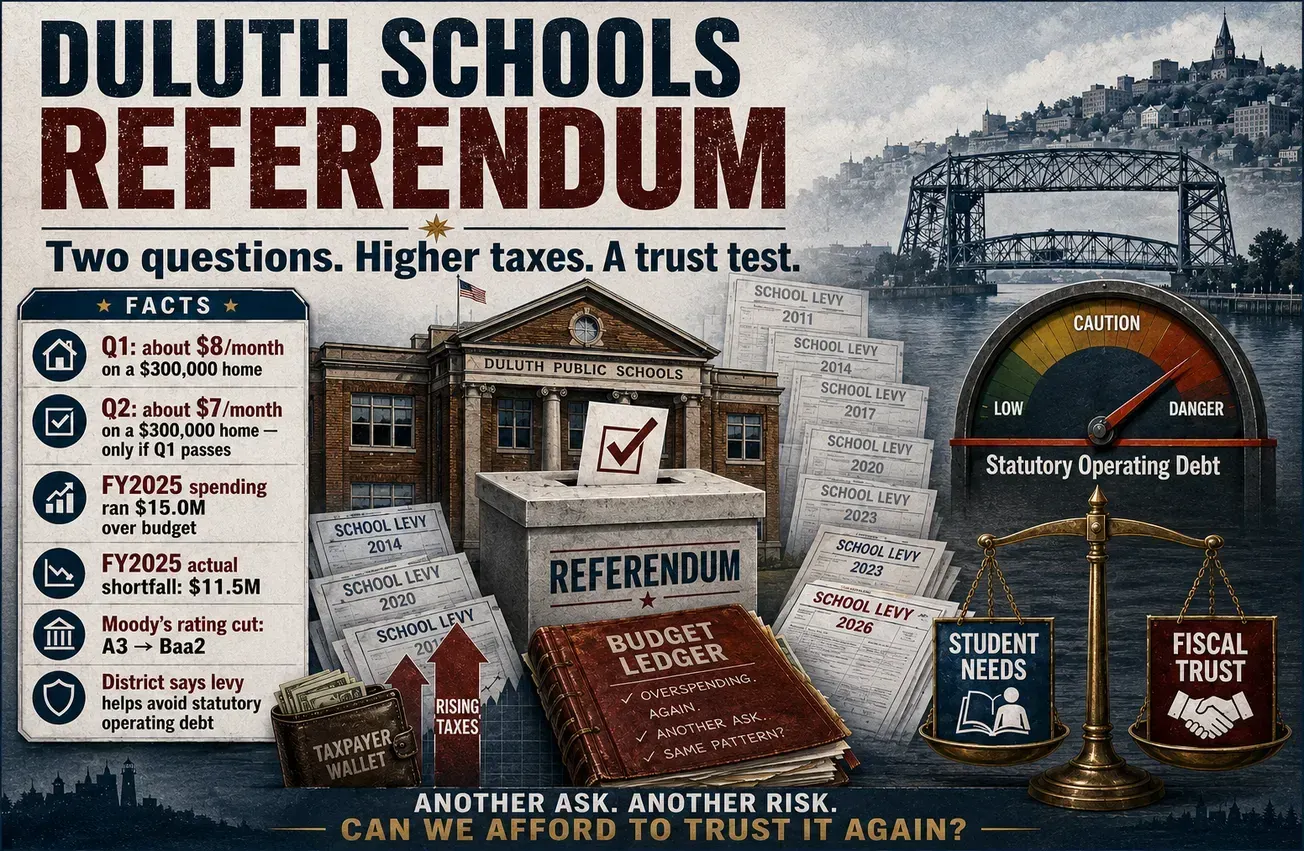
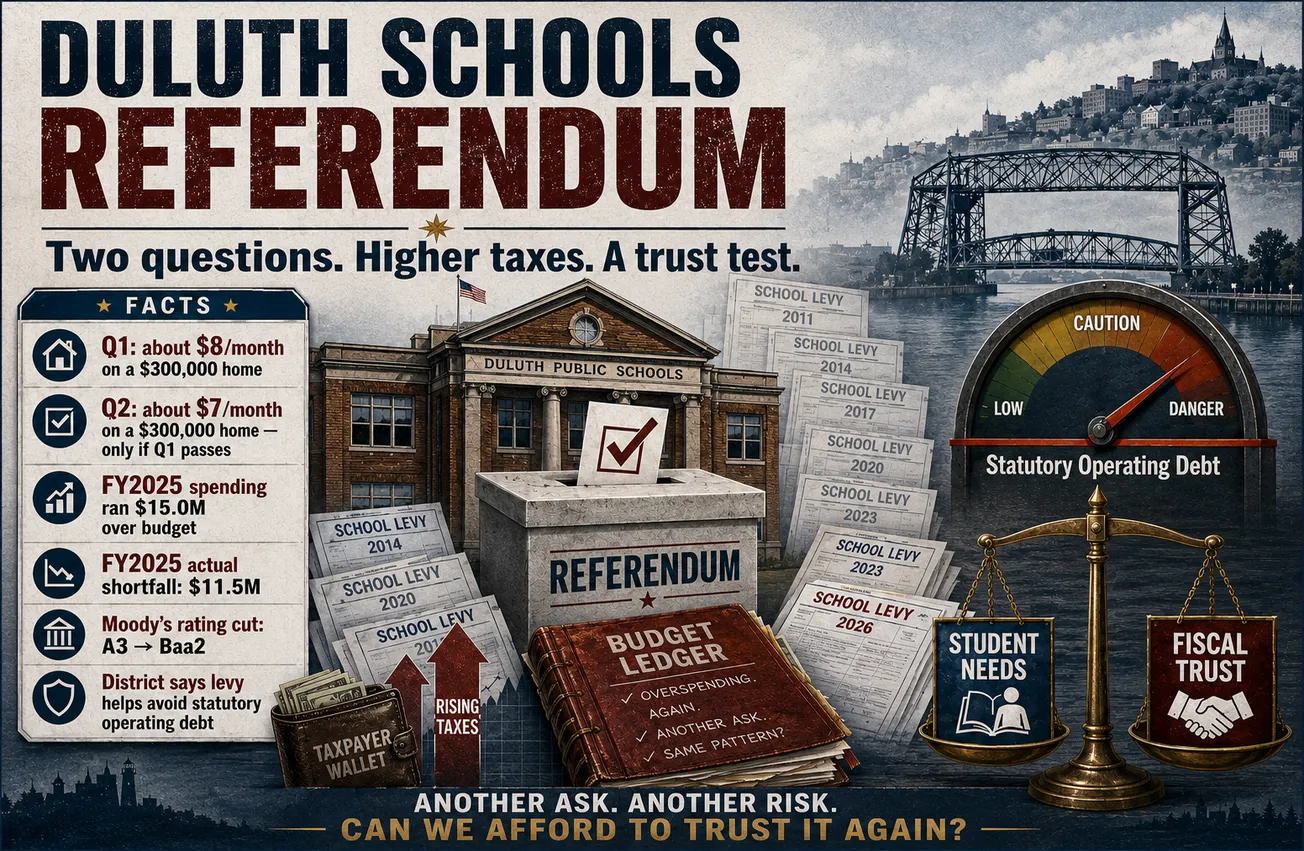
The amount at stake deserves equal clarity. Question 1 would raise an estimated $3.9 million in its first year and $8.3 million in each of the following nine years, for approximately $78.6 million over 10 years. Question 2 would raise another $3.4 million annually, or approximately $34 million over 10 years, and would take effect only if Question 1 passes. Together, the questions would raise approximately $112.6 million over a decade, using the district’s rounded annual estimates and before inflation adjustments. Both levies would increase with inflation, so actual collections could be higher. The estimated initial combined tax increase is about $181 a year for a $300,000 home.
“We want to ensure our community has clear, factual information about our financial standing and what is at stake,” Superintendent John Magas said in Thursday’s release. “While budget adjustments like these can be very painful, our priority remains protecting classroom instruction and keeping our community informed every step of the way.”

Clear information must include more than the cost of rejecting the levies. It must also explain how Duluth Public Schools reached this point after receiving substantially more revenue, including state revenue, over the last five completed fiscal years.
State-source revenue across the district’s governmental funds rose from approximately $91.04 million in fiscal 2021 to $115.06 million in fiscal 2025, an increase of $24.02 million, or about 26.4%. Within the General Fund, which pays most everyday school operating costs, state-source revenue rose from approximately $86.25 million to $107.45 million. That was an increase of roughly $21.2 million, or 24.6%.
Those numbers complicate a central explanation in the district’s referendum campaign: that state education funding has not kept pace with inflation. Minnesota’s basic per-pupil formula allowance did lag inflation over that period, rising from $6,567 in fiscal 2021 to $7,281 in fiscal 2025, an increase of about 10.9%. But the total state-source revenue Duluth Public Schools actually received rose much faster than that formula allowance. Other state funding streams, including special education aid and categorical funding, are part of the district’s financial picture.

The distinction matters. The national Consumer Price Index rose approximately 19% between the 2021 and 2025 annual averages. Duluth’s state-source governmental revenue rose about 26.4% over those fiscal years. Those measures do not match school costs item for item, and state aid did not outpace inflation every year. They do show why a broad claim about “state funding” needs more explanation when taxpayers are being asked to approve levies lasting a decade.
The sharper financial problem is what happened to spending while revenue was rising. General Fund revenue increased from approximately $118.86 million in fiscal 2021 to $140.89 million in fiscal 2025, a gain of about $22 million, or 18.5%. General Fund expenditures climbed from approximately $110.79 million to $153.21 million — an increase of more than $42 million, or 38.3%. Spending grew at more than twice the percentage rate of revenue.
By fiscal 2025, General Fund expenditures exceeded revenue by approximately $12.33 million before other financing activity. After that activity was included, the fund balance fell by about $11.53 million. The final result was roughly $8.75 million worse than the district had budgeted. General Fund expenditures and other financing uses finished nearly $15 million above the final budget, although additional revenue offset part of the overrun. Special education and transportation were major sources of the higher costs.

These are fiscal 2025 results, not a completed audit of fiscal 2026. Keeping the years straight is essential. The current 2026-27 budget presents another warning: The School Board adopted it with a projected deficit of approximately $3.9 million, even after reductions, when the district said it had only about $2.5 million remaining in its fund balance. A district with reserves that thin has little capacity to withstand another major forecasting miss.
Duluth Public Schools has made cuts. It says it has reduced its operating budget by $12 million, or about 8%, over three school years. Thursday’s release said those reductions included a 16% cut in district administration costs and the elimination of 48 positions across school sites. Those decisions have consequences for employees and students. They also have not yet produced a durable balance between recurring revenue and spending.
Moody’s Ratings lowered the district’s issuer and general obligation debt ratings from A3 to Baa2 in August. Rising operating expenses and shrinking reserves were central to the downgrade. The district also has said it will use short-term borrowing as needed to manage cash flow. More operating revenue could help stabilize the budget, but a stronger financial position would require the district to produce sustained results and rebuild its reserves.

The referendum also intersects with Duluth’s long history of school building debt. Question 1 is designed to increase operating levy collections after some existing building bond debt expires, limiting the change in the overall tax bill attributable to that portion of the plan. That arrangement brings the Red Plan, the district’s costly and controversial construction and consolidation program, back into the discussion. The proposed operating levies would pay for day-to-day school expenses. They would not pay off the remaining building bonds.
Building bond debt is also different from statutory operating debt. The former is money the district owes on its facilities. The latter is a state-law designation tied to a negative general fund balance. Duluth was not listed among districts in statutory operating debt at the close of fiscal 2025, but district leaders have warned that continuing deficits could put it there as early as the end of the current fiscal year. That would require a recovery plan subject to review and monitoring by the Minnesota Department of Education.
Thursday’s release presents three possible election outcomes. If both questions fail, the district projects $12 million in cuts over two fiscal years, potentially affecting staffing, programs and class sizes. If Question 1 passes alone, the new revenue would cover much of the immediate shortfall, though some permanent reductions could still be required. If both pass, the district says it could avoid the deepest long-term cuts and potentially restore positions or programs in 2028-29. In all three cases, it says a $5 million reduction for 2027-28 will remain necessary because of the timing of property tax collections. The School Board has not approved a final list of those cuts.

Voters deserve a precise accounting before they make a 10-year commitment. How much of the $42 million increase in General Fund spending since fiscal 2021 came from special education, transportation, compensation, insurance and contracts? Which increases were required by law, and which resulted from local decisions? How will the district prevent another substantial gap between its final budget and actual spending? Under each referendum outcome, when would the General Fund stop running deficits, and when would reserves recover?
The district can accurately say its basic per-pupil formula lagged inflation. It can accurately say that some costs rose faster than revenue and that rejecting the levies would force difficult choices. But its audited figures also show substantial growth in the state money it received and even faster growth in what it spent.
That is the full financial equation Duluth taxpayers must weigh. Passing both questions would give the district approximately $112.6 million in additional operating revenue over 10 years before inflation adjustments. The district’s own projections show that even then, cuts and further financial repair would still be necessary.